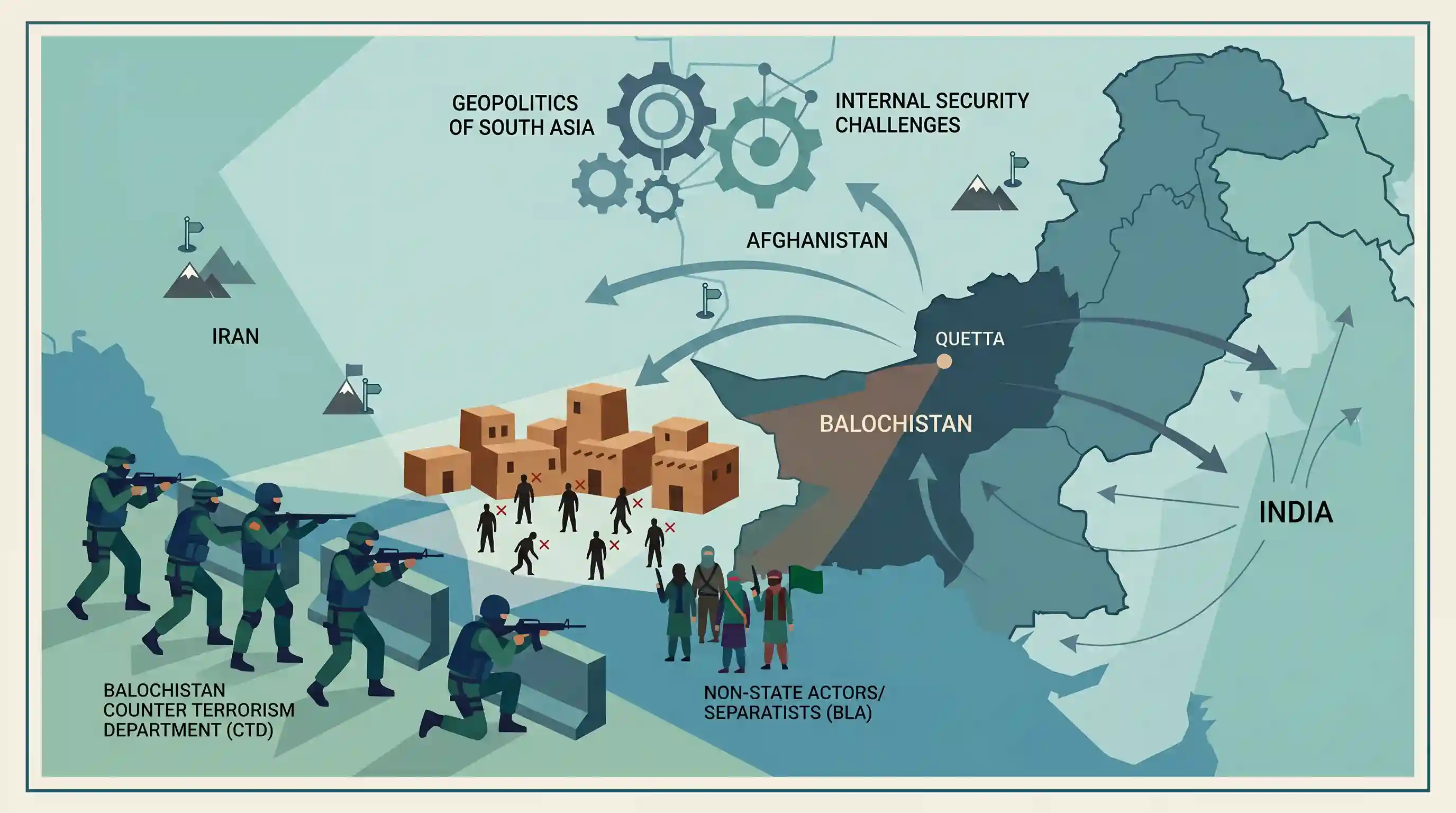
Security forces neutralize suspected militants in Pakistan Balochistan
Source:The Hindu ↗
Why It Matters
Understanding the internal dynamics and security challenges of neighboring countries like Pakistan (specifically the Balochistan insurgency) is vital for analyzing regional stability, cross-border terrorism, and their broader implications for India's foreign policy and national security.
Summary
At least eight suspected terrorists were killed during an intelligence-based raid conducted by the Balochistan Counter Terrorism Department (CTD) near Darakshan town on the outskirts of Quetta, Pakistan. The region has been plagued by a decades-long separatist insurgency, predominantly spearheaded by groups like the Balochistan Liberation Army (BLA), which have intensified their attacks over the last few years. Pakistan's Interior Minister Mohsin Naqvi confirmed the successful operation. The continued violence underscores Pakistan's significant internal security challenges and the enduring instability in its restive southwestern province, which remains a focal point in the geopolitical discourse regarding South Asian regional security.
Key Points
- At least eight suspected terrorists were killed in an intelligence-based raid by the Balochistan Counter Terrorism Department (CTD) near Quetta, Pakistan.
- Pakistan's Interior Minister Mohsin Naqvi confirmed the incident and the neutralization of the militants.
- The region has witnessed escalating violence and insurgency led by separatist groups such as the Balochistan Liberation Army (BLA).
- This incident highlights the persisting internal security challenges and fragility in Pakistan's restive southwestern province, which holds implications for broader regional stability.
Important Terms
Balochistan Liberation Army (BLA)

A prominent separatist militant group seeking independence for Pakistan's Balochistan province. It frequently targets security personnel, infrastructure, and Chinese nationals associated with the China-Pakistan Economic Corridor (CPEC).
UPSC context
GS Paper 2 & 3: Tests understanding of regional security, non-state actors, and threats to India’s neighborhood stability.
Balochistan
Pakistan's largest, most resource-rich, yet least developed province. Its strategic location bordering Iran and Afghanistan and its coast on the Arabian Sea make it a geopolitical focal point.
UPSC context
GS Paper 1 & 2: Geography and International Relations; vital for understanding South Asian geopolitical dynamics and connectivity.
China-Pakistan Economic Corridor (CPEC)
A multi-billion dollar infrastructure project connecting China’s Xinjiang region to Pakistan’s Gwadar Port. It is a flagship of China’s Belt and Road Initiative (BRI).
UPSC context
GS Paper 2: India's neighborhood policy, sovereignty concerns (PoK), and China’s expanding regional influence.
Balochistan Counter Terrorism Department (CTD)
A specialized wing of the provincial police in Pakistan responsible for intelligence-led operations against militant, sectarian, and separatist organizations to maintain internal security.
UPSC context
GS Paper 3: Case study in counter-insurgency (COIN) strategies and internal security challenges in neighboring states.
Gwadar Port
A strategic deep-water port in Balochistan developed with Chinese investment. It serves as the maritime anchor for CPEC, providing China a trade route to the Arabian Sea.
UPSC context
GS Paper 2: Geopolitics (String of Pearls theory) and regional maritime security.
Separatist Insurgency
An ethno-nationalist movement in Balochistan driven by grievances over political marginalization and the perceived exploitation of the province's natural gas and mineral resources by the central government.
UPSC context
GS Paper 3: Internal security challenges and the impact of sub-nationalism on regional stability.
Prelims Trap
The Balochistan Liberation Army (BLA) is a religiously motivated extremist organization seeking to establish Islamic rule in Pakistan.
The BLA is a secular, ethno-nationalist separatist group fighting for the independence of Balochistan, distinct from religious extremist groups like the TTP.
Static Concepts Connected
What is the geographical and strategic significance of Pakistan's Balochistan province?
- Bordering nations: Shares critical international borders with Iran to the west and Afghanistan to the north.
- Coastal access: Features the Makran coast on the Arabian Sea, which hosts the strategically vital, Chinese-operated Gwadar port.
- Resource wealth: It is Pakistan's largest but least developed province, possessing massive untapped reserves of natural gas, copper, and gold.
How does the Baloch insurgency impact the China-Pakistan Economic Corridor (CPEC)?
- Infrastructure targeting: Insurgents frequently target CPEC personnel and infrastructure, viewing Chinese investments as exploitative tools of the federal government.
- Gwadar vulnerability: Gwadar port is the critical southern anchor of CPEC; chronic instability in Balochistan threatens the viability of the entire trade corridor.
Cross-Topic Patterns
CPEC vulnerabilities & India's Chabahar alternative
Instability in Balochistan directly threatens China's Gwadar port, elevating the comparative geopolitical value of India's strategic investments in the nearby Chabahar port in Iran.
Ethno-nationalism vs. Religious Extremism in Af-Pak
Unlike the religiously motivated Tehrik-i-Taliban Pakistan (TTP), the BLA represents secular, ethno-nationalist separatism driven by grievances over resource exploitation and political marginalization.

Map questions linking Gwadar, Chabahar, and the Makran coast to the broader Balochistan-Iran-Afghanistan borders are highly likely in 2026.
Linked PYQs · 3
Linked PYQs · 3
- 2016MainsGS2
Increasing cross-border terrorist attacks in India and growing interference in the internal affairs of several member-states by Pakistan are not conducive for the future of SAARC (South Asian Association for Regional Cooperation)." Explain with suitable examples.
- 2015MainsGS2
Terrorist activities and mutual distrust have clouded India-Pakistan relations. To what extent the use of soft power like sports and cultural exchanges could help generate goodwill between the two countries? Discuss with suitable examples.
- 2021MainsGS3
Analyse the multidimensional challenges posed by external state and non-state actors, to the internal security of India. Also discuss measures required to be taken to combat these threats.
