Border Security Challenges on the Afghanistan Pakistan Frontier
Source:The Hindu ↗
Why It Matters
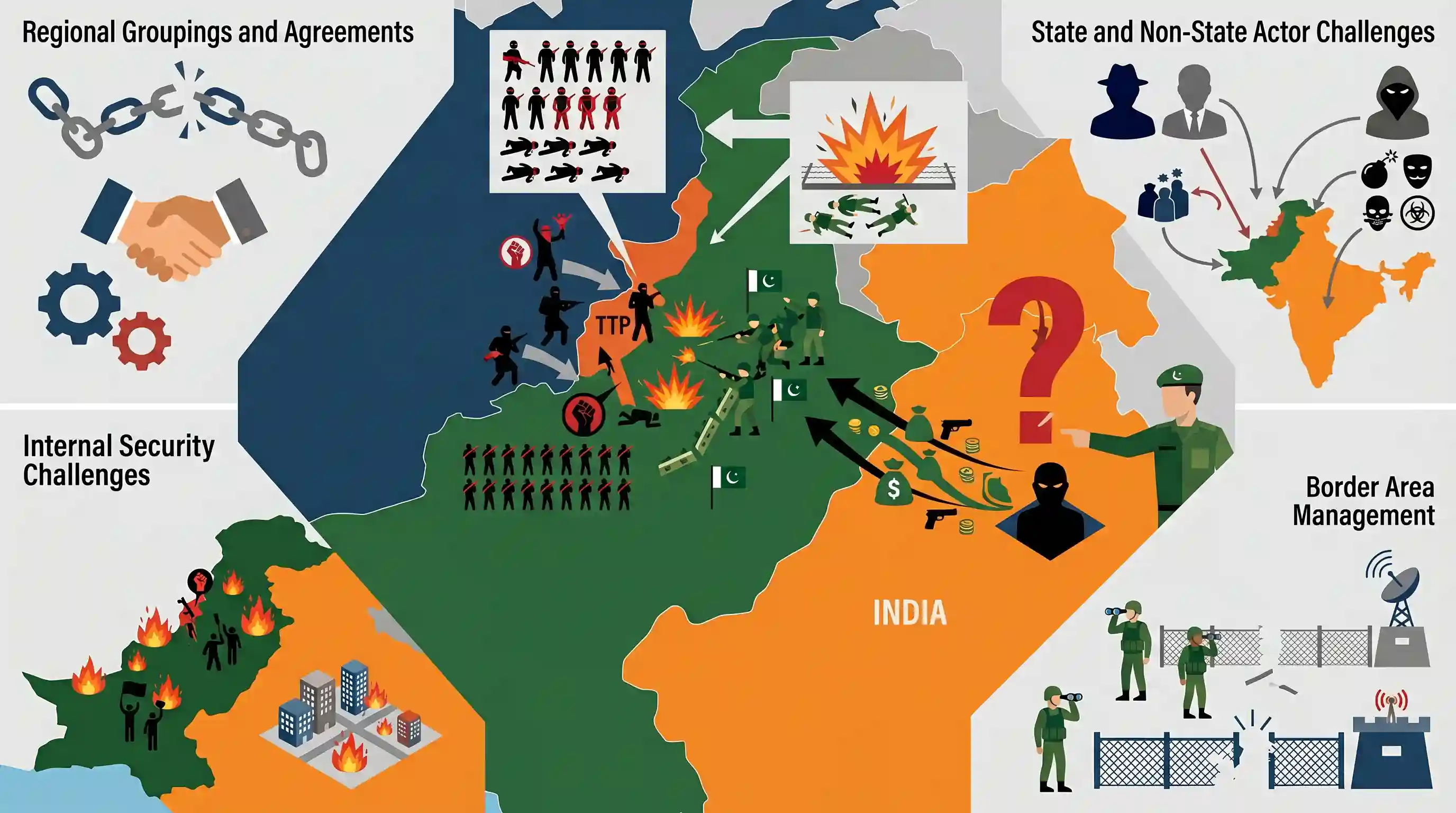
The article highlights the volatile security situation on the Afghanistan-Pakistan border and demonstrates how regional terrorism is weaponized in diplomatic discourse. Pakistan's accusation that India supports the TTP is a critical element of the ongoing narrative war between the two nations regarding state-sponsored terrorism, directly impacting bilateral relations and regional stability.
Summary
The Pakistan Army claimed to have killed 30 militants affiliated with the Pakistan Taliban (TTP) as they attempted to infiltrate the North Waziristan district from Afghanistan. The operation follows a recent suicide attack in the same frontier region that resulted in the deaths of 16 Pakistani soldiers. Notably, the Pakistani military explicitly accused India of backing the militants, highlighting the persistent mutual accusations of state-sponsored terrorism and the complex security dynamics involving state and non-state actors in the region.
Key Points
- The Pakistan military reported killing 30 militants who were attempting to cross the border from Afghanistan into the North Waziristan district.
- The militants were identified as belonging to the Pakistan Taliban (TTP) or its affiliated groups.
- The Pakistani military accused India of backing these militant factions, compounding the diplomatic friction between the two countries.
- This clash follows a recent suicide attack in the same frontier region that claimed the lives of 16 Pakistani soldiers.
Important Terms
Tehreek-e-Taliban Pakistan (TTP)

An umbrella organization of militant groups formed in 2007 seeking to overthrow the Pakistani state. It operates primarily along the Afghanistan-Pakistan border and is designated a terrorist entity.
UPSC context
GS Paper 3: Internal Security; tests understanding of regional extremist groups and their impact on India’s neighborhood stability.
Durand Line
The 2,640 km frontier between Pakistan and Afghanistan established in 1893. Afghanistan’s non-recognition of this line remains a major source of diplomatic tension and cross-border militancy.
UPSC context
GS Paper 2: International Relations; crucial for analyzing border disputes and historical colonial legacies in South Asia.
State-sponsored Terrorism
Violent acts or insurgencies supported by one state against another through proxies, providing funding, weapons, or sanctuary to militant groups to achieve strategic goals.
UPSC context
GS Paper 3: Security; relevant to India’s stance on global counter-terrorism and the role of external actors in internal security.
Non-state Actors
Individuals or organizations (e.g., terrorist groups, NGOs) that exert political or security influence but are not formally affiliated with any sovereign government.
UPSC context
GS Paper 3: Internal Security; tests knowledge on the varied challenges to national stability from unofficial entities.
Cross-border Terrorism
Terrorist activities originating in one country and targeting another, typically exploiting porous borders and lack of bilateral security cooperation.
UPSC context
GS Paper 3: Security challenges in border areas; a recurring theme in India's regional security discourse.
North Waziristan
A strategically significant district in Pakistan’s Khyber Pakhtunkhwa province, bordering Afghanistan. It has long been a major base for militant groups like the TTP and Al-Qaeda.
UPSC context
GS Paper 1 & 2: Geography/IR; understanding the "ungoverned spaces" and geographic hotspots of regional conflict.
Prelims Trap
"The Tehrik-i-Taliban Pakistan (TTP) is an official state-sponsored paramilitary wing of the current Afghan government."
TTP is an anti-state militant umbrella group aiming to overthrow the Pakistani state. It is distinct from the Afghan Taliban, though they share ideological roots and safe havens.
Static Concepts Connected
What is the historical and geographic context of the Durand Line?
- Colonial Origin: Demarcated in 1893 by Mortimer Durand to separate British India and the Afghan Emirate.
- Ethnic Divide: Arbitrarily divides Pashtun tribal regions, leading to persistent non-recognition and border disputes by modern Afghanistan.
- Security Nightmare: Its highly porous, rugged terrain serves as a natural conduit for transnational militancy and illicit smuggling.
What is Pakistan's 'Strategic Depth' doctrine?
- Core Objective: A military strategy historically seeking to use Afghanistan as a pliant rear-base in case of a full-scale conflict with India.
- Proxy Reliance: Relied heavily on cultivating allied non-state militant factions (like the Haqqani network or Taliban) to control Afghan territory.
- Policy Failure: The strategy has largely failed, as ungoverned spaces created for proxies are now used by anti-Pakistan militants (TTP).
Cross-Topic Patterns
State proxies & the boomerang effect
Pakistan's cultivation of extremist proxies in Afghanistan illustrates the 'boomerang effect' in geopolitics—a concept heavily tested in GS-3 internal security regarding state vs. non-state actors.
India as a scapegoat for internal security
Blaming Indian intelligence for TTP attacks is a recurring tactic used by Islamabad to divert domestic attention from policy failures and internationalize bilateral frictions.

GS-3 Mains will likely test the failure of Pakistan's 'Strategic Depth' policy and its boomerang effect on internal border security.
Linked PYQs · 3
Linked PYQs · 3
- 2021MainsGS3
Analyse the multidimensional challenges posed by external state and non-state actors, to the internal security of India. Also discuss measures required to be taken to combat these threats.
- 2015MainsGS2
Terrorist activities and mutual distrust have clouded India-Pakistan relations. To what extent the use of soft power like sports and cultural exchanges could help generate goodwill between the two countries? Discuss with suitable examples.
- 2020MainsGS3
Analyze internal security threats and transborder crimes along Myanmar, Bangladesh and Pakistan borders including Line of Control (LoC). Also discuss the role played by various security forces in this regard.
