India Pakistan Border Security and Nuclear Deterrence Rhetoric
Source:Indian Express ↗
Why It Matters
This highlights the ongoing geopolitical fragility and security dynamics between India and Pakistan, including military retaliation (Operation Sindoor), nuclear deterrence, and mutual allegations of sponsoring proxy terrorism. These are critical themes in International Relations and Internal Security for UPSC Mains.
Summary
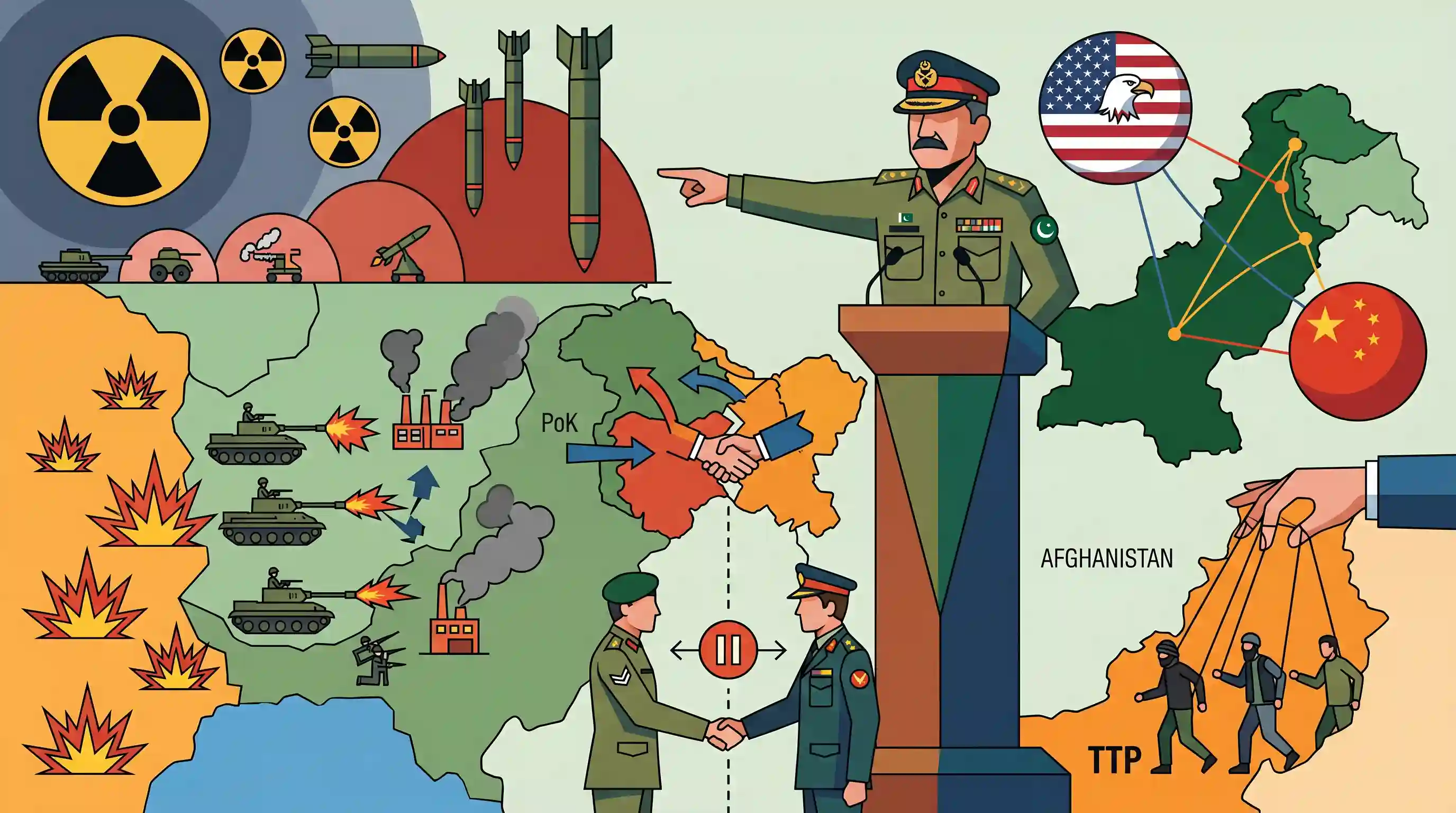
Pakistan's Army Chief Field Marshal Syed Asim Munir cautioned India against any provocation, asserting a decisive response and highlighting the risks of escalation in a nuclearized environment. This rhetoric follows "Operation Sindoor," India's May 2025 retaliation against terror infrastructure in Pakistan and PoK after the Pahalgam terror attack. The conflict was halted through DGMO-level dialogue. Munir further accused India of utilizing proxies like the TTP from Afghanistan to destabilize Pakistan, while advocating for the resolution of the Kashmir dispute and emphasizing Pakistan's diplomatic ties with major global powers like the US and China.
Key Points
- Pakistan Army Chief Field Marshal Syed Asim Munir warned India of a "decisive response" to provocations, emphasizing that war has no place in a "nuclearised environment."
- The statements come in the backdrop of "Operation Sindoor" (May 2025), where India targeted terror infrastructure in Pakistan and PoK after 26 civilians were killed in the Pahalgam attack.
- The brief military conflict concluded on May 10 following talks between the Directors General of Military Operations (DGMOs) after intense drone and missile strikes.
- Munir accused India of using proxies operating from Afghan soil (like TTP) to destabilize Pakistan and reiterated support for Kashmir under international norms.
Important Terms
Operation Sindoor

A 2025 Indian military operation involving precision missile and drone strikes on terror infrastructure in Pakistan and PoK, launched in response to a major terror attack in Pahalgam.
UPSC context
GS-3 (Security); tests understanding of India's proactive defense doctrine and precision-strike capabilities against cross-border terror infrastructure.
Tehreek-i-Taliban Pakistan (TTP)
An umbrella organization of militant groups on the Afghan-Pak border seeking to overthrow the Pakistani state; often central to bilateral proxy-war allegations between India and Pakistan.
UPSC context
GS-2/3 (IR & Security); relevant for regional stability, non-state actors, and security challenges on India's western flank.
Nuclear Deterrence
A strategic doctrine where nuclear weapons possession discourages an adversary from aggression by ensuring that the cost of conflict would be unacceptably high.
UPSC context
GS-3 (Security); tests comprehension of strategic stability in South Asia and the 'nuclear overhang' influencing conventional military options.
DGMO Hotline
A dedicated communication link between the Directors General of Military Operations of India and Pakistan, used for crisis management and de-escalating border tensions.
UPSC context
GS-2 (IR); evaluates knowledge of bilateral confidence-building measures (CBMs) and military-to-military crisis resolution mechanisms.
Proxy War
A conflict where a state uses third-party non-state actors to fight an adversary indirectly, typically to avoid direct conventional or nuclear warfare.
UPSC context
GS-3 (Internal Security); key concept for 'Role of external state and non-state actors in challenging internal security.'
Pakistan Military Academy (PMA)
Pakistan's premier military officer training institution in Kakul, Abbottabad, often used by the Army Chief for major strategic signaling and policy pronouncements.
UPSC context
GS-2 (IR); symbolic venue for observing Pakistan's military-strategic posture and its impact on South Asian security dynamics.
Prelims Trap
DGMO-level dialogues and hotline communications are a key form of Track II diplomacy between India and Pakistan.
DGMO communications are Track I (official military/government) channels serving as Confidence Building Measures (CBMs), whereas Track II involves non-officials like retired diplomats.
Static Concepts Connected
What is the Stability-Instability Paradox in South Asia?
- Nuclear deterrence: Possession of nuclear weapons by both nations effectively prevents a full-scale conventional war due to the fear of mutual destruction.
- Sub-conventional escalation: This nuclear umbrella paradoxically emboldens state actors to engage in proxy wars and cross-border terrorism, assuming the adversary will avoid massive retaliation.
What are key military Confidence Building Measures (CBMs) between India and Pakistan?
- DGMO Hotline: A direct, secure communication link established post-1971 war to defuse tensions and enforce ceasefires along the LoC.
- Nuclear Non-Attack pact: A 1988 bilateral agreement where both nations exchange lists of nuclear facilities annually to prevent accidental strikes.
- Missile notification: A 2005 agreement mandating prior notification to the other country before testing ballistic missiles to avoid misinterpretation.
Cross-Topic Patterns
Reversal of Pakistan's 'Strategic Depth'
Pakistan's historical policy of cultivating the Afghan Taliban for 'strategic depth' has backfired, with the TTP now exploiting Afghan safe havens to conduct attacks against the Pakistani state.
Asymmetric warfare and drone incursions
The integration of UAVs and drone strikes into sub-conventional border conflicts connects physical border management challenges directly to India's internal security technology modules.

Mains 2026 may ask how proactive retaliations (like Op Sindoor) challenge the Stability-Instability paradox in a nuclearised South Asia.
Linked PYQs · 4
Linked PYQs · 4
- 2015MainsGS2
Terrorist activities and mutual distrust have clouded India-Pakistan relations. To what extent the use of soft power like sports and cultural exchanges could help generate goodwill between the two countries? Discuss with suitable examples.
- 2016MainsGS2
Increasing cross-border terrorist attacks in India and growing interference in the internal affairs of several member-states by Pakistan are not conducive for the future of SAARC (South Asian Association for Regional Cooperation)." Explain with suitable examples.
- 2020MainsGS3
Analyze internal security threats and transborder crimes along Myanmar, Bangladesh and Pakistan borders including Line of Control (LoC). Also discuss the role played by various security forces in this regard.
- 2021MainsGS3
Analyse the complexity and intensity of terrorism, its causes, linkages and obnoxious nexus. Also suggest measures required to be taken to eradicate the menace of terrorism.
