Pakistan Army Chief visits Tehran amid US-Iran mediation efforts
Source:Indian Express ↗
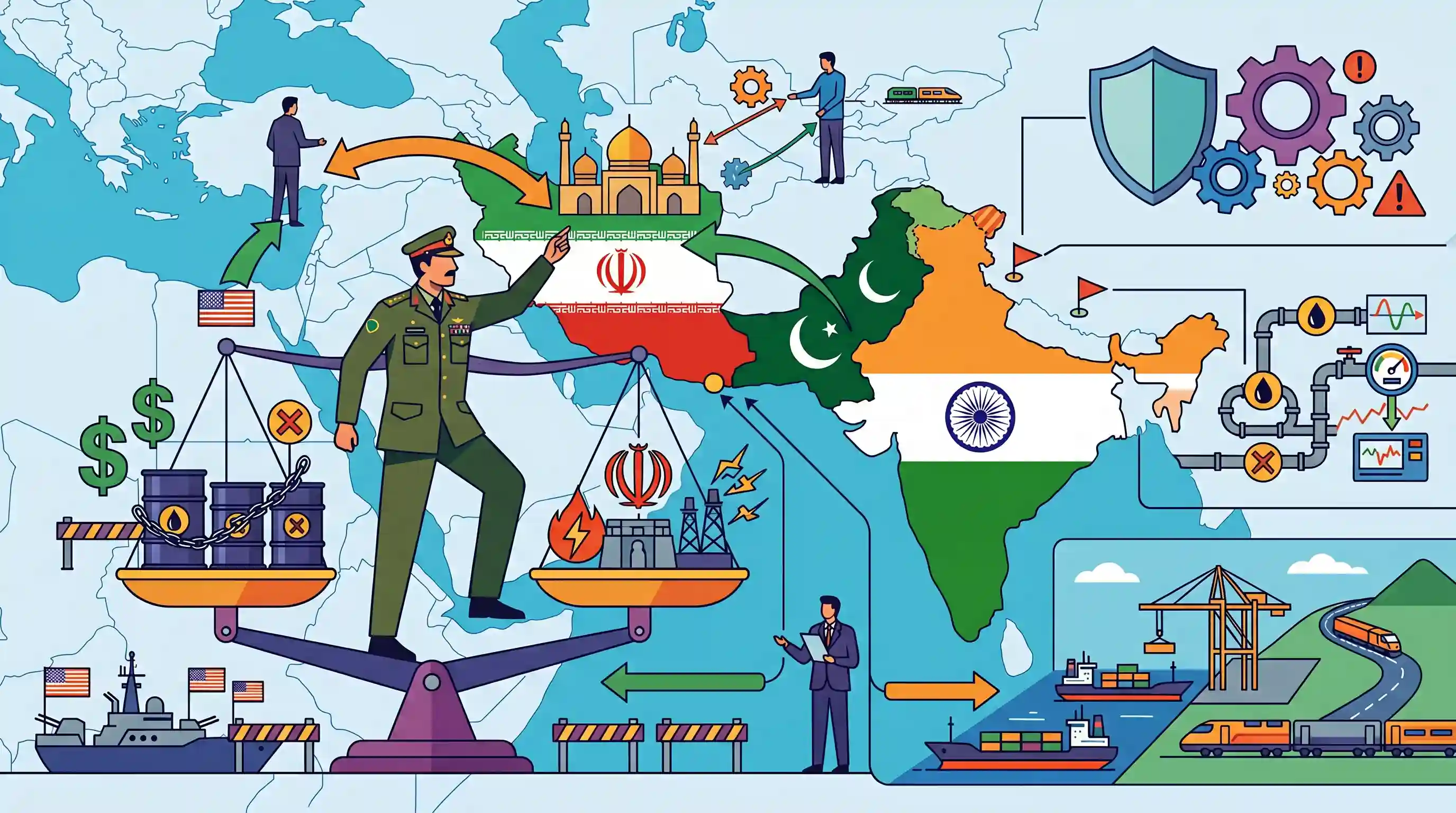
Why It Matters
The geopolitical interplay involving Pakistan, Iran, and the US directly influences regional stability in the Middle East and South Asia. Understanding these shifts is crucial for analyzing India's foreign policy challenges, particularly regarding energy security, managing adversarial neighbors, and securing access to Central Asia via Chabahar.
Summary
Pakistan's Army Chief, General Asim Munir, recently visited Tehran to mediate between the United States and Iran amidst intensifying US blockades and sanctions. This high-profile diplomatic effort highlights Pakistan's attempt to position itself as a key regional mediator, balancing its relations with both Washington and Tehran. For India, the unfolding US-Iran dynamics and Pakistan's increasing strategic engagement with Iran hold significant implications, particularly concerning regional security, energy interests, and crucial connectivity projects like the Chabahar port.
Key Points
- Pakistan's Army Chief, General Asim Munir, visited Tehran in an attempt to mediate the ongoing diplomatic deadlock between the US and Iran.
- The visit occurs against the backdrop of an intensifying US blockade and mounting sanctions against Iran, escalating regional tensions in the Middle East.
- This diplomatic maneuver reflects Pakistan's strategic intent to balance its relations with both Washington and Tehran while asserting its role as a regional mediator.
- For India, the evolving dynamics between the US, Iran, and Pakistan are strategically significant, directly impacting its energy security, regional stability, and connectivity initiatives such as the Chabahar Port.
Important Terms
Pakistan Army

The most powerful institution in Pakistan, often directing foreign policy and national security. In 2026, its chief served as the primary mediator in US-Iran peace negotiations.
UPSC context
GS-II: India's Neighborhood; analyzes military influence on regional diplomacy and its impact on Indian security interests.
Chabahar Port
A strategic Iranian seaport on the Gulf of Oman, developed with Indian assistance to bypass Pakistan for trade with Afghanistan and Central Asia.
UPSC context
GS-II: Regional Connectivity; tests knowledge of strategic maritime projects and India-Iran-Afghanistan trilateral relations.
Strait of Hormuz
A vital maritime chokepoint between the Persian Gulf and Gulf of Oman, through which approximately 20% of global oil trade passes.
UPSC context
GS-I: World Geography; GS-III: Energy Security; examines global energy supply chains and maritime security.
US-Iran Sanctions
Economic and diplomatic penalties imposed by the US to restrict Iran’s nuclear program and maritime trade, often impacting global oil prices and India's energy imports.
UPSC context
GS-II: Effect of policies of developed countries; evaluates impacts on India’s economy and strategic autonomy.
International North-South Transport Corridor (INSTC)
A 7,200-km multi-modal trade route connecting India to Russia and Europe via Iran, aimed at reducing transit time and costs compared to the Suez Canal.
UPSC context
GS-II: International Relations; tests understanding of India's outreach to Eurasia and alternative trade routes.
Joint Comprehensive Plan of Action (JCPOA)
A 2015 landmark agreement (also known as the Iran Nuclear Deal) that restricted Iran’s nuclear activities in exchange for lifting international sanctions.
UPSC context
GS-II: Global Groupings; analyzes non-proliferation efforts and West Asian geopolitical stability.
Prelims Trap
Chabahar Port is located in the Persian Gulf and gives India direct access to the Middle East.
Chabahar is located on the Gulf of Oman, not the Persian Gulf. Its primary strategic utility for India is bypassing Pakistan, not accessing the Middle East.
Static Concepts Connected
What are the key geographical nodes of the INSTC?
- Maritime Leg: Mumbai (India) to Bandar Abbas (Iran) via the Arabian Sea and Gulf of Oman.
- Overland Leg: Goods move from Bandar Abbas to Bandar-e-Anzali on the Caspian Sea via Iranian rail/road networks.
- Russian Leg: Transport across the Caspian Sea to Astrakhan, moving landwards to St. Petersburg and wider Europe.
How does Chabahar port differ strategically from Gwadar?
- Location: Chabahar (Iran) and Gwadar (Pakistan) are situated roughly 170 km apart along the Makran coast.
- Sponsorship: Chabahar is backed by India for Central Asian access, whereas Gwadar is the crown jewel of China's CPEC.
- Strategic Goal: Chabahar bypasses Pakistan's overland blockade for India; Gwadar helps China bypass the Malacca Strait dilemma.
Cross-Topic Patterns
I2U2/IMEC vs INSTC/Chabahar
India's simultaneous involvement in US/Israel-backed IMEC and Iran/Russia-backed INSTC highlights its multi-alignment strategy, which is continuously challenged by regional US-Iran hostilities.
The stalled IPI Pipeline
Pakistan's diplomatic maneuvering with Iran may accelerate the bilateral Iran-Pakistan (IP) gas pipeline, originally the IPI project before India exited due to security and pricing fears.

Expect a map question linking Iran's ports (Chabahar, Bandar Abbas) to INSTC nodes, contrasting them with China's Gwadar/CPEC routes.
Linked PYQs · 3
Linked PYQs · 3
- 2012MainsGS2
How have the US sanctions against Iran affected India's bilateral relations with Iran?
- 2018MainsGS2
In what ways would the ongoing US-Iran Nuclear Pact Controversy affect the national interest of India? How should India respond to this situation?
- 2017PrelimsGS1
What is the importance of developing Chabahar Port by India?
