US Middle East Peace Initiative and Pakistan Inclusion
Source:The Hindu ↗
Why It Matters
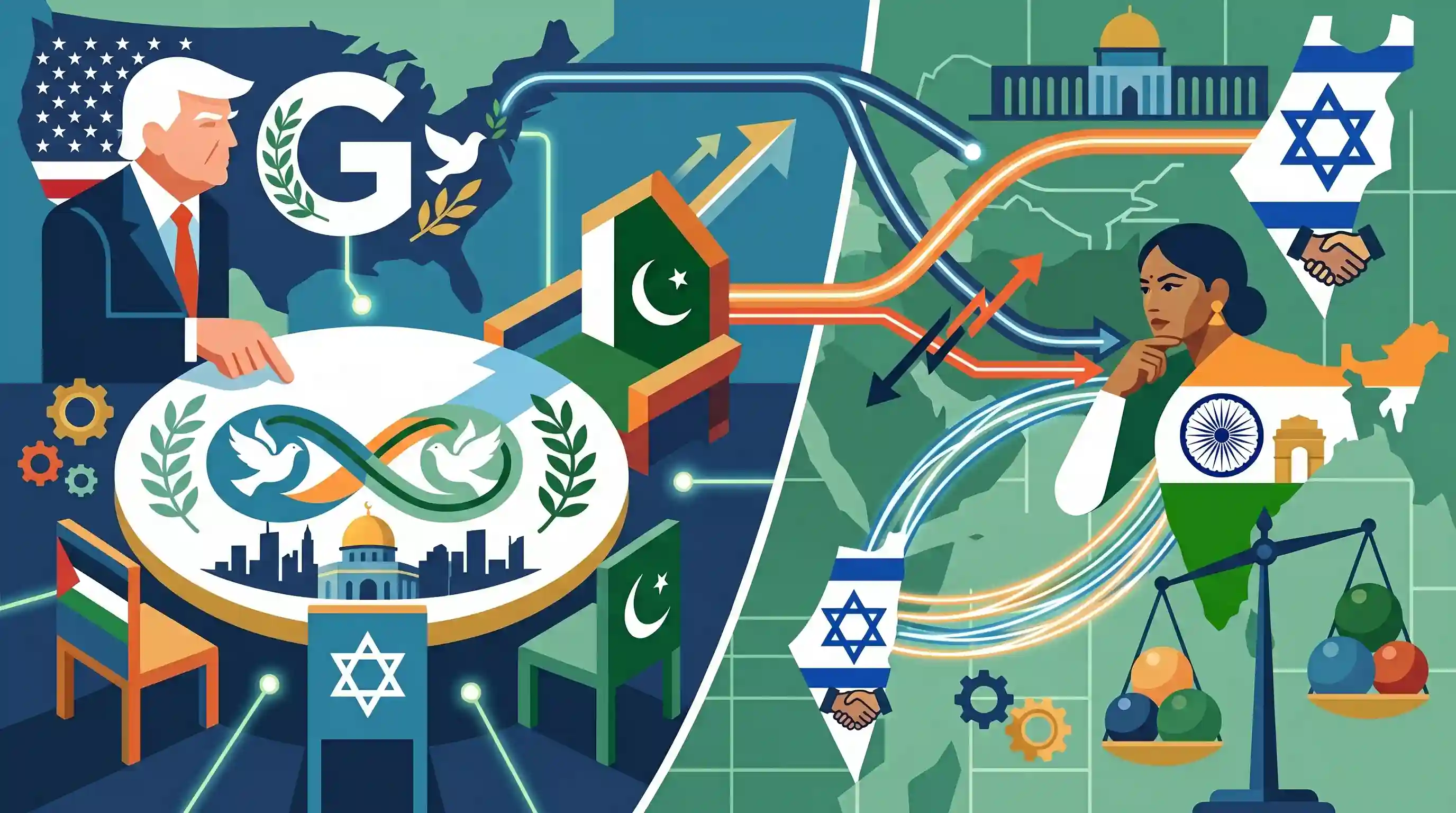
The inclusion of Pakistan in a major US-led Middle East peace initiative marks a significant shift in US foreign policy, potentially boosting Pakistan's diplomatic clout. This directly impacts India's strategic calculations, as it could introduce friction into India-US relations and challenge New Delhi's diplomatic maneuvers in the Middle East.
Summary
The article analyzes US President Donald Trump's proposed 'Gaza Board of Peace' aimed at addressing the Israel-Palestine conflict and highlights the strategic implications of incorporating Pakistan into this initiative. By giving Pakistan a seat at the table in Middle Eastern diplomacy, the US is providing Islamabad an opportunity to boost its geopolitical standing. This recalibration of US policy presents a diplomatic challenge for India, which must navigate the potential friction of an elevated US-Pakistan partnership while maintaining its own deepening ties with Israel and strategic equities in the Middle East.
Key Points
- US President Donald Trump has proposed a 'Gaza Board of Peace' to manage post-conflict stabilization and diplomatic processes in the Middle East.
- The proposal notably includes Pakistan, signaling Washington's intent to utilize Islamabad's influence within the broader Islamic world.
- Pakistan's integration into this Middle Eastern diplomatic framework provides it with renewed geopolitical leverage and a platform to engage closely with the US, moving beyond its traditional Afghanistan-centric role.
- For India, this development poses a strategic challenge, as a diplomatically elevated Pakistan backed by the US could complicate New Delhi's balancing act between Israel, Arab nations, and Washington.
Important Terms
Gaza Board of Peace

A US-led international initiative proposed to oversee Gaza's post-war transition, including reconstruction, security restructuring, and humanitarian aid. It includes diverse member states to lend regional and operational legitimacy.
UPSC context
GS Paper II: International Relations. Tests understanding of evolving Middle Eastern peace frameworks and their impact on India-Pakistan-US dynamics.
De-hyphenation
India's diplomatic strategy of treating relations with Israel and Palestine independently, allowing for deep strategic ties with Israel while maintaining support for the Palestinian cause.
UPSC context
GS Paper II: India’s Foreign Policy. Essential for discussing India's balanced approach in West Asian conflicts.
West Asia
A regional term used by India for the Middle East, encompassing the Arabian Peninsula, Levant, and Iran. It is critical for India’s energy security and diaspora interests.
UPSC context
GS Paper II: Regional groupings and agreements. Tests knowledge of India's 'Think West' policy and regional strategic priorities.
Strategic Autonomy
The principle that a nation should make independent foreign policy decisions based on its own national interests, without being compelled by the dictates of other powers.
UPSC context
GS Paper II: International Relations. A core concept often tested regarding India's navigation of great-power rivalries.
I2U2 Group
A strategic grouping of India, Israel, the UAE, and the USA aimed at cooperation in six areas: water, energy, transportation, space, health, and food security.
UPSC context
GS Paper II: Bilateral, regional and global groupings. Important for understanding India's 'West Asian Quad' and expanded regional footprint.
India-Middle East-Europe Economic Corridor (IMEC)
A connectivity project proposed at the 2023 G20 summit, aiming to link India to Europe via the UAE, Saudi Arabia, Jordan, and Israel through rail and shipping routes.
UPSC context
GS Paper II/III: Infrastructure and Connectivity. Tests understanding of India's efforts to counter China’s BRI and enhance regional trade.
Prelims Trap
"The Gaza Board of Peace is a UN-backed multilateral initiative for post-conflict stabilization..."
The Gaza Board of Peace is a US-led minilateral initiative bypassing the UN. Aspirants often default to associating post-conflict stabilization bodies with UN peacekeeping/multilateral frameworks.
Static Concepts Connected
What distinguishes minilateralism from traditional multilateralism?
- Scope: Narrow, issue-specific groups (e.g., Quad, I2U2) versus broad global mandates (UN).
- Membership: Small, exclusive, ad-hoc coalitions versus near-universal, treaty-based membership.
- Decision-making: Faster, consensus-driven or hegemon-led initiatives versus slow, bureaucratic, legally binding processes.
What are the key pillars of India's current West Asia policy?
- De-hyphenation: Treating bilateral relations with Israel and Palestine as independent of each other.
- Strategic hedging: Balancing ties simultaneously between rival regional poles (e.g., Iran, Saudi Arabia, and Israel).
- Diaspora & Energy: Securing the economic/safety interests of the ~9 million Indian diaspora and ensuring crude oil supply lines.
Cross-Topic Patterns
Rise of US-led minilaterals over UN
The 'Gaza Board of Peace' mirrors a broader trend (like I2U2 or Quad) where major powers bypass paralyzed UN structures to enforce geoeconomic solutions via ad-hoc coalitions.
Pakistan's geopolitical shift from Af-Pak
Leveraging its Islamic identity, Pakistan is transitioning from a localized 'Af-Pak' proxy to a middle-power broker in West Asia to regain relevance in Washington's strategic calculus.
Western alignment vs Global South leadership
India's dilemma in joining US-led structures that bypass Palestinian sovereignty directly tests its ambition to act as the primary normative voice of the Global South.

Expect a 2026 GS-2 Mains question contrasting UN obsolescence with the rise of hegemon-led minilaterals in post-conflict reconstruction.
Linked PYQs · 3
Linked PYQs · 3
- 2019MainsGS2
‘What introduces friction into the ties between India and the United States is that Washington is still unable to find for India a position in its global strategy, which would satisfy India's national self-esteem and ambitions.’ Explain with suitable examples.
- 2018MainsGS2
“India’s relations with Israel have, of late, acquired a depth and diversity, which cannot be rolled back.” Discuss.
- 2022PrelimsGS1
The term "Levant" often heard in the news roughly corresponds to which of the following regions?
