US Intervention Claims in India Pakistan Bilateral Disputes
Source:Indian Express ↗
Why It Matters
This event is significant for UPSC aspirants as it touches upon a core pillar of India's foreign policy—rejecting third-party mediation in bilateral disputes. It also exemplifies the role of external powers (like the US) and the use of economic levers in regional security issues.
Summary
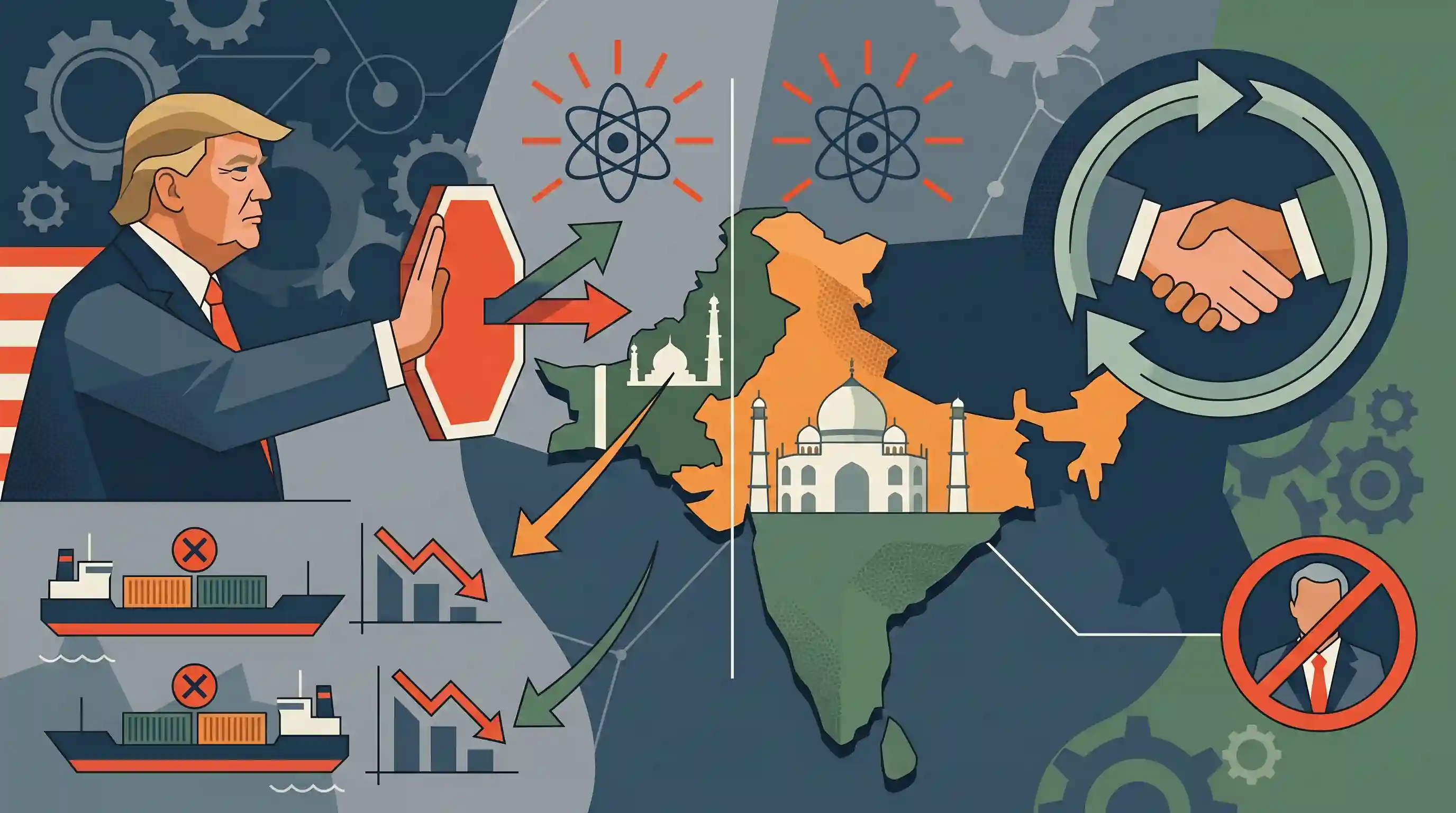
US President Donald Trump claimed to have averted a major conflict between nuclear-armed India and Pakistan by threatening trade sanctions against both nations. This assertion, which emerged following his meeting with Pakistani leadership, contradicts India's long-standing foreign policy doctrine of bilateralism. India consistently rejects third-party mediation in its disputes with Pakistan, tracing this stance back to the 1972 Simla Agreement. The incident underscores the complexities of external power dynamics in South Asia and the increasing use of trade as a tool of geopolitical leverage.
Key Points
- US President Donald Trump claimed he resolved a 'very big' conflict between India and Pakistan by threatening to halt trade with both countries.
- This statement followed a meeting between Pakistani Prime Minister Shehbaz Sharif, Army Chief Asim Munir, and Trump at the White House.
- India has consistently maintained a strict policy of resolving issues with Pakistan bilaterally, rejecting any third-party mediation in accordance with the Simla Agreement.
- The claim highlights the use of economic statecraft (trade leverage) by global powers to influence geopolitical conflicts.
Important Terms
Simla Agreement

A 1972 peace treaty between India and Pakistan that established the Line of Control and mandated resolving disputes through bilateral negotiations, excluding third-party intervention.
UPSC context
GS Paper II (International Relations); essential for understanding the legal framework of Indo-Pak ties and India's 'no-mediation' stance on Kashmir.
Bilateralism
The diplomatic practice of two nations resolving disputes directly without external interference; the cornerstone of India's policy toward Pakistan to ensure strategic autonomy.
UPSC context
GS Paper II (International Relations); tests knowledge of India's opposition to third-party mediation in regional conflicts.
Economic Statecraft
The strategic use of economic tools, such as trade sanctions, aid, or investment, as instruments of foreign policy to influence other states and achieve geopolitical objectives.
UPSC context
GS Papers II and III; relevant for analyzing modern geopolitical leverage and the use of 'geo-economics' over traditional military force.
Directors General of Military Operations (DGMOs)
High-ranking military officers (usually Lieutenant Generals in India) responsible for operational planning who maintain a hotline to de-escalate border tensions and manage ceasefires.
UPSC context
GS Papers II and III; key to understanding institutional mechanisms for crisis management and border stability between nuclear-armed neighbors.
Prelims Trap
"The Simla Agreement (1972) allows for UN or third-party mediation if bilateral negotiations fail."
The Simla Agreement strictly binds India and Pakistan to resolve disputes through bilateral negotiations only, explicitly rejecting any third-party or UN mediation.
Static Concepts Connected
What are the core dispute resolution tenets of the 1972 Simla Agreement?
- Strict Bilateralism: Both nations committed to settle differences peacefully through bilateral negotiations, precluding any third-party intervention or mediation.
- LoC Sanctity: Converted the 1949 UN Ceasefire Line into the Line of Control (LoC), with both sides explicitly agreeing not to alter it unilaterally.
- Sidelining UNMOGIP: India argues the agreement rendered the UN Military Observer Group (UNMOGIP) obsolete, as all disputes must now be handled purely bilaterally.
How does Economic Statecraft function in contemporary geopolitics?
- Trade Weaponisation: Using tariffs, sanctions, or export controls on critical dependencies to force a state's compliance on foreign policy, bypassing traditional military intervention.
- Geopolitical Leverage: Major powers leverage their market dominance to threaten trade halts, deliberately blurring the lines between economic partnerships and security alignments.
Cross-Topic Patterns
Economic Statecraft & Strategic Autonomy
The US threatening trade sanctions to force geopolitical mediation highlights how economic interdependence is increasingly weaponized, bridging GS-2 (IR) and GS-3 (Trade) themes of strategic autonomy.
US De-hyphenation Policy Reversal
Joint White House meetings with Pakistan's civil-military leadership and offers of mediation threaten to re-hyphenate India-Pakistan relations in US foreign policy, complicating New Delhi's stance.

Expect a 2026 GS-2 question evaluating if India's strict bilateralism doctrine (Simla) can survive the modern weaponisation of trade.
Linked PYQs · 2
Linked PYQs · 2
- 2015MainsGS2
Terrorist activities and mutual distrust have clouded India-Pakistan relations. To what extent the use of soft power like sports and cultural exchanges could help generate goodwill between the two countries? Discuss with suitable examples.
- 2019MainsGS2
‘What introduces friction into the ties between India and the United States is that Washington is still unable to find for India a position in its global strategy, which would satisfy India's national self-esteem and ambitions.’ Explain with suitable examples.
