Pakistan Afghanistan Airstrikes Cross Border Terrorism Doha Agreement
Source:Indian Express ↗
Why It Matters
The border tensions and airstrikes between Pakistan and Afghanistan underscore the enduring threat of cross-border terrorism and terrorist safe havens. It highlights the geopolitical complexities of the post-US withdrawal phase in Afghanistan and the relevance of international treaties like the Doha Agreement. For India, instability in its neighborhood and the unchecked presence of proxy militant groups significantly affect its own national security calculations.
Summary
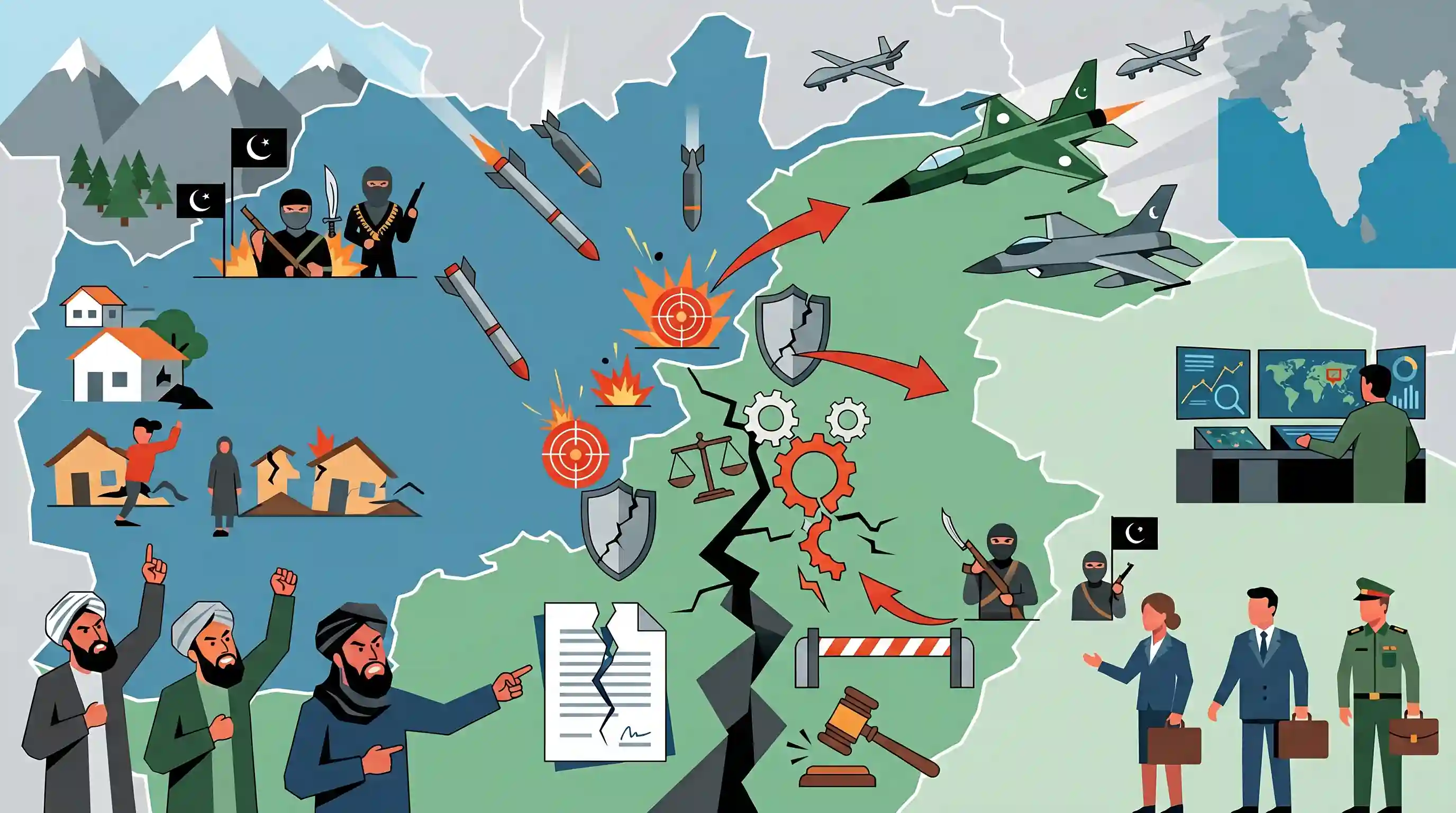
Pakistan carried out intelligence-based airstrikes in the Afghan provinces of Nangarhar and Paktika, targeting hideouts of the Tehrik-e-Taliban Pakistan (TTP) and an Islamic State affiliate. The operations followed accusations by Pakistan that the Afghan Taliban has failed to curb militant groups launching cross-border attacks from Afghan soil, in violation of their obligations under the Doha Agreement. In response, Afghanistan's Defence Ministry condemned the strikes, reporting civilian casualties and vowing retaliation while labeling the action a clear violation of international law. The escalation underscores deteriorating security relations between the two neighbors and the continued challenge of cross-border terrorism in the region.
Key Points
- Pakistan conducted cross-border airstrikes in Afghanistan's Nangarhar and Paktika provinces, specifically targeting TTP and Islamic State militant hideouts.
- Afghanistan's Defence Ministry condemned the strikes as a violation of international law and vowed a calculated retaliation, citing civilian casualties.
- Pakistan defended the airstrikes as necessary for its national security following a surge in attacks, and accused the Taliban regime of inaction against militant proxies.
- The incident draws attention to the Doha Agreement, with Pakistan demanding the Taliban fulfil its commitment to prevent Afghan territory from being used as a safe haven for terrorists.
Important Terms
Doha Agreement

A 2020 peace deal between the US and the Taliban facilitating foreign troop withdrawal in exchange for counter-terrorism guarantees and intra-Afghan dialogue.
UPSC context
GS Paper II (IR); critical for analyzing regional stability and the shift in South Asian geopolitics after the US withdrawal.
Tehrik-e-Taliban Pakistan (TTP)
An umbrella organization of Islamist militant groups along the Afghan-Pakistani border seeking to overthrow the Pakistani state and implement strict Sharia law.
UPSC context
GS Paper III (Internal Security); relevant to cross-border terrorism and security dynamics in India's extended neighborhood.
Afghan Taliban
A Deobandi Islamic fundamentalist movement and the de facto ruling authority of Afghanistan since August 2021 following the collapse of the Western-backed government.
UPSC context
GS Paper II (IR); central to India’s "neighborhood first" policy and regional security engagements in Central Asia.
Islamic State Khorasan (IS-K)
A regional affiliate of the Islamic State active in South and Central Asia; it is an ideological rival to the Taliban and the Pakistani state.
UPSC context
GS Paper III (Security); represents the threat of transnational terrorism and radicalization affecting regional peace and India's security.
Durand Line
The 2,640 km international border between Afghanistan and Pakistan, historically contested by Kabul and a frequent site of cross-border skirmishes and militant transit.
UPSC context
GS Paper II (IR); a primary geographical cause of friction between Pakistan and Afghanistan, impacting regional border management.
Prelims Trap
"The 2020 Doha Agreement was signed between the US and the democratic Afghan Government to counter the Tehrik-e-Taliban Pakistan (TTP)."
The agreement was signed between the US and the Afghan Taliban (excluding the then-Afghan government) to stop international terror (Al-Qaeda), not specifically the TTP.
Static Concepts Connected
What is the Durand Line and why does Afghanistan dispute it?
- Historical Boundary: A 2,640-km border drawn by the British (Sir Mortimer Durand) in 1893, separating British India from the Emirate of Afghanistan.
- Ethnic Division: It arbitrarily cuts through traditional Pashtun and Baloch tribal areas. Kabul has historically refused to recognize it, advocating for a united 'Pashtunistan'.
- Security Impact: Its disputed, porous nature prevents effective fencing, allowing militant groups like the TTP to freely move and establish cross-border safe havens.
What is Pakistan's 'Strategic Depth' doctrine regarding Afghanistan?
- Core Objective: A historical military doctrine seeking a pliable, pro-Pakistan government in Kabul to provide strategic space and a fallback area in case of a conventional war with India.
- Proxy Methodology: To achieve this, Pakistan’s military nurtured and supported proxy militant groups (like the Afghan Taliban) to counter Indian influence and consolidate power in Kabul.
- The Blowback: The state sponsorship of radical proxies has backfired (blowback), creating emboldened militant umbrellas like the TTP that utilize the very same sanctuaries to attack the Pakistani state.
Cross-Topic Patterns
The "Good vs. Bad Terrorist" Fallacy
Pakistan’s current crisis validates India's consistent stand at the UN (CCIT): differentiating between 'good' proxies (Afghan Taliban) and 'bad' terrorists (TTP) is unsustainable and inevitably endangers state security.
Geography of Insurgency & Porous Borders
The rugged, porous terrain of the Af-Pak border mirrors India's internal security challenges along the Myanmar border (FMR), where difficult geography and cross-border ethnic overlaps sustain militant sanctuaries.

Expect map questions on Af-Pak border provinces (Nangarhar, Paktika) and a Mains Q on the blowback of Pakistan's proxy-war strategy.
Linked PYQs · 3
Linked PYQs · 3
- 2024MainsGS2
‘Terrorism has become a significant threat to global peace and security.’ Evaluate the effectiveness of the United Nations Security Council's Counter Terrorism Committee (CTC) and its associated bodies in addressing and mitigating this threat at the international level.
- 2016MainsGS2
Increasing cross-border terrorist attacks in India and growing interference in the internal affairs of several member-states by Pakistan are not conducive for the future of SAARC (South Asian Association for Regional Cooperation)." Explain with suitable examples.
- 2021MainsGS3
Analyse the complexity and intensity of terrorism, its causes, linkages and obnoxious nexus. Also suggest measures required to be taken to eradicate the menace of terrorism.
