Pakistan Continues Airspace Restrictions for Indian Civil Aircraft
Source:Indian Express ↗
Why It Matters
It illustrates the real-world economic, logistical, and environmental fallout of bilateral border disputes, demonstrating how nations leverage sovereign airspace as a strategic tool in modern geopolitics.
Summary
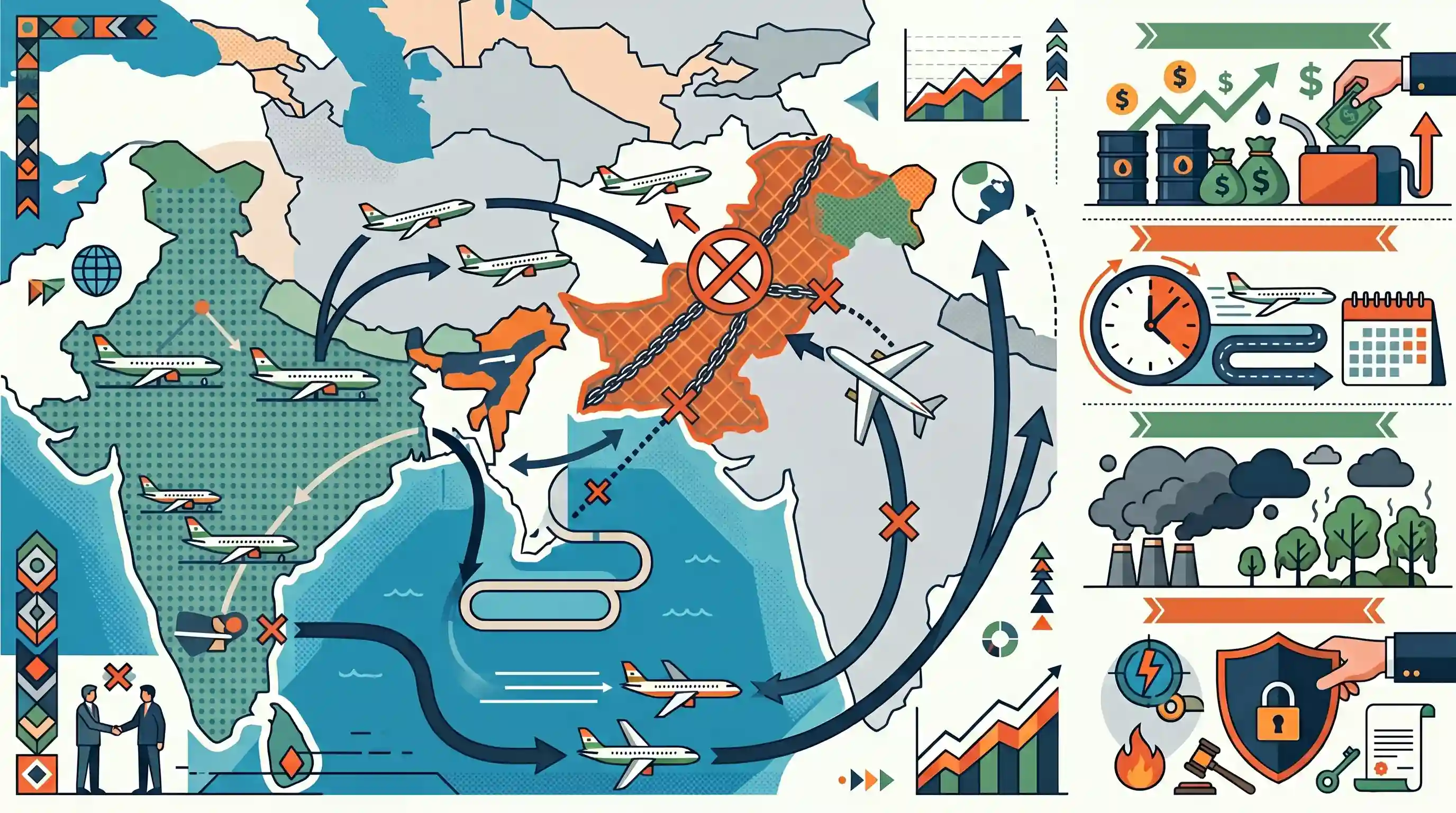
Despite a recent ceasefire announcement between India and Pakistan, Pakistan continues to deny Indian civil aviation aircraft the right to overfly its territory. This airspace blockade forces Indian carriers heading to Western destinations to take longer, circuitous routes via the Arabian Sea, severely impacting the aviation sector through increased fuel costs, extended flight times, and higher carbon emissions. While international civil aviation is governed by treaties like the Chicago Convention, the convention also grants states complete sovereignty over their airspace, allowing airspace denial to be utilized as a potent geopolitical and diplomatic tool in bilateral disputes.
Key Points
- Despite a recent ceasefire understanding, Pakistan has maintained its restriction on Indian commercial aircraft utilizing its sovereign airspace for overflight.
- The airspace closure forces westbound Indian flights (to Europe, North America, and the Middle East) to take circuitous detours over the Arabian Sea.
- This detour leads to significant economic and environmental costs, including increased flight times, higher aviation turbine fuel (ATF) consumption, increased carbon emissions, and inflated ticket prices.
- Under Article 1 of the Chicago Convention, states have complete and exclusive sovereignty over their airspace, allowing them to weaponize airspace access for geopolitical leverage or citing national security.
Important Terms
Chicago Convention on International Civil Aviation

A 1944 treaty establishing the core principles of international air navigation, affirming that each state has exclusive sovereignty over the airspace above its territory.
UPSC context
GS Paper-2 (International Relations/Treaties). It forms the legal bedrock for all international aviation rights and state disputes.
International Civil Aviation Organization (ICAO)
A UN specialized agency that coordinates global aviation standards and facilitates cooperation between 193 member states to ensure safe and orderly air transport.
UPSC context
GS Paper-2 (Important International Institutions). Often discussed in the context of India's council membership and aviation safety.
International Air Services Transit Agreement (IASTA)
A multilateral treaty granting airlines of signatory states the right to overfly another country's territory (First Freedom) and land for non-commercial reasons (Second Freedom).
UPSC context
GS Paper-2/3. Key to understanding diplomatic use of airspace as a tool in bilateral tensions like India-Pakistan.
Freedoms of the Air
A series of commercial aviation rights (such as overflight and landing) granted by one state to another, enabling international air services.
UPSC context
GS Paper-3 (Economy/Infrastructure). Crucial for understanding civil aviation liberalization and regional connectivity issues.
Airspace Sovereignty
The legal concept that a state has complete and exclusive control over the atmosphere above its land and territorial waters.
UPSC context
GS Paper-2 (International Law). This principle allows nations to restrict foreign aircraft for security or political reasons.
Standard and Recommended Practices (SARPs)
Technical specifications adopted by ICAO to ensure global uniformity in flight safety, security, and air navigation procedures.
UPSC context
GS Paper-3 (Aviation). Refers to the mechanisms by which international aviation safety is regulated globally.
Prelims Trap
"The Chicago Convention guarantees foreign commercial aircraft the right of innocent passage through sovereign airspace."
Under Article 1 of the Chicago Convention, states have absolute and exclusive sovereignty over their airspace. Overflight (First Freedom) is a granted privilege, not a guaranteed right.
Static Concepts Connected
What are the fundamental principles of international airspace and the "Freedoms of the Air"?
- Chicago Convention (1944): Under Article 1, every state possesses complete and exclusive sovereignty over the airspace directly above its territory.
- First Freedom: The privilege to fly across a foreign country's territory without landing. This is often suspended during bilateral disputes.
- ICAO's mandate: A UN specialized agency that sets Standards and Recommended Practices (SARPs) for global air transport but cannot override state sovereignty.
What is the CORSIA scheme in the context of international aviation emissions?
- CORSIA objective: Carbon Offsetting and Reduction Scheme for International Aviation, established by ICAO to achieve carbon-neutral growth for international flights.
- Market-based mechanism: Airlines must offset CO2 emissions exceeding the baseline by purchasing carbon credits from approved environmental projects globally.
- Coverage parameters: It applies exclusively to international flights, exempting domestic aviation. Participation shifted from voluntary to mandatory phases.
Cross-Topic Patterns
Geopolitics undermining CORSIA climate goals
Airspace blockades force massive detours, spiking Aviation Turbine Fuel (ATF) consumption. This creates a direct conflict between sovereign geopolitical leverage and the aviation sector's carbon-neutral growth targets under ICAO's CORSIA.
Land blockades mirrored in airspace
Just as Pakistan blocks India's land access to Central Asia (forcing reliance on the Chabahar Port), its airspace denial mirrors this geographical weaponization, forcing reliance on maritime air-corridors over the Arabian Sea.

ICAO's CORSIA and Freedoms of the Air (Chicago Convention) are highly probable as a multi-statement Prelims question on aviation laws.
Linked PYQs · 2
Linked PYQs · 2
- 2014MainsGS3
International civil aviation laws provide all countries complete and exclusive sovereignty over the airspace above their territory. What do you understand by 'airspace'? What are the implications of these laws on the space above this airspace? Discuss the challenges which this poses and suggest ways to contain the threat.
- 2015MainsGS2
Terrorist activities and mutual distrust have clouded India-Pakistan relations. To what extent the use of soft power like sports and cultural exchanges could help generate goodwill between the two countries? Discuss with suitable examples.
