Af-Pak Border Tensions and Regional Mediation Efforts in Turkiye
Source:The Hindu ↗
Why It Matters
The unresolved border issues and presence of terror outfits in the Af-Pak region have direct implications for India's regional security framework. For UPSC aspirants, understanding the geography of the Durand Line, the geopolitical influence of mediators like Turkiye and Qatar, and the threat of non-state actors is critical for both Prelims map-based questions and Mains security/IR answers.
Summary
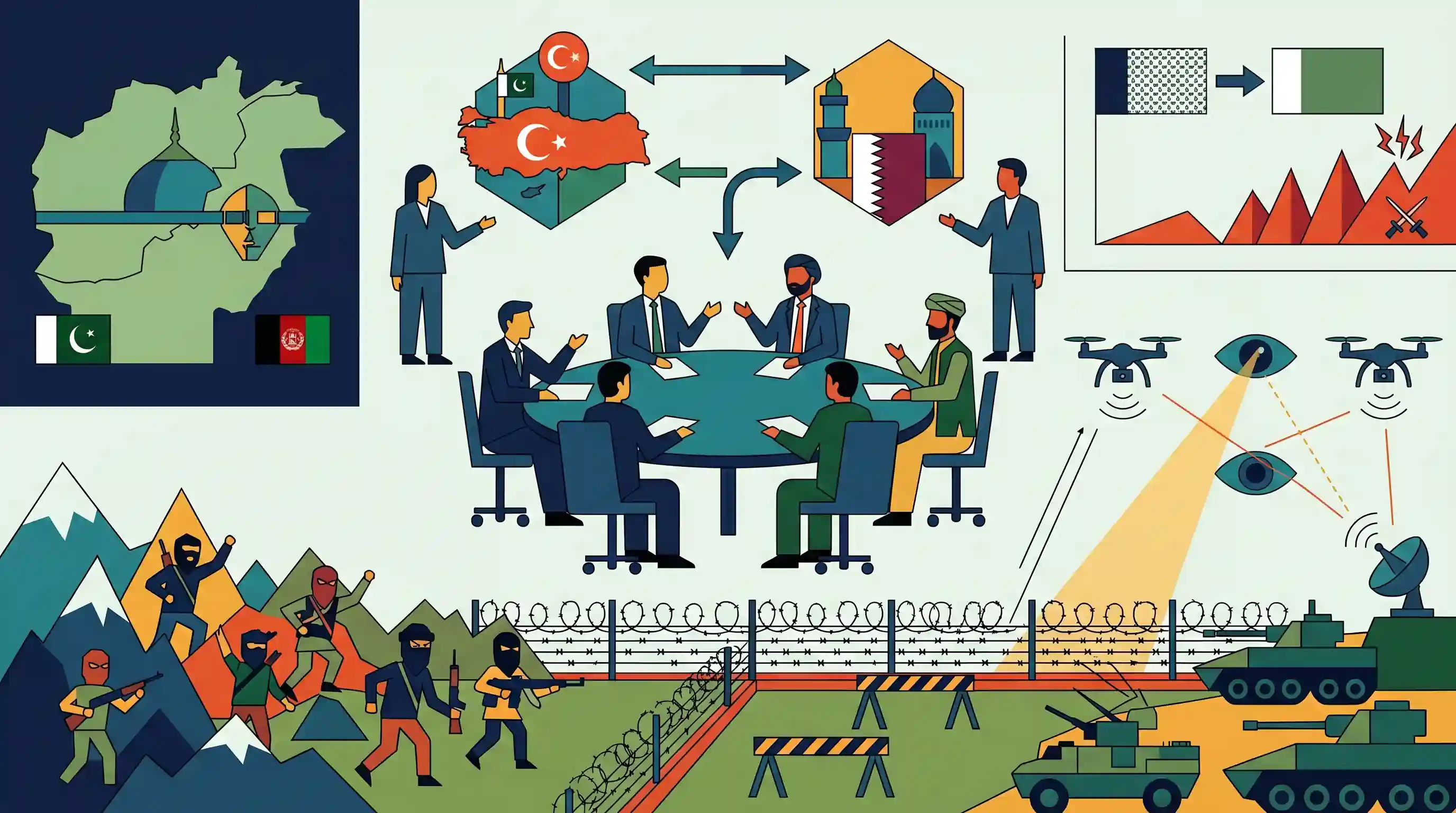
Pakistan and Afghanistan are scheduled to hold a second round of talks in Turkiye, following an initial round in Qatar, aimed at de-escalating border tensions along the contested Durand Line. The diplomatic effort focuses on establishing a verifiable monitoring mechanism to curb the activities of non-state actors, particularly the Tehreek-i-Taliban Pakistan (TTP) and the Balochistan Liberation Army (BLA), operating from Afghan soil. The involvement of Turkiye and Qatar highlights a shift toward regional middle powers mediating South Asian security dynamics, while the enduring dispute underscores the volatile security environment that has worsened since the Taliban's 2021 return to power.
Key Points
- Pakistan and Afghanistan are preparing for a second round of high-level talks in Istanbul, Turkiye, to ease ongoing border tensions and combat cross-border terrorism.
- The first round of these talks was held in Doha, Qatar, indicating the increasing role of Middle Eastern powers (Qatar, Turkiye) in regional dispute mediation.
- Pakistan seeks to establish a concrete monitoring mechanism to curb terrorist activities from Afghan soil, primarily targeting the TTP and BLA.
- The core geographic dispute lies in the 2,611-km-long Durand Line, which serves as the de facto border but remains unrecognized by the Afghan Taliban regime.
- Security concerns for Pakistan have heightened significantly since the Taliban retook control of Kabul in 2021, leading to an upsurge in militant attacks along the border.
Important Terms
Durand Line

The 2,640-km boundary established in 1893 between British India and Afghanistan. Pakistan recognizes it as the official border, but Afghanistan does not, leading to persistent conflict.
UPSC context
GS II: International Relations. Crucial for understanding India’s neighborhood, regional security, and historical border disputes in South Asia.
Tehreek-i-Taliban Pakistan (TTP)
An umbrella organization of militant groups formed in 2007 seeking to overthrow the Pakistani state. It operates along the porous Afghanistan-Pakistan border with ideological ties to the Afghan Taliban.
UPSC context
GS III: Internal Security. Tests knowledge of non-state actors, cross-border terrorism, and their impact on regional stability.
Balochistan Liberation Army (BLA)
A secular ethno-nationalist militant group seeking independence for Pakistan's Balochistan province. It frequently targets Pakistani security forces and Chinese infrastructure projects (CPEC) from regional sanctuaries.
UPSC context
GS III: Internal Security. Relevant for secessionist movements and challenges to internal security from external and non-state actors.
Taliban
A Sunni Islamist movement that returned to power in Afghanistan in 2021. While mediating regional talks, it remains at odds with Pakistan over border recognition and militant sanctuaries.
UPSC context
GS II: International Relations. Key to analyzing India’s Afghan policy, regional geopolitics, and the shift in South Asian security dynamics.
Doha Framework
A diplomatic structure initially facilitating U.S.-Taliban peace, currently used for regional mediation (facilitated by Qatar and Turkiye) to address cross-border terrorism and border management.
UPSC context
GS II: Important International institutions/agencies. Tests understanding of multilateral diplomacy and the role of middle powers in peace processes.
Prelims Trap
The Taliban regime officially recognizes the Durand Line as the demarcated international border.
Afghanistan has historically never recognized the 1893 Durand Line, as it artificially divides ethnic Pashtun areas. No Afghan government, including the Taliban, accepts it.
Static Concepts Connected
What is the historical origin of the Durand Line dispute?
- 1893 Agreement: Signed between Mortimer Durand of British India and Afghan Amir Abdur Rahman Khan to demarcate their respective spheres of influence.
- Ethnic division: It artificially divided Pashtun and Baloch tribal territories, leading to persistent historical rejection by all subsequent Afghan governments.
- India's connection: India officially considers a segment of the Durand Line as its own border with Afghanistan, via its claim over PoK.
What is Middle Power diplomacy in International Relations?
- Niche mediation: States like Qatar and Turkiye use mediation in regional conflicts to project soft power and diplomatic indispensability where superpowers are distrusted.
- Strategic autonomy: These powers maintain flexible alliances, acting independently of traditional Western blocs to secure localized geopolitical and economic interests.
Cross-Topic Patterns
Durand Line + India's PoK Claim
The Durand Line dispute indirectly affects India. India's official map includes a 106-km border with Afghanistan in PoK, making the geopolitical stability of this line relevant to India's territorial claims.
Strategic Depth + State-sponsored Terrorism
Pakistan's historical military doctrine of cultivating the Taliban for 'strategic depth' against India has triggered severe blowback, with the Taliban now harboring anti-Pakistan terror groups like the TTP.

Expect a multi-statement Prelims question testing the origin of the Durand Line alongside India's 106-km PoK-Afghanistan border claim.
Linked PYQs · 4
Linked PYQs · 4
- 2022PrelimsGS1
Consider the following countries: 1. Azerbaijan 2. Kyrgyzstan 3. Tajikistan 4. Turkmenistan 5. Uzbekistan Which of the above have borders with Afghanistan ?
- 2014PrelimsGS1
Turkey is located between
- 2021MainsGS3
Analyse the multidimensional challenges posed by external state and non-state actors, to the internal security of India. Also discuss measures required to be taken to combat these threats.
- 2020MainsGS3
Analyze internal security threats and transborder crimes along Myanmar, Bangladesh and Pakistan borders including Line of Control (LoC). Also discuss the role played by various security forces in this regard.
