Military clashes and airstrikes between Pakistan and Afghanistan
Source:The Hindu ↗
Why It Matters
The geopolitical friction between Afghanistan and Pakistan directly impacts the security environment in South Asia. Understanding the fragility of the Durand Line and state-sponsored or harbored terrorism is critical for UPSC aspirants analyzing India's neighborhood first policy and broader regional stability.
Summary
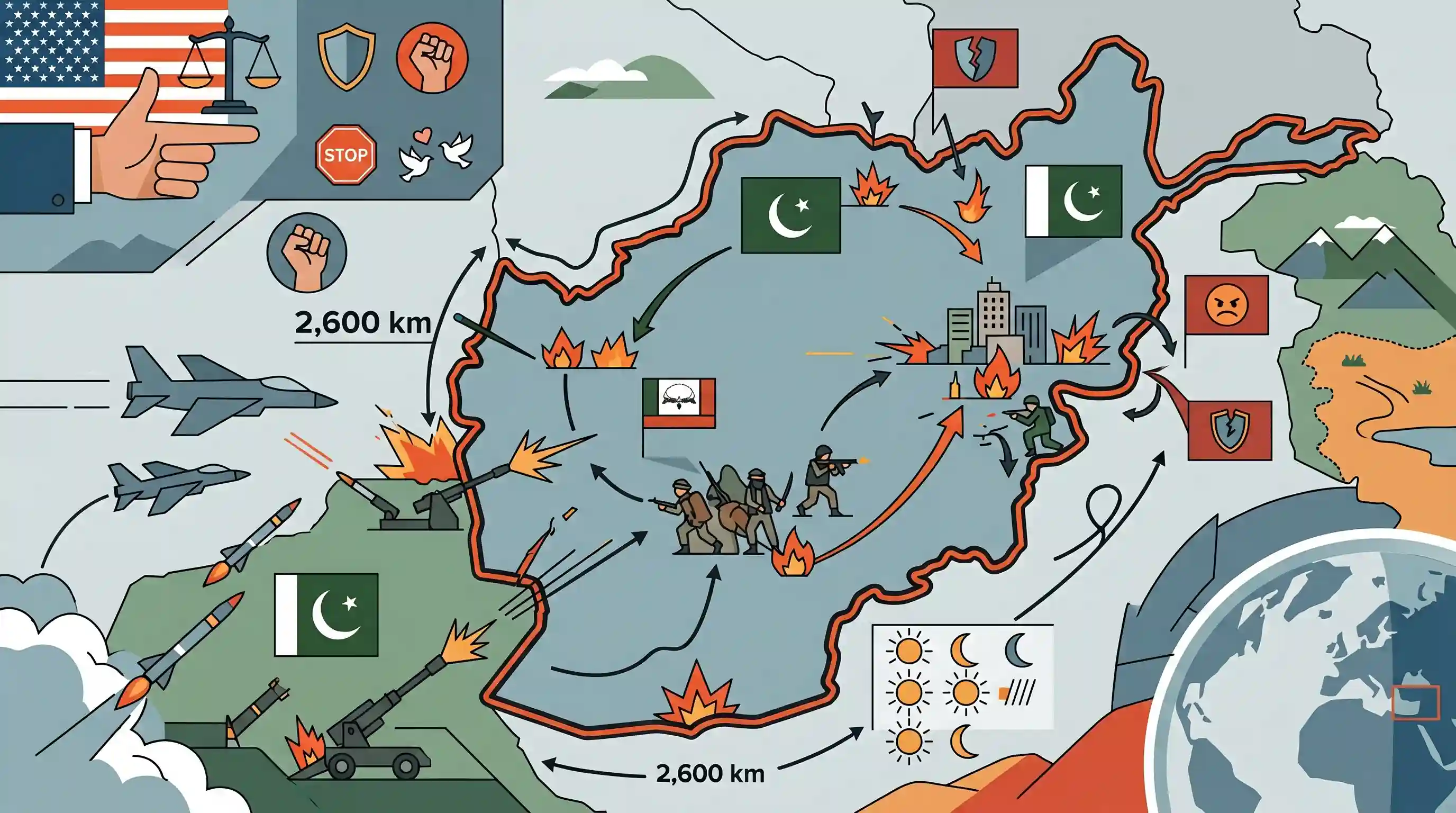
Escalating military clashes between Afghanistan and Pakistan have reached Kabul, with explosions heard as fighting enters its fourth day. Pakistan has conducted airstrikes within Afghan territory, claiming to target militant infrastructure linked to the Tehrik-i-Taliban Pakistan (TTP), a group Pakistan accuses the Afghan Taliban of sheltering. The Afghan administration condemned the strikes as a breach of sovereignty and retaliated along the contested 2,600 km Durand Line. The U.S. has backed Pakistan's right to self-defense while urging restraint to minimize civilian casualties, spotlighting the volatile regional security environment and the complex interplay of cross-border terrorism and state sovereignty.
Key Points
- Clashes and explosions in Kabul marked the fourth day of fighting between Afghan and Pakistani forces.
- Pakistan launched airstrikes inside Afghanistan, claiming they were intelligence-based operations targeting Tehrik-i-Taliban Pakistan (TTP) militant infrastructure.
- The Afghan Taliban condemned the airstrikes as a violation of Afghanistan's sovereignty and retaliated by targeting Pakistani aircraft and conducting operations along the 2,600 km Durand Line.
- The United States supported Pakistan's right to self-defense against cross-border terrorism but urged civilian protection and restraint.
- The ongoing conflict highlights the porous nature of the Durand Line and the persistent challenge of cross-border terrorism in South Asia.
Important Terms
Durand Line

The 2,640 km international border between Afghanistan and Pakistan, established in 1893 by Sir Mortimer Durand. It remains a major source of diplomatic tension as Afghanistan does not formally recognize its legitimacy.
UPSC context
GS-2 (IR) and GS-3 (Border Management); tests knowledge of colonial-era borders and their impact on regional security and tribal dynamics.
Tehrik-i-Taliban Pakistan (TTP)
An umbrella organization of militant groups founded in 2007 that seeks to overthrow the Pakistani state to impose Sharia law. It is ideologically aligned with but organizationally distinct from the Afghan Taliban.
UPSC context
GS-3 (Internal Security); relevant for understanding terrorism in India's neighborhood and the security challenges posed by non-state actors.
Taliban
A Deobandi Islamist movement that has served as the de facto government of Afghanistan since 2021. Their governance and harboring of militant groups significantly impact South Asian stability.
UPSC context
GS-2 (International Relations); critical for questions on India's 'Neighborhood First' policy and regional security architecture.
Cross-border Terrorism
The use of a country's soil by state or non-state actors to plan and execute terrorist attacks in another country. It is a key challenge for Indian internal security.
UPSC context
GS-3 (Security); a core syllabus topic testing the understanding of proxy wars and border management strategies.
Prelims Trap
The Durand Line is the officially recognized international border between Afghanistan and Pakistan.
Afghanistan has never formally recognized the 1893 Durand Line, as the colonial-era demarcation arbitrarily divides contiguous ethnic Pashtun and Baloch populations.
Static Concepts Connected
What is the 'Unwilling or Unable' doctrine in international law?
- Self-defense justification: Used by states to justify extraterritorial military strikes against non-state terrorist actors.
- Host state failure: Invoked when the host nation (e.g., Afghanistan) refuses or lacks the capacity to neutralize the threat.
- Article 51 Link: Operates as a modern, albeit debated, extension of the UN Charter's Article 51 right to self-defense.
What was Pakistan's 'Strategic Depth' policy regarding Afghanistan?
- Military objective: A doctrine seeking a compliant Afghan state to provide territorial retreat space during an Indo-Pak war.
- Proxy support: Drove Islamabad's historical backing of the Afghan Taliban to aggressively block Indian influence in Kabul.
- Current collapse: The TTP's sanctuary in Taliban-ruled Afghanistan has backfired, turning the doctrine into a severe domestic security crisis.
Cross-Topic Patterns
Colonial cartography and modern conflict
The Durand Line's arbitrary bisection of Pashtun tribes mirrors syllabus themes on how unscientific colonial borders (like the Radcliffe or McMahon lines) fuel perennial South Asian instability.
Shift in India's Two-Front calculus
Heavy Pakistani military engagement and airstrikes on its western border force a tactical redeployment, temporarily altering the conventional threat matrix for India along the Line of Control (LoC).

Expect a 2026 Mains question linking Pakistan's failed 'strategic depth' in Afghanistan to shifting terror dynamics on India's borders.
Linked PYQs · 4
Linked PYQs · 4
- 2016MainsGS2
Increasing cross-border terrorist attacks in India and growing interference in the internal affairs of several member-states by Pakistan are not conducive for the future of SAARC (South Asian Association for Regional Cooperation)." Explain with suitable examples.
- 2022PrelimsGS1
Consider the following countries: 1. Azerbaijan 2. Kyrgyzstan 3. Tajikistan 4. Turkmenistan 5. Uzbekistan Which of the above have borders with Afghanistan ?
- 2024MainsGS2
‘Terrorism has become a significant threat to global peace and security.’ Evaluate the effectiveness of the United Nations Security Council's Counter Terrorism Committee (CTC) and its associated bodies in addressing and mitigating this threat at the international level.
- 2023MainsGS3
The use of unmanned aerial vehicles (UAVs) by our adversaries across the borders to ferry arms/ammunitions, drugs, etc., is a serious threat to the internal security. Comment on the measures being taken to tackle this threat.
