CPI Base Year Revision and Structural Flaws in Inflation Metrics
Source:The Hindu ↗
Why It Matters
Understanding how inflation is measured (CPI weights, base year) and the difference between core and headline inflation is fundamental for the UPSC Economy syllabus. The specific issue of high food weight in the CPI basket directly relates to the RBI's monetary policy effectiveness, which has been directly tested in recent Mains exams.
Summary
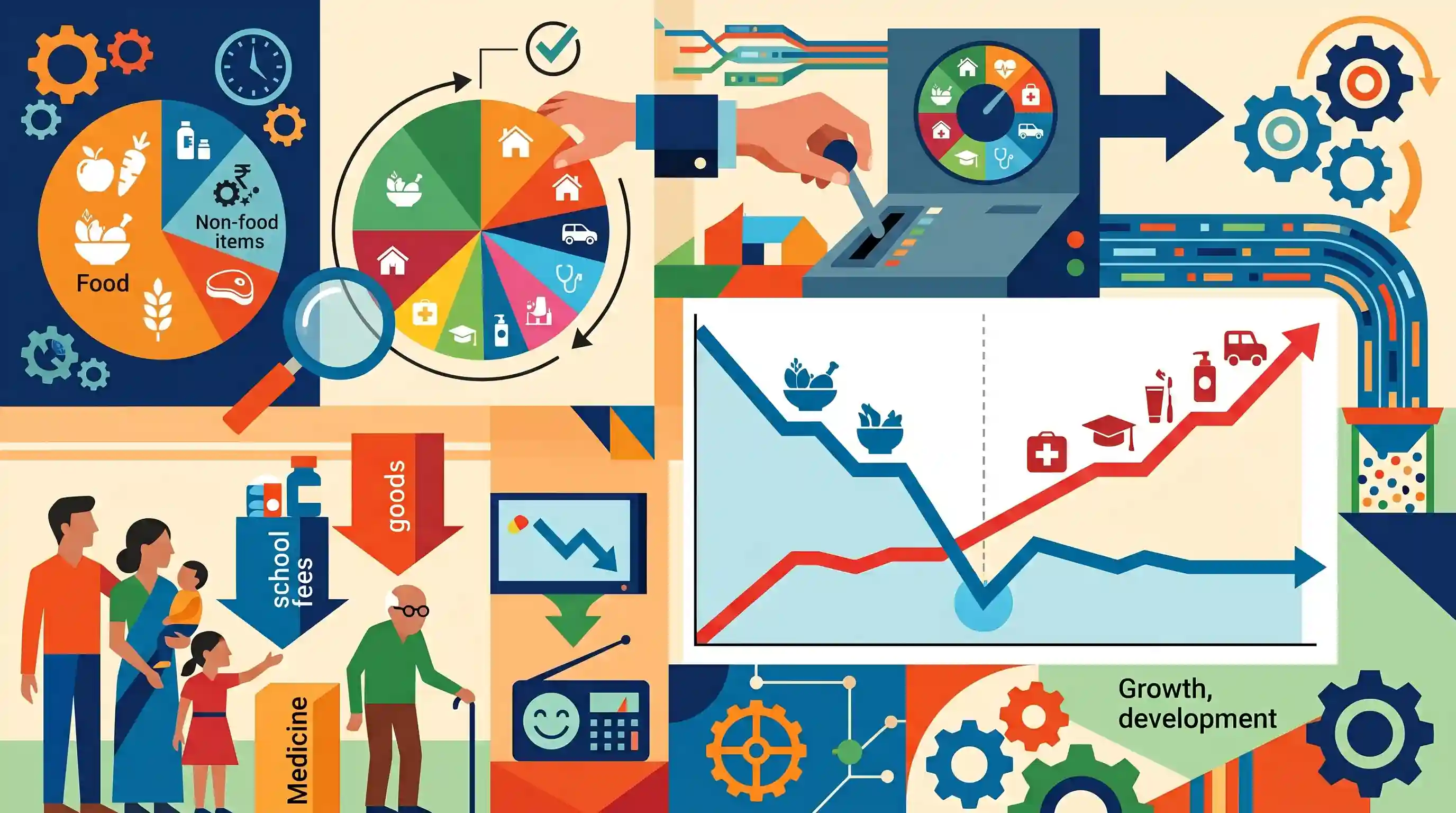
The editorial questions the true economic reality behind India's recent dip in headline retail inflation to a 77-month low of 2.1%. While a high base effect and seasonal factors eased food inflation, core inflation components like education, healthcare, and personal care continued to rise. The article highlights a structural flaw in the current Consumer Price Index (CPI), which overweights food at 46% based on a 2011-12 base year, contradicting recent Household Consumption Expenditure Surveys that estimate food spending at around 30%. This disparity emphasizes the urgency for the Ministry of Statistics and Programme Implementation to update the CPI base year. Until then, relying on an outdated index threatens to distort the Reserve Bank of India's (RBI) inflation-targeting monetary policy and masks the real cost-of-living squeeze on average citizens.
Key Points
- India's headline retail inflation dropped to a 77-month low of 2.1% in June 2025, primarily due to easing food inflation from base effects and seasonal factors.
- Core inflation components, such as education, healthcare, and personal care, actually witnessed price increases despite the overall drop in headline inflation.
- The current Consumer Price Index (CPI) basket, anchored to a 2011-12 base year, assigns a disproportionately high weight of 46% to food.
- Recent Household Consumption Expenditure Surveys indicate food expenditure is now closer to 30%, suggesting current headline CPI figures may misrepresent the true cost of living.
- The Ministry of Statistics and Programme Implementation is currently revising the CPI base year and item weights to reflect actual modern consumption patterns.
- The RBI currently relies on this potentially flawed, food-heavy CPI metric to guide its inflation-targeting monetary policy.
Important Terms
Consumer Price Index (CPI)

A metric measuring the average change in retail prices paid by consumers for a fixed basket of goods and services, used as India's primary inflation measure.
UPSC context
GS Paper III (Economy). Vital for understanding monetary policy, cost of living, and the RBI's primary target for price stability.
Household Consumption Expenditure Survey (HCES)
A quinquennial survey conducted by the NSSO to estimate household spending patterns, crucial for updating the weights and base year of the CPI basket.
UPSC context
GS Paper III. Tests knowledge of data collection methods and their role in accurately reflecting consumption shifts in economic indicators.
Headline Inflation
The total inflation figure in an economy, representing the price change of the entire CPI basket, including volatile items like food and fuel.
UPSC context
GS Paper III. Critical for comparing overall price levels against the RBI's 4% inflation target (+/- 2% tolerance band).
Core Inflation
A measure of inflation that excludes volatile price movements in food and fuel to reveal the underlying long-term trend in the economy.
UPSC context
GS Paper III. Essential for evaluating demand-side pressures and the persistence of price rises beyond seasonal supply shocks.
Base Effect
The statistical distortion where unusually high or low price levels in the previous year's corresponding month cause current inflation rates to appear lower or higher.
UPSC context
GS Paper III. Explains short-term fluctuations in economic data, testing the ability to distinguish between genuine price trends and statistical anomalies.
Ministry of Statistics and Programme Implementation (MoSPI)
The nodal ministry responsible for the collection and dissemination of national statistics, including the calculation of CPI and conducting consumption surveys.
UPSC context
GS Paper III/Prelims. Significant for identifying the institutional framework behind India's economic data and periodic indicator revisions.
Inflation Targeting
A monetary policy framework where the central bank uses interest rate adjustments to maintain inflation within a pre-defined range (currently 2%-6%).
UPSC context
GS Paper III. Key to the RBI's mandate and the functioning of the statutory Monetary Policy Committee (MPC).
Prelims Trap
The RBI uses Core Inflation as the legal anchor for its Flexible Inflation Targeting framework.
The RBI legally mandates targeting Headline CPI, not Core CPI. Aspirants often mistakenly assume the RBI uses Core inflation because it removes volatile food/fuel shocks.
Static Concepts Connected
How does the Consumer Price Index differ from the Wholesale Price Index?
- Services inclusion: CPI measures price changes in both goods and services (e.g., healthcare, education), whereas WPI tracks only the prices of goods at the wholesale level.
- Food weight: The current CPI basket assigns a massive ~46% weight to food, making it highly sensitive to agricultural supply shocks compared to the WPI.
- Policy anchor: Since the Urjit Patel Committee recommendations, the RBI uses CPI-Combined, not WPI, as the official anchor for inflation targeting.
What is the difference between Headline and Core inflation?
- Headline inflation: Represents the total inflation rate in an economy, tracked across all items in the CPI basket, including highly volatile items.
- Core inflation: Excludes volatile food and fuel/energy components from the CPI basket to reflect underlying, long-term, and structural price trends.
- Base effect: Refers to the distortion of inflation rates due to abnormally high or low prices in the corresponding month of the previous year.
Cross-Topic Patterns
HCES data and Poverty Estimation
The Household Consumption Expenditure Survey doesn't just reweigh the CPI; it forms the foundational dataset for evaluating poverty lines (e.g., Tendulkar/Rangarajan committees) and determining PDS allocations.
Distorted CPI and Real Interest Rates
Artificially low headline inflation inflates the perceived 'real interest rate' for savers, complicating the RBI's repo rate transmission and monetary policy stance.

Expect a 2026 prelims question contrasting HCES food consumption shifts with RBI’s Headline CPI targeting mandate and base effects.
Linked PYQs · 3
Linked PYQs · 3
- 2020PrelimsGS1
Consider the following statements: 1. The weightage of food in Consumer Price Index (CPI) is higher than that in Wholesale Price Index (WPI). 2. The WPI does not capture changes in the prices of services, which CPI does. 3. Reserve Bank of India has now adopted WPI as its key measure of inflation and to decide on changing the key policy rates. Which of the statements given above is/are correct?
- 2010PrelimsGS1
With reference to India, consider the following statements : 1. The Wholesale Price Index (WPI) in India is available on a monthly basis only. 2. As compared to Consumer Price Index for Industrial Workers (CPI(IW)), the WPI gives less weight to food articles. Which of the statements given above is/are correct ?
- 2024MainsGS3
What are the causes of persistent high food inflation in India? Comment on the effectiveness of the monetary policy of the RBI to control this type of inflation.
