India Suspends Indus Waters Treaty And Visas After Pahalgam Attack
Source:Indian Express ↗
Why It Matters
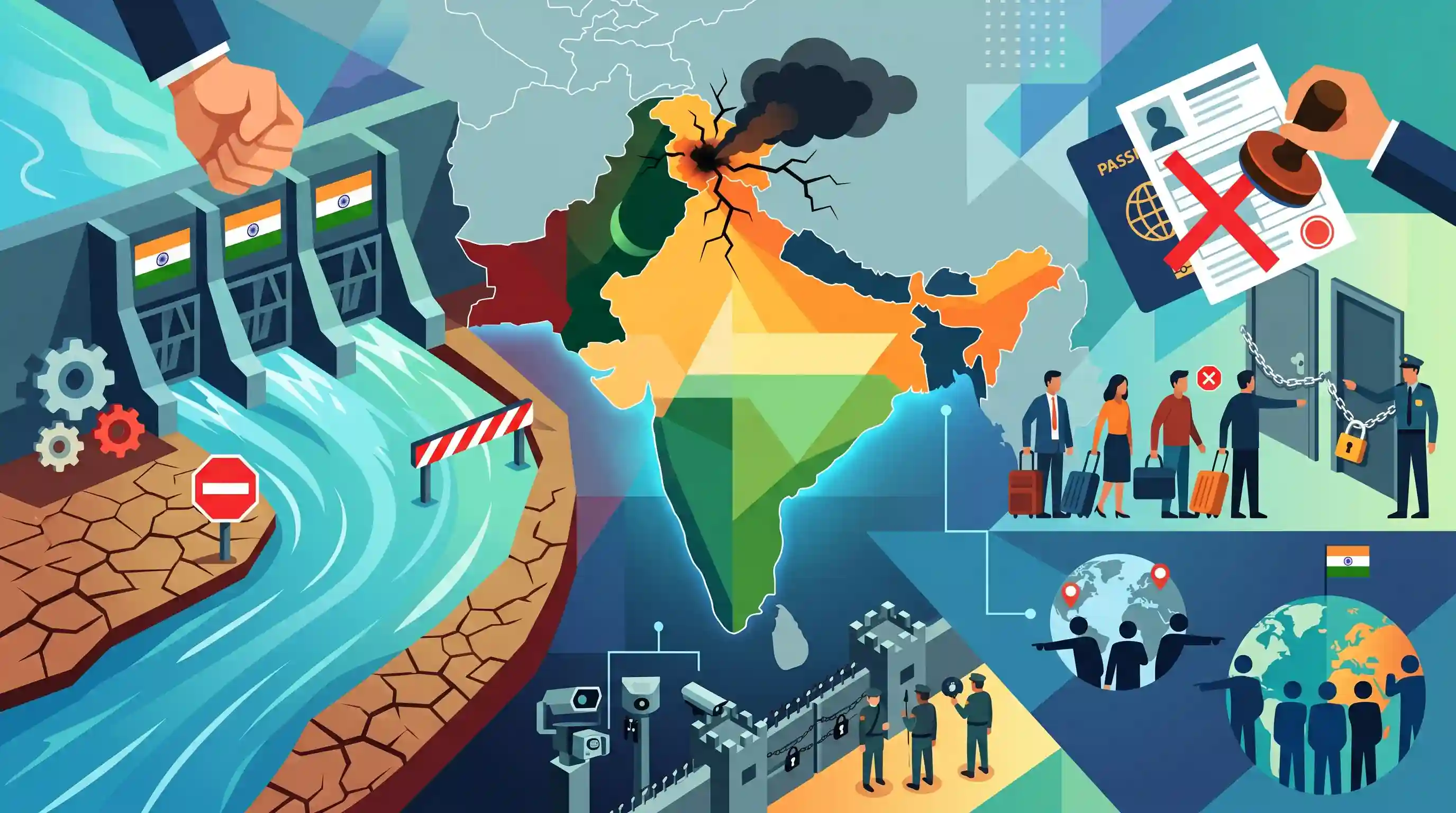
The Indus Water Treaty (1960) has historically survived wars and conflicts, making its official abeyance a monumental paradigm shift in India's strategic leverage (using water as a geopolitical tool). The diplomatic freezing and visa cancellations present a vital case study for UPSC aspirants regarding how India responds to cross-border terrorism using non-military, diplomatic, and economic coercive measures.
Summary
In the aftermath of the Pahalgam terror attack, India has significantly escalated its diplomatic response against Pakistan by turning up the pressure on multiple fronts. New Delhi officially announced the abeyance of the Indus Water Treaty mechanisms and cancelled all visas for Pakistani nationals, effectively stalling bilateral engagements. This robust retaliation underscores a zero-tolerance policy towards cross-border terrorism, utilizing India's upper-riparian geographic advantage and diplomatic isolation as strategic tools to penalize state-sponsored terror in Jammu and Kashmir.
Key Points
- Following a deadly terror attack in Pahalgam, the Indian government has announced a series of severe diplomatic retaliatory measures against Pakistan.
- New Delhi has officially placed the workings of the Indus Water Treaty (IWT) in 'abeyance,' signaling a suspension of bilateral water-sharing discussions and leveraging its upper-riparian status.
- All visas for Pakistani nationals have been cancelled as part of a broader strategic move to downgrade bilateral ties and isolate Islamabad.
- The actions reflect a significant hardening of India's strategic posture, strictly linking the fulfillment of bilateral treaty obligations to the cessation of cross-border terrorism.
Important Terms
Indus Waters Treaty (IWT)

A 1960 World Bank-brokered water-sharing agreement between India and Pakistan, allocating the three Eastern rivers (Ravi, Beas, Sutlej) to India and three Western rivers (Indus, Jhelum, Chenab) to Pakistan.
UPSC context
GS Paper II (Bilateral Relations); tests understanding of transboundary water governance and India-Pakistan diplomatic levers.
Abeyance
A state of temporary suspension. In this context, India's official halting of treaty mechanisms and data-sharing without formal termination, a move not explicitly recognized under the Vienna Convention on Treaties.
UPSC context
GS Paper II (International Relations); tests knowledge of legal vs. political terminology in treaty management and diplomatic escalation.
Upper-riparian State
A nation located upstream on a river system. India's upper-riparian status on the Indus gives it geographic control over water flow entering downstream Pakistan.
UPSC context
GS Paper I (Geography) & II (IR); critical for analyzing power dynamics in transboundary river disputes.
Permanent Indus Commission (PIC)
A bilateral body established by the IWT comprising officials from both nations to manage water sharing, exchange data, and resolve technical disputes.
UPSC context
GS Paper II (IR); tests knowledge of institutional mechanisms for conflict resolution between neighboring states.
Cross-border Terrorism
Terrorism where the perpetrators cross international borders or are supported by a foreign state to commit acts of violence in another country.
UPSC context
GS Paper III (Internal Security); a core theme regarding non-state actors and border management challenges.
Zero-tolerance Policy
India’s stated national security doctrine that refuses to engage in diplomatic dialogue or normalization with any state that sponsors or facilitates terrorist activities.
UPSC context
GS Paper III (Security) & II (IR); reflects India's strategic shift toward punitive deterrence and diplomatic isolation.
Prelims Trap
India has unilaterally withdrawn from the Indus Water Treaty and stopped all water flow to Pakistan.
The IWT has no unilateral exit clause. India placed treaty mechanisms (like the Permanent Indus Commission) in abeyance; it did not abrogate the treaty itself.
Static Concepts Connected
What are India's rights over the Western Rivers under the IWT?
- Allocation: The Western rivers (Indus, Jhelum, Chenab) are primarily allocated to Pakistan; Eastern rivers (Ravi, Beas, Sutlej) to India.
- Permitted Use: India holds non-consumptive rights on Western rivers, allowing for run-of-the-river hydroelectricity projects, domestic use, and limited agricultural use.
- Dispute Redressal: It follows a graduated 3-step mechanism: Permanent Indus Commission (PIC), followed by a Neutral Expert, and finally a Court of Arbitration.
What international conventions govern transboundary river water sharing?
- Helsinki Rules (1966): An international guideline establishing the core principle of 'equitable and reasonable utilization' of international drainage basins.
- UN Watercourses Convention: Mandates states to prevent 'significant harm' to other states sharing a watercourse. Neither India nor Pakistan are signatories.
Cross-Topic Patterns
Weaponization of Hydro-Diplomacy
Moving beyond military strikes, India is utilizing structural retaliation by weaponizing its upper-riparian geographic advantage, intertwining internal security with transboundary water governance.
World Bank as Treaty Guarantor
Unlike most bilateral pacts, the IWT includes the World Bank as a signatory, raising complex questions about third-party mediation when bilateral mechanisms are placed in abeyance.

IWT dispute mechanisms (Neutral Expert vs Court of Arbitration) and J&K river mapping are prime targets for a 2026 Prelims question.
Linked PYQs · 4
Linked PYQs · 4
- 2012MainsGS2
The situation today is far different to that prevalent fifty years back when the Indus Water Treaty was signed." Highlight the complexity of the current challenges on both sides of the border in this regard. Do you think that a review of the Treaty is in India's best interests?
- 2015MainsGS2
Terrorist activities and mutual distrust have clouded India-Pakistan relations. To what extent the use of soft power like sports and cultural exchanges could help generate goodwill between the two countries? Discuss with suitable examples.
- 2023MainsGS3
Winning of 'Hearts and Minds' in terrorism-affected areas is an essential step in restoring the trust of the population. Discuss the measures adopted by the Government in this respect as part of the conflict resolution in Jammu and Kashmir.
- 2021PrelimsGS1
With reference to the Indus river system, of the following four rivers, three of them pour into one of them which joins the Indus direct. Among the following, which one is such river that joins the Indus direct?
