Suspension of Indus Waters Treaty and Strategic Retaliation
Source:Indian Express ↗
Why It Matters
The suspension or modification of the Indus Waters Treaty is a highly debated topic in strategic circles. It touches upon international law, hydro-diplomacy, and internal security, making it highly relevant for GS Paper 2 (International Relations) and GS Paper 3 (Security). Aspirants must understand the geographical nuances of the Indus river system for Prelims, and the geopolitical ramifications of weaponizing water treaties for Mains.
Summary
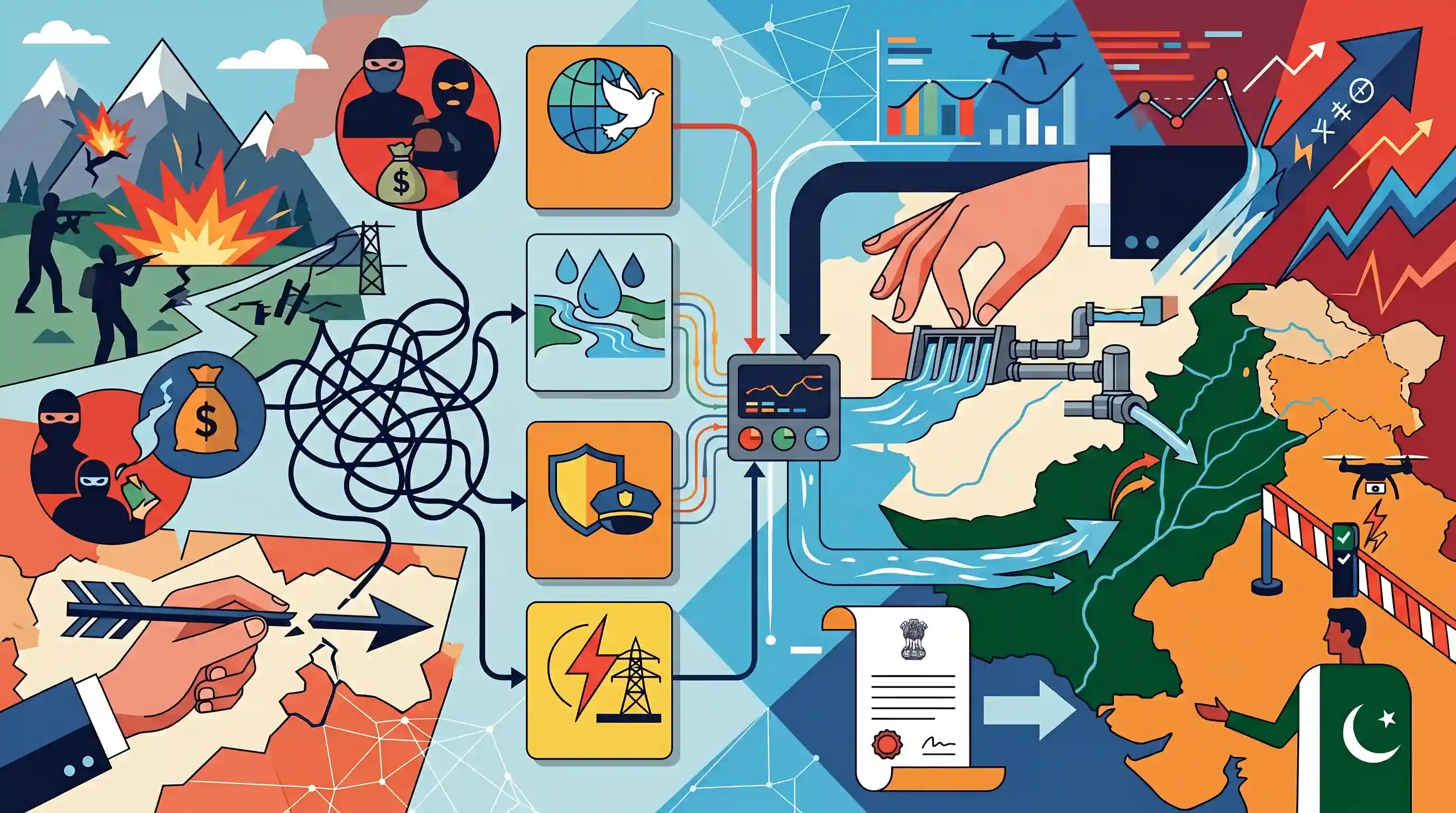
Following a deadly terror attack in Pahalgam, India has formally notified Pakistan of its decision to pause operations under the Indus Waters Treaty (IWT). To operationalize this strategic shift, four key Union Ministries—External Affairs, Jal Shakti, Home, and Power—are working in tandem to chart out future steps. This unprecedented move reflects India's intent to utilize water diplomacy and its legal rights over the western rivers as a coercive geopolitical tool to counter state-sponsored terrorism from Pakistan, marking a significant escalation in bilateral tensions.
Key Points
- Following the Pahalgam terror attack, India has officially notified Pakistan of its decision to pause the Indus Waters Treaty (IWT).
- Four Union Ministries—External Affairs, Jal Shakti, Home Affairs, and Power—are coordinating to formulate the strategic next steps.
- The move signals a major shift in India's foreign policy, linking water-sharing agreements directly to the cessation of cross-border terrorism.
- India aims to expedite the construction of strategic hydropower and irrigation projects to maximize its permitted usage of the western rivers (Indus, Jhelum, Chenab) under the treaty.
Important Terms
Indus Waters Treaty (IWT)

A 1960 World Bank-brokered water-sharing agreement between India and Pakistan. It allocates the Eastern rivers (Ravi, Beas, Sutlej) to India and the Western rivers (Indus, Jhelum, Chenab) to Pakistan, allowing India limited non-consumptive usage.
UPSC context
GS-2 (International Relations) and GS-1 (Geography). Tests understanding of transboundary water governance and its impact on regional geopolitical stability.
Permanent Indus Commission (PIC)
A bilateral body established under the IWT to manage treaty implementation and resolve technical disputes. It is mandated to meet annually, alternating between India and Pakistan, to exchange hydrological data and project details.
UPSC context
GS-2 (Bilateral Relations). Tests knowledge of formal dispute resolution mechanisms and institutional frameworks governing Indo-Pak water sharing.
Water Diplomacy
The strategic integration of transboundary water management into foreign policy. It utilizes resource control and water-sharing agreements as leverage to achieve geopolitical goals, resolve conflicts, or counter security threats like cross-border terrorism.
UPSC context
GS-2 (International Relations/Foreign Policy). Tests analysis of non-military statecraft tools and the use of natural resources as strategic leverage.
Western Rivers
The Indus, Jhelum, and Chenab rivers. Under the IWT, Pakistan has primary rights to their waters, while India is permitted non-consumptive uses, including run-of-the-river hydroelectricity, without significantly altering downstream flow.
UPSC context
GS-1 (Geography) and GS-2 (International Relations). Tests knowledge of the Indus Basin's geography and the legal partitioning of river systems.
Ministry of Jal Shakti
The Indian Union Ministry responsible for the management, development, and regulation of water resources. It oversees the technical implementation and monitoring of international water treaties, including the Indus Waters Treaty.
UPSC context
GS-2 (Governance/Government Policies). Tests awareness of the administrative machinery for managing critical national resources and transboundary water obligations.
Abeyance (Treaty Status)
In this diplomatic context, the temporary suspension of treaty operations or cooperative mechanisms. India placed the IWT in abeyance following the Pahalgam attack to leverage water as a coercive tool against cross-border terrorism.
UPSC context
GS-2 (International Relations/Security). Tests understanding of diplomatic escalation strategies and legal-strategic responses to state-sponsored security challenges.
Prelims Trap
"India unilaterally abrogated the Indus Waters Treaty by invoking its exit clause."
The IWT lacks a formal exit clause. India is merely 'pausing' operations (holding it in abeyance) to withhold data and bypass restrictions, not formally terminating it.
Static Concepts Connected
What are the core allocations and rights under the Indus Waters Treaty (1960)?
- River Allocation: Eastern rivers (Ravi, Beas, Sutlej) allocated to India for unrestricted use; Western rivers (Indus, Jhelum, Chenab) primarily allocated to Pakistan.
- India's Western Rights: India retains specific rights for domestic, non-consumptive, agricultural use, and 'run-of-the-river' hydroelectric projects on the Western rivers.
- Dispute Mechanism: Brokered by the World Bank, the treaty features a graded dispute mechanism: Permanent Indus Commission, Neutral Expert, and Court of Arbitration.
What defines 'run-of-the-river' hydroelectric projects permitted under IWT?
- No Large Storage: Hydropower plants that do not require large storage reservoirs, generating electricity using the natural downward flow and elevation drop of a river.
- Key Projects: Major Indian projects on Western river tributaries, such as Kishanganga (Jhelum) and Ratle (Chenab), often face design-parameter objections from Pakistan.
Cross-Topic Patterns
Water diplomacy as coercive statecraft
Using upper-riparian leverage as a non-kinetic response to cross-border terrorism links international water sharing agreements directly with Internal Security and border management doctrines.
Run-of-the-river projects & Green Energy
Maximizing hydro-potential on the Chenab and Jhelum aligns with India's renewable energy targets, bridging international treaties with domestic climate commitments and infrastructure execution.

IWT's lack of an exit clause, Eastern vs Western river distributions, and specific hydro-projects (Kishanganga/Ratle) are prime 2026 targets.
Linked PYQs · 4
Linked PYQs · 4
- 2012MainsGS2
The situation today is far different to that prevalent fifty years back when the Indus Water Treaty was signed." Highlight the complexity of the current challenges on both sides of the border in this regard. Do you think that a review of the Treaty is in India's best interests?
- 2024MainsGS3
India has a long and troubled border with China and Pakistan fraught with contentious issues. Examine the conflicting issues and security challenges along the border. Also give out the development being undertaken in these areas under the Border Area Development Programme (BADP) and Border Infrastructure and Management (BIM) Scheme.
- 2023MainsGS3
Winning of 'Hearts and Minds' in terrorism-affected areas is an essential step in restoring the trust of the population. Discuss the measures adopted by the Government in this respect as part of the conflict resolution in Jammu and Kashmir.
- 2021PrelimsGS1
With reference to the Indus river system, of the following four rivers, three of them pour into one of them which joins the Indus direct. Among the following, which one is such river that joins the Indus direct?
