Civil Defence Preparedness and Wartime Safety Protocols in India
Source:Indian Express ↗
Why It Matters
The mandate to rehearse wartime civil defence measures such as blackouts and air raid sirens is a rare and significant administrative action. It highlights the immediate intersection of national security, cross-border terrorism, and civilian disaster preparedness, which is crucial for GS-3 Internal Security and Disaster Management syllabi.
Summary
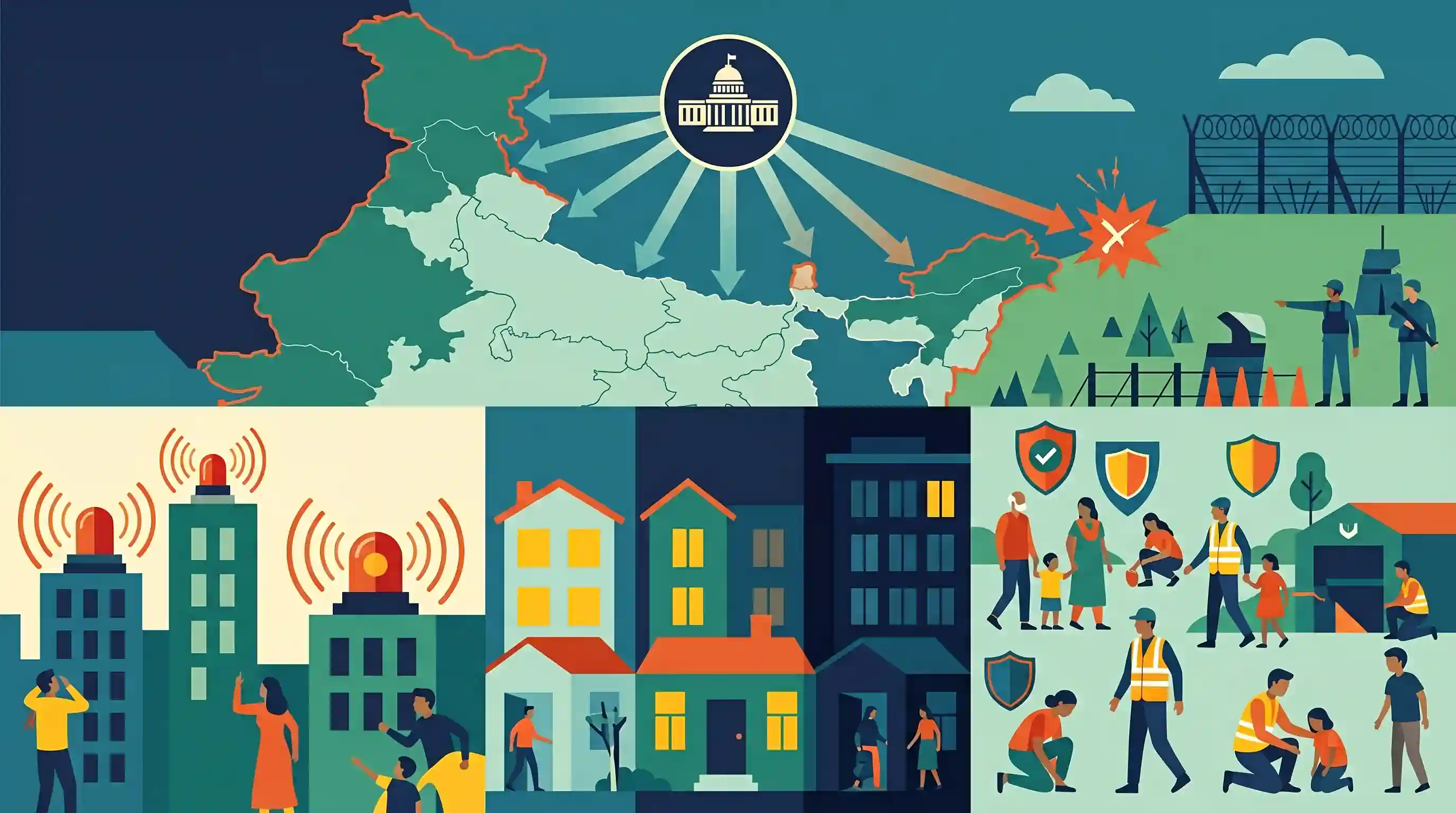
Following a terror attack in Pahalgam, the Central Government has directed northern and western states and Union Territories to implement strict civil defence measures. The directives include activating air raid sirens, rehearsing blackouts, and conducting safety drills for civilians. This development underscores an escalation in internal security concerns and cross-border tensions with Pakistan, necessitating wartime-like preparedness to ensure civilian safety in vulnerable regions.
Key Points
- The Union Government has directed states and Union Territories in northern and western India to initiate emergency civilian preparedness measures.
- The mandated drills include the activation of air raid sirens, rehearsal of blackouts, and comprehensive civilian safety exercises.
- These directives were issued in the aftermath of a major terror attack in Pahalgam, Jammu and Kashmir, signaling heightened cross-border tensions with Pakistan.
- The implementation of wartime civil defence protocols highlights a strategic shift toward proactive civilian readiness in vulnerable border and strategic regions.
Important Terms
Civil Defence Act, 1968

The primary law authorizing non-combat measures to protect persons and property in India during hostile attacks. Amended in 2009 to include disaster management within its scope.
UPSC context
Relevant for GS Paper III (Security/Disaster Management); tests knowledge of legal frameworks for national resilience and civilian protection during war-like scenarios.
Civil Defence Corps
A volunteer-based organization established under the Civil Defence Act to perform non-combat duties like rescue, fire-fighting, and evacuation during emergencies or hostile attacks.
UPSC context
GS Paper III topic 'Various Security Forces and Agencies'; tests understanding of community participation in national security and disaster response.
Operation Abhyas
A large-scale nationwide civil defence mock drill (2025) involving air raid sirens and blackouts to assess emergency preparedness following heightened cross-border tensions.
UPSC context
GS Paper III Internal Security; illustrates proactive state measures for civilian readiness and strategic signaling during regional instability.
Blackout (Civil Defence)
The deliberate suppression of all visible lights in a specific area to prevent enemy aircraft or missiles from identifying targets during nighttime.
UPSC context
GS Paper III; technical measure for 'Security Challenges in Border Areas' and 'Disaster Management' preparedness against aerial threats.
Internal Security
The protection of a nation's borders and territory from internal threats such as terrorism, insurgency, and organized crime.
UPSC context
Core GS Paper III syllabus topic; involves managing state and non-state threats and the role of various security agencies.
Cross-border Terrorism
Terrorist activities perpetrated by groups based in one country against another, often involving infiltration across international borders or the Line of Control.
UPSC context
GS Paper III topic 'Security challenges and their management in border areas'; critical for understanding India-Pakistan relations and regional stability.
Ministry of Home Affairs (MHA)
The nodal ministry in the Government of India responsible for the maintenance of internal security, border management, and civil defence.
UPSC context
Fundamental for GS Paper II (Governance) and Paper III (Security); the primary administrative body executing national security policies.
Prelims Trap
Civil defence duties in India are exclusively restricted to wartime contingencies and hostile attacks.
The Civil Defence (Amendment) Act, 2009, explicitly expanded their legal mandate to include disaster management, making them active during peacetime emergencies too.
Static Concepts Connected
What is the statutory and functional mandate of India's Civil Defence framework?
- Statutory Basis: Governed by the Civil Defence Act, 1968, which was enacted after the 1962 and 1965 wars to formalize national non-combat defense measures.
- 2009 Amendment: The legal mandate was significantly broadened beyond hostile military attacks to formally include natural disaster management and mitigation.
- Volunteer Driven: It operates as a community-driven initiative, relying heavily on the Civil Defence Corps manned by trained citizen volunteers and a small paid staff.
How are Civil Defence preparedness measures geographically prioritized in India?
- District Categorization: The Ministry of Home Affairs (MHA) designates specific Civil Defence Districts based on strategic and tactical vulnerability.
- Vulnerability Criteria: Districts are prioritized based on their proximity to international borders, vulnerability to cross-border shelling, or the presence of critical national infrastructure.
- Blackout Protocols: Wartime measures like blackout rehearsals are enforced under the Civil Defence Rules, 1968, regulating light/sound to prevent aerial detection.
Cross-Topic Patterns
Civil Defence & Disaster Management Synergy
The dual mandate of Civil Defence links GS3 Internal Security to GS3 Disaster Management, positioning local volunteers as crucial first responders in both hostile attack and natural disaster contexts.
Border Management & Vibrant Villages
While the Vibrant Villages Programme builds border economies to retain populations, wartime civil defence protocols address the acute tactical security and evacuation needs of these strategic demographics.

The 2009 expansion of the Civil Defence Act to include peacetime disaster management is a highly likely multi-statement Prelims question.
Linked PYQs · 4
Linked PYQs · 4
- 2024MainsGS3
India has a long and troubled border with China and Pakistan fraught with contentious issues. Examine the conflicting issues and security challenges along the border. Also give out the development being undertaken in these areas under the Border Area Development Programme (BADP) and Border Infrastructure and Management (BIM) Scheme.
- 2021MainsGS3
Analyse the multidimensional challenges posed by external state and non-state actors, to the internal security of India. Also discuss measures required to be taken to combat these threats.
- 2023MainsGS3
Winning of 'Hearts and Minds' in terrorism-affected areas is an essential step in restoring the trust of the population. Discuss the measures adopted by the Government in this respect as part of the conflict resolution in Jammu and Kashmir.
- 2016MainsGS3
Border management is a complex task due to difficult terrain and hostile relations with some countries. Elucidate the challenges and strategies for effective border management.
