Infiltration Dynamics Revealed in Pahalgam Terror Probe
Source:The Hindu ↗
Why It Matters
The incident highlights evolving terrorist tactics, including long-term sleeper cells and the use of UHF communication systems that bypass conventional mobile networks. It underscores the challenges of border management and the importance of integrating technical and human intelligence in counter-insurgency operations in Jammu and Kashmir.
Summary
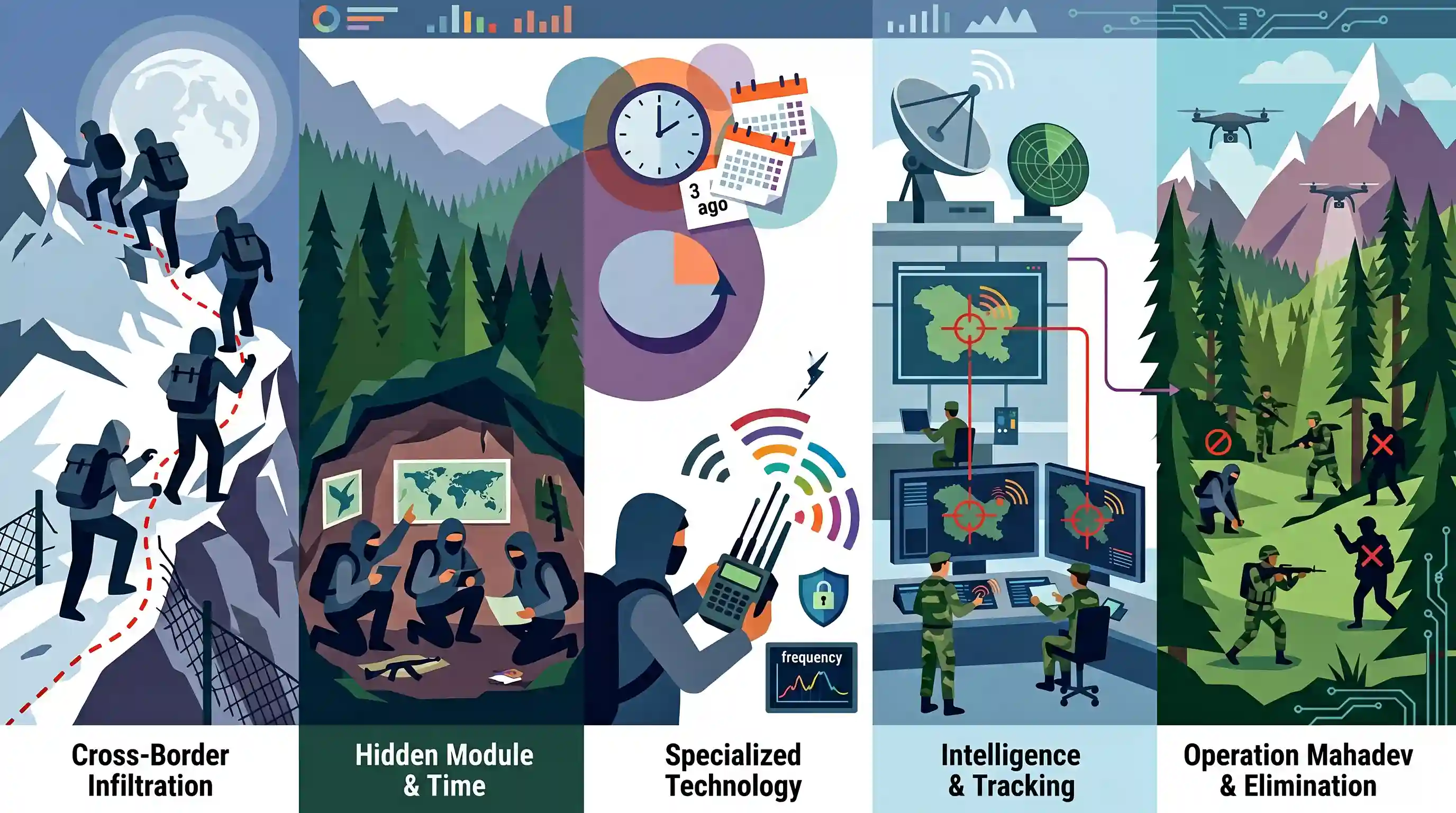
Three Pakistani terrorists involved in the April 22, 2025, Pahalgam terror attack, which claimed 26 civilian lives, were eliminated by security forces during Operation Mahadev in the Dachigam forest range. The militants, affiliated with Lashkar-e-Taiba (LeT), had infiltrated India about three years ago. They utilized ultra-high frequency (UHF) wireless sets for secure communication to avoid normal interception. However, intelligence agencies and the Army tracked their unique signal frequencies over weeks. The encounter underscores the persistent threat of cross-border infiltration and the use of specialized technology by terror modules operating in Jammu and Kashmir.
Key Points
- Three Pakistani terrorists from Lashkar-e-Taiba (LeT) responsible for the April 2025 Pahalgam attack that killed 26 civilians were neutralized in the Dachigam forest range.
- The militants had infiltrated from Pakistan about three years ago, indicating the presence of long-term sleeper cells orchestrating strikes.
- They used ultra-high frequency (UHF) wireless sets for cross-border communication to evade interception, though security forces tracked their unique signals using direction finders.
- Recoveries including Pakistani voter ID cards, US-made M4 carbines, and matching ballistic evidence confirmed their identities and cross-border origins.
Important Terms
Operation Mahadev

A 93-day Indian Army counter-insurgency operation (2025) that neutralized the Lashkar-e-Taiba terrorists responsible for the Pahalgam massacre in the Dachigam forest range.
UPSC context
GS Paper III (Internal Security); tests knowledge of counter-insurgency (COIN) strategies and special forces operations in high-altitude terrain.
Lashkar-e-Taiba (LeT)
A Pakistan-based UN-designated terrorist organization seeking to detach Jammu and Kashmir from India; responsible for major attacks including Mumbai 2008 and Pahalgam 2025.
UPSC context
GS Paper III (Internal Security); tests understanding of major terror groups and the challenges of cross-border terrorism.
The Resistance Front (TRF)
A proxy organization of Lashkar-e-Taiba (LeT) formed in 2019 to provide plausible deniability for Pakistan-backed terror activities in Jammu and Kashmir.
UPSC context
GS Paper III (Internal Security); tests knowledge of "hybrid terrorism" and the evolution of proxy militant groups post-Article 370.
Operation Sindoor
The 2025 Indian military campaign involving precision missile strikes against terror infrastructure in Pakistan following the deadly Pahalgam terror attack.
UPSC context
GS Paper II & III (IR and Security); tests understanding of India’s proactive deterrence and "Zero Tolerance" policy toward terror.
UHF Wireless Sets
A method using radio waves (300 MHz to 3 GHz) employed by terror modules to maintain secure tactical communication and evade traditional signal interception.
UPSC context
GS Paper III (Science & Tech/Security); tests awareness of the "technology-security nexus" and evolving tools used by non-state actors.
National Investigation Agency (NIA)
India’s premier counter-terrorism agency established under the NIA Act, 2008, to investigate offenses affecting the sovereignty, security, and integrity of the nation.
UPSC context
GS Paper III (Statutory Bodies); tests knowledge of the institutional and legal framework for national internal security.
Prelims Trap
UHF radio waves can travel vast cross-border distances by reflecting off the Earth's ionosphere.
UHF relies on line-of-sight (space wave) propagation. It is High Frequency (HF) that reflects off the ionosphere (sky waves) for long-distance communication.
Static Concepts Connected
What are the key ecological features of Dachigam National Park?
- Location: Situated in the Zabarwan Range of the Western Himalayas in Jammu and Kashmir.
- Flagship Species: Primary habitat for the Hangul (Kashmir Stag), which is critically endangered on the IUCN Red List.
- Vegetation: Comprises Himalayan moist temperate forests, alpine pastures, and scrub vegetation.
How do Ultra-High Frequency (UHF) radio waves propagate?
- Line-of-sight propagation: UHF waves travel via space waves in a direct line of sight, meaning they do not follow the Earth's curvature.
- Ionospheric penetration: Unlike High Frequency (HF) waves, UHF waves penetrate the ionosphere rather than reflecting off it.
- Tactical advantage: Their limited range in hilly terrain makes them difficult for adversaries to intercept without proximate direction-finding equipment.
Cross-Topic Patterns
Geopolitics meets Internal Security
Recovery of US-made M4 carbines in Kashmir links the 2021 US withdrawal from Afghanistan directly to the tactical escalation of cross-border militancy in India.
OGWs and Asymmetric Warfare
Terrorists surviving undetected for three years highlights the crucial role of Over-Ground Workers (OGWs) providing logistics and safe havens, a persistent GS-3 focus area.

Dachigam (Hangul habitat) + line-of-sight UHF tech limits in hilly terrain could form a hybrid geography-science Prelims question in 2026.
Linked PYQs · 4
Linked PYQs · 4
- 2019MainsGS3
Cross-border movement of insurgents is only one of the several security challenges facing the policing of the border in North-East India. Examine the various challenges currently emanating across the India-Myanmar border. Also, discuss the steps to counter the challenges.
- 2023MainsGS3
The use of unmanned aerial vehicles (UAVs) by our adversaries across the borders to ferry arms/ammunitions, drugs, etc., is a serious threat to the internal security. Comment on the measures being taken to tackle this threat.
- 2019MainsGS3
The banning of 'Jamaat-e-Islami' in Jammu and Kashmir brought into focus the role of over-ground workers (OGWs) in assisting terrorist organizations. Examine the role played by OGWs in assisting terrorist organizations in insurgency affected areas. Discuss measures to neutralize influence of OGWs.
- 2023MainsGS3
Winning of 'Hearts and Minds' in terrorism-affected areas is an essential step in restoring the trust of the population. Discuss the measures adopted by the Government in this respect as part of the conflict resolution in Jammu and Kashmir.
