UN chief urges maximum restraint following Pahalgam terror attack
Source:The Hindu ↗
Why It Matters
Demonstrates the geopolitical fallout of cross-border terrorism, showcasing India's evolving toolkit of diplomatic and strategic retaliation—such as the suspension of the historic Indus Waters Treaty. It is highly relevant for GS2 (India-Pakistan relations) and GS3 (internal security).
Summary
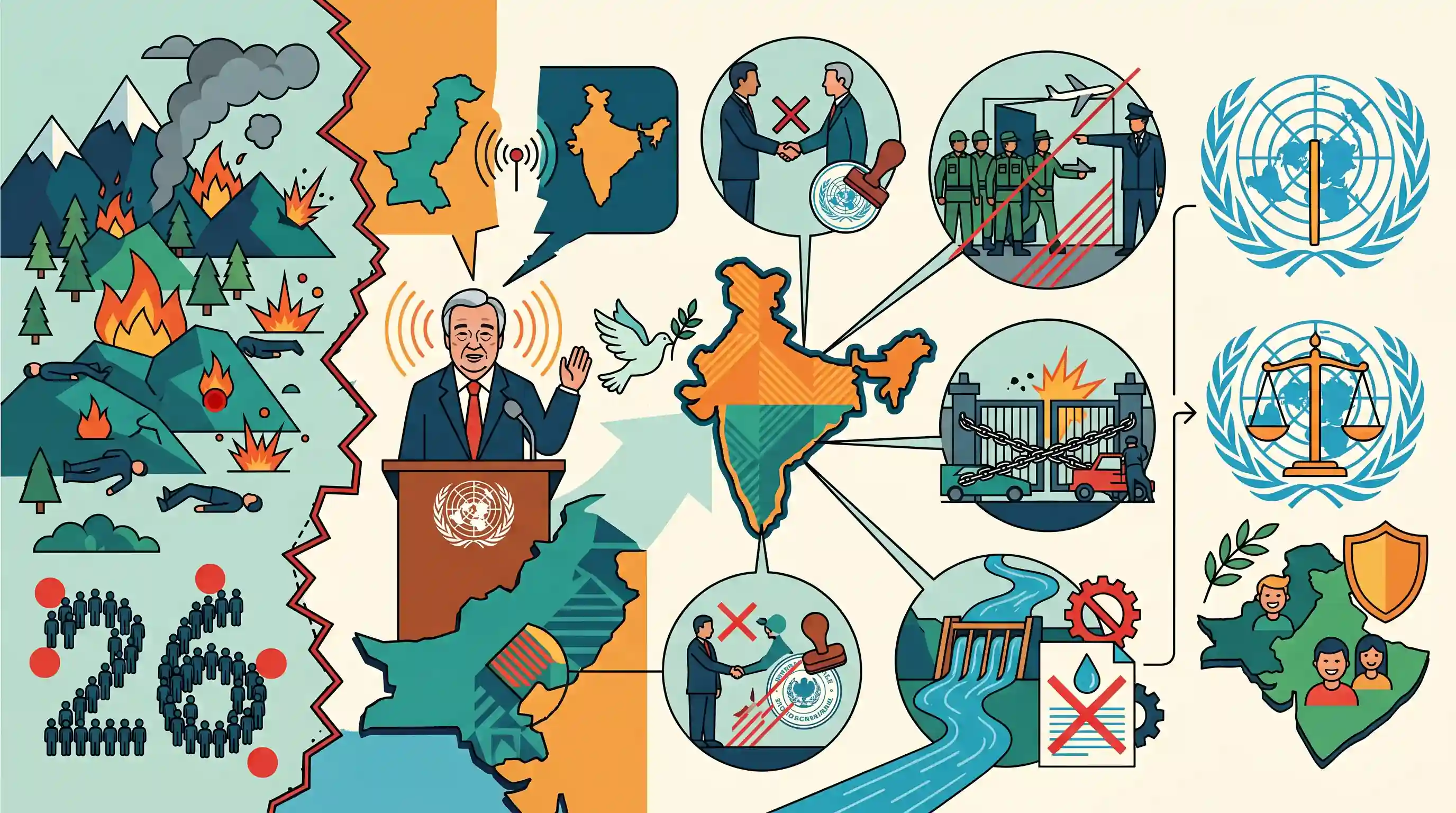
Following a deadly terror attack in Pahalgam, Jammu and Kashmir, that killed 26 civilians, UN Secretary-General Antonio Guterres has urged both India and Pakistan to exercise 'maximum restraint'. India swiftly responded by downgrading diplomatic ties, expelling Pakistani military attaches, closing the Attari land-transit post, and notably suspending the Indus Waters Treaty of 1960. The UN has emphasized peaceful resolution and cautioned against actions that could further deteriorate regional stability.
Key Points
- A terror attack in Pahalgam, Jammu and Kashmir, killed 26 civilians, mostly tourists, marking the deadliest strike in the region since the 2019 Pulwama attack.
- UN Secretary-General Antonio Guterres and UNGA President Philemon Yang strongly condemned the attack, urging India and Pakistan to exercise 'maximum restraint'.
- In retaliation, India downgraded diplomatic ties with Pakistan, expelled Pakistani military attaches, and shut down the Attari land-transit post.
- India suspended the Indus Waters Treaty of 1960, a significant escalation in bilateral tensions.
- The Border Security Force (BSF) scaled down the Beating Retreat ceremony and suspended the traditional handshake with Pakistani soldiers.
Important Terms
Indus Waters Treaty (1960)

A 1960 water-sharing agreement between India and Pakistan mediated by the World Bank, allocating eastern rivers to India and western rivers to Pakistan.
UPSC context
GS Paper II: International Relations. Tests knowledge of transboundary water governance and India-Pakistan bilateral agreements.
United Nations (UN)
The principal international organization established in 1945 to maintain global peace and security, facilitate international law, and promote human rights.
UPSC context
GS Paper II: Important International institutions. Tests understanding of the mandate and role of global agencies in regional conflicts.
Military Attaché
A specialized diplomat representing their home country's defense establishment at an embassy, responsible for bilateral military relations and intelligence gathering.
UPSC context
GS Paper II: International Relations. Relevant for understanding diplomatic structures and methods used to downgrade bilateral ties.
Attari Land-Transit Post
An Integrated Check Post (ICP) near Amritsar, serving as the only legal land route for trade and transit between India and Pakistan.
UPSC context
GS Paper II: Bilateral Relations. Tests knowledge of border infrastructure, strategic geography, and economic impacts of trade suspension.
Vienna Convention on Diplomatic Relations (1961)
A 1961 international treaty defining the framework for diplomatic relations, providing legal immunity to diplomats and allowing host nations to expel personnel.
UPSC context
GS Paper II: International Relations. Fundamental for understanding the legalities of declaring diplomats 'persona non grata'.
Maximum Restraint
A diplomatic phrase used by the United Nations to urge conflicting parties to de-escalate and avoid actions leading to full-scale war.
UPSC context
GS Paper II: International Relations. Tests familiarity with standard diplomatic terminology used by international mediators in crisis management.
Prelims Trap
"The Indus Waters Treaty contains a specific clause allowing unilateral suspension in cases of cross-border terrorism."
The IWT lacks any unilateral exit or suspension clause. Suspending it is a political measure invoking general international law (like the Vienna Convention), not an exercise of treaty provisions.
Static Concepts Connected
What are the water allocation rules under the 1960 Indus Waters Treaty?
- Eastern Rivers: Ravi, Beas, and Sutlej are allocated for exclusive, unrestricted use by India.
- Western Rivers: Indus, Jhelum, and Chenab are allocated to Pakistan, but India retains rights for limited agricultural and non-consumptive uses like run-of-the-river hydroelectricity.
- Dispute Resolution: Created the Permanent Indus Commission (PIC), requiring commissioners from both sides to meet regularly to resolve technical differences.
What is the significance of the 1972 Simla Agreement for India's diplomatic stance?
- Bilateral Resolution: India and Pakistan committed to resolving their differences peacefully and exclusively through bilateral negotiations.
- Rejection of Mediation: India uses this bilateral commitment to consistently reject third-party mediation, including by the UN, rendering historical UN resolutions on Kashmir effectively moot.
- Line of Control: Converted the 1949 UN ceasefire line into the mutually recognized Line of Control (LoC).
Cross-Topic Patterns
Weaponization of upper-riparian geography
Suspending the Indus Waters Treaty links internal security responses to cross-border hydro-diplomacy, marking a shift toward utilizing upper-riparian geographical advantages as coercive leverage against state-sponsored terrorism.
Soft targets and economic normalization
Targeting civilian tourists connects internal security to economic geography. It aims to disrupt J&K's post-Article 370 tourism boom, reversing state-led livelihood and 'hearts and minds' normalization initiatives.

Expect a 2026 Mains question examining the legality and strategic efficacy of suspending the Indus Waters Treaty as a coercive diplomatic tool.
Linked PYQs · 5
Linked PYQs · 5
- 2015MainsGS2
Terrorist activities and mutual distrust have clouded India-Pakistan relations. To what extent the use of soft power like sports and cultural exchanges could help generate goodwill between the two countries? Discuss with suitable examples.
- 2016MainsGS2
Increasing cross-border terrorist attacks in India and growing interference in the internal affairs of several member-states by Pakistan are not conducive for the future of SAARC (South Asian Association for Regional Cooperation)." Explain with suitable examples.
- 2012MainsGS2
The situation today is far different to that prevalent fifty years back when the Indus Water Treaty was signed." Highlight the complexity of the current challenges on both sides of the border in this regard. Do you think that a review of the Treaty is in India's best interests?
- 2023MainsGS3
Winning of 'Hearts and Minds' in terrorism-affected areas is an essential step in restoring the trust of the population. Discuss the measures adopted by the Government in this respect as part of the conflict resolution in Jammu and Kashmir.
- 2025MainsGS3
Terrorism is a global scourge. How has it manifested in India? Elaborate with contemporary examples. What are the counter measures adopted by the State? Explain.
