India Shares Intelligence Dossier On Pakistan Link To Pahalgam Attack
Source:Indian Express ↗
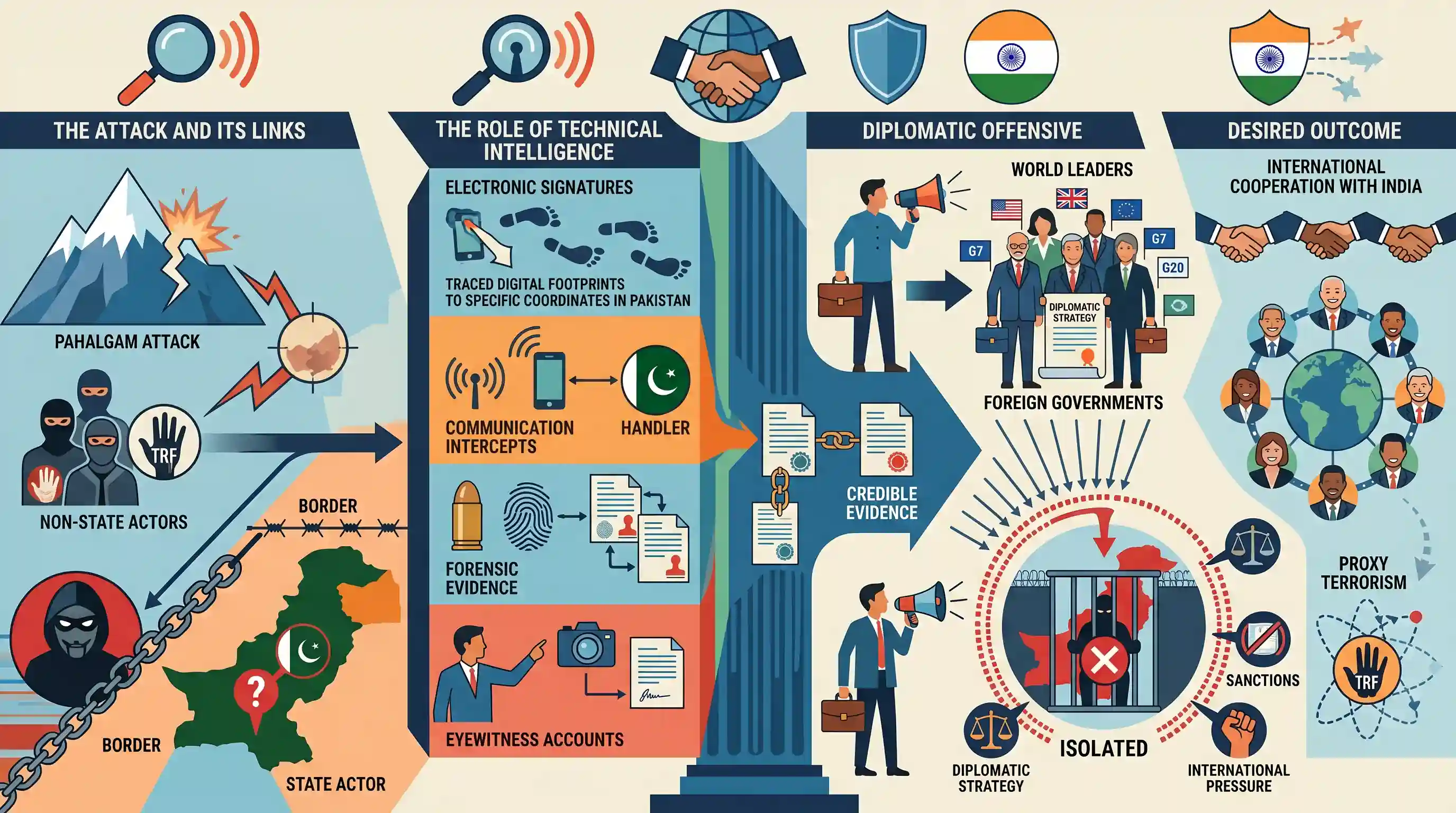
Why It Matters
Illustrates the intersection of internal security and foreign policy, specifically how intelligence gathering (TECHINT) is utilized as a diplomatic tool to counter state-sponsored terrorism on the global stage.
Summary
In the aftermath of the Pahalgam terror attack, India has leveraged technical intelligence and other credible inputs to establish a definitive link to Pakistan. New Delhi is actively sharing this evidence with foreign governments as part of a diplomatic campaign to expose Pakistan's role in state-sponsored terrorism. This move not only seeks to isolate Pakistan internationally but also underscores the crucial role of technical intelligence in substantiating claims of cross-border terrorism and shaping India's diplomatic strategy.
Key Points
- Following a terror attack in Pahalgam, India has gathered conclusive technical intelligence (TECHINT) and other credible inputs confirming Pakistan's involvement.
- The Indian government has initiated a diplomatic outreach, sharing this intelligence dossier with foreign governments.
- This strategy aims to expose Pakistan's continued support for cross-border terrorism and build international consensus against state-sponsored terror.
- The development underscores India's dual approach to counter-terrorism: robust intelligence gathering at home and aggressive diplomatic pressure abroad.
Important Terms
External State and Non-State Actors

Entities outside a country that influence its security. State actors are foreign governments/agencies (e.g., ISI); non-state actors are independent groups like terrorist outfits (e.g., LeT) or insurgencies.
UPSC context
GS Paper 3: Core syllabus topic regarding internal security challenges and managing India's volatile neighborhood.
State-sponsored Terrorism
The provision of funding, training, logistics, or sanctuary by a sovereign state to violent groups to achieve foreign policy goals while maintaining plausible deniability.
UPSC context
GS Paper 3: Tests understanding of asymmetric warfare and India-Pakistan security dynamics.
Technical Intelligence (TECHINT)
Intelligence gathered through technical means, including signals (SIGINT), imagery (IMINT), and analysis of electronic data to identify threats, weapon capabilities, or perpetrator identities.
UPSC context
GS Paper 3: Modern intelligence-gathering tools for internal security and counter-terrorism.
Cross-border Terrorism
Terrorism originating in one country but executed in another, involving the illicit movement of personnel, weapons, or funds across international borders.
UPSC context
GS Paper 3: Major security challenge specifically regarding Jammu & Kashmir and border management.
Diplomatic Isolation
A strategy designed to sever a target nation's international ties and legitimacy in order to pressure it into stopping hostile activities like terrorism.
UPSC context
GS Paper 2: India's strategic foreign policy response to state-sponsored terrorism.
Prelims Trap
The Comprehensive Convention on International Terrorism (CCIT) has been formally adopted by the UNGA.
India proposed the CCIT in 1996, but it remains stalled. The UN has NOT adopted it due to disagreements among member states over a universal definition of terrorism and 'freedom fighters'.
Static Concepts Connected
What is the mandate of the National Technical Research Organisation (NTRO)?
- Apex TECHINT agency: Functions under the National Security Advisor (NSA) in the PMO, operating as India's apex technical intelligence agency.
- SIGINT focus: Gathers Signals Intelligence (SIGINT) and Imagery Intelligence (IMINT), leaving Human Intelligence (HUMINT) gathering to RAW and IB.
- Cyber security role: Houses the National Critical Information Infrastructure Protection Centre (NCIIPC), making it vital for national cyber defense.
What is the Comprehensive Convention on International Terrorism (CCIT)?
- Indian initiative: A draft treaty proposed by India at the UN in 1996 to establish a universal, legally binding definition of terrorism.
- Key obstacle: Stalled largely over OIC and Western disagreements on defining terrorism, specifically exceptions demanded for 'national liberation movements'.
- Core objectives: Aims to criminalize all terror acts universally, cut off state-sponsored terrorist funding, and extradite offenders by denying safe havens.
Cross-Topic Patterns
Dossier diplomacy and FATF grey-listing
Intelligence sharing with foreign governments feeds directly into India's strategy to influence FATF plenary sessions, building international pressure to impose financial sanctions on state-sponsors of terror.
TECHINT and cyber security architecture
Agencies like NTRO that gather technical intelligence (SIGINT) for counter-terrorism are also pivotal in safeguarding India's critical information infrastructure against state-sponsored cyber warfare.

Expect a GS-3 question evaluating 'dossier diplomacy' & TECHINT vs FATF/UN designations in neutralizing state-sponsored proxy warfare.
Linked PYQs · 3
Linked PYQs · 3
- 2025MainsGS3
Terrorism is a global scourge. How has it manifested in India? Elaborate with contemporary examples. What are the counter measures adopted by the State? Explain.
- 2023MainsGS3
What are the internal security challenges being faced by India? Give out the role of Central Intelligence and Investigative Agencies tasked to counter such threats.
- 2015MainsGS2
Terrorist activities and mutual distrust have clouded India-Pakistan relations. To what extent the use of soft power like sports and cultural exchanges could help generate goodwill between the two countries? Discuss with suitable examples.
