Legislative and Diplomatic Strategy Post Pahalgam Attack
Source:The Hindu ↗
Why It Matters
The article highlights practical legislative and diplomatic strategies—such as leveraging India's market size, sending bipartisan parliamentary delegations, and approaching the UNSC—that can be utilized in India's foreign policy toolkit to counter cross-border terrorism and isolate state sponsors of terror globally.
Summary
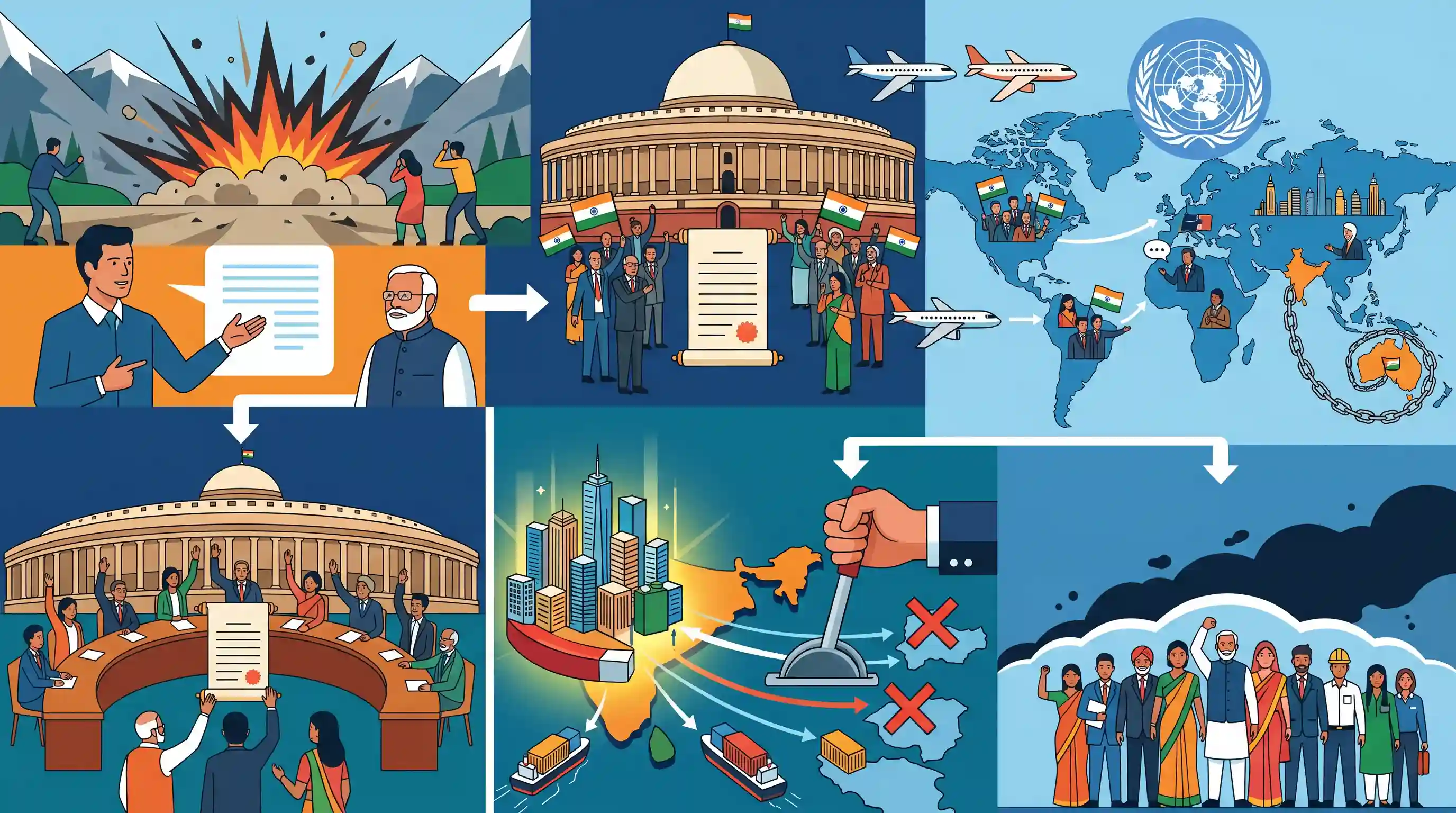
Following the Pahalgam terror attack, Rajya Sabha MP Kapil Sibal proposed a series of diplomatic and legislative measures to hold Pakistan accountable. He urged the Prime Minister to convene a special session of Parliament to pass a unanimous resolution against the attack. Furthermore, Sibal suggested dispatching cross-party parliamentary delegations to major countries and the UN Security Council to isolate Pakistan diplomatically. He also advocated for leveraging India's market power by threatening economic repercussions against nations that continue to trade with Pakistan, while emphasizing the importance of a united national front against terrorism.
Key Points
- Rajya Sabha MP Kapil Sibal urged PM Modi to call a special session of Parliament to pass a unanimous resolution condemning the recent Pahalgam terror attack.
- He suggested sending bipartisan parliamentary delegations to key global capitals to expose Pakistan's role in state-sponsored terrorism and mount international diplomatic pressure.
- Sibal proposed leveraging India's massive consumer market by forcing major nations to choose between trading with India or Pakistan.
- He recommended approaching the UN Security Council to build a global consensus against Pakistan and to pressure China into clarifying its stance on its ally.
- The former Union Minister emphasized the need for national unity and urged political parties not to exploit terrorism for electoral gains.
Important Terms
Special Session of Parliament

A session summoned outside the regular three-session calendar. While not defined in the Constitution, Article 85(1) empowers the President to summon Parliament as they think fit on Cabinet advice.
UPSC context
GS Paper II: Parliament and State Legislatures. Tests knowledge of constitutional provisions for summoning, prorogation, and conduct of business.
United Nations Security Council (UNSC)
The UN body responsible for global peace and security, consisting of five permanent members (P5) with veto power and ten rotating non-permanent members.
UPSC context
GS Paper II: International institutions. Tests understanding of India's role in global governance and diplomatic efforts to sanction terror.
Parliamentary Resolution
A formal motion passed by a House of Parliament to express a collective opinion, decision, or recommendation on matters of public interest or national policy.
UPSC context
GS Paper II: Parliamentary devices. Tests knowledge of how the legislature signals consensus on national security and foreign policy.
Diplomatic Isolation
The use of diplomatic pressure and international forums to sever or reduce a target nation's ties with other countries, often as a response to security threats.
UPSC context
GS Paper II: India and its neighborhood. Tests strategy regarding 'coercive diplomacy' and the policy of 'Terror and Talks don't go together'.
Cross-party Parliamentary Delegation
Groups of MPs from multiple political parties sent on foreign missions to represent a unified national front on critical issues like sovereignty and counter-terrorism.
UPSC context
GS Paper II: Functions of the Union. Highlights the role of 'parliamentary diplomacy' in projecting soft power and domestic political unity.
Comprehensive Convention on International Terrorism (CCIT)
A legal framework proposed by India at the UN in 1996 to provide a universal definition of terrorism and facilitate global prosecution/extradition of terrorists.
UPSC context
GS Paper III: Internal Security. Tests India's proactive role in global counter-terror legal regimes and challenges from non-state actors.
Prelims Trap
The Constitution explicitly defines the grounds and procedures for calling a 'Special Session' of Parliament.
The Constitution does not mention 'Special Session'. Under Article 85, the President simply summons Parliament based on the Cabinet Committee on Parliamentary Affairs' advice.
Static Concepts Connected
What is the constitutional basis for a "Special Session" of Parliament?
- Constitutional silence: The Constitution lacks the explicit term 'Special Session'. Article 85 merely empowers the President to summon Parliament to meet at such time and place as he thinks fit.
- Executive prerogative: The Cabinet Committee on Parliamentary Affairs decides to convene the session. The President then formally issues the summons to MPs.
- Historical precedents: Past special sittings include the 2017 GST rollout, the 50th anniversary of Independence in 1997, and the 2023 shift to the new Parliament building.
How does the UNSC 1267 Sanctions Committee function against global terrorism?
- Global mandate: It oversees asset freezes, travel bans, and arms embargoes against individuals and entities tied to ISIL (Da'esh) and Al-Qaida.
- Technical holds: Decisions require consensus. P5 members, notably China, frequently use 'technical holds' to block or delay India's requests to designate Pakistan-based terrorists.
Cross-Topic Patterns
Economic Statecraft and IR
Leveraging India's massive consumer market to force trade ultimatums on allies of Pakistan connects GS-3 economic scale with GS-2 hard-power diplomacy.
Parliamentary Diplomacy in Security
Deploying bipartisan delegations to foreign capitals acts as a Track-1.5 diplomatic tool, augmenting the executive's foreign policy to isolate state sponsors of terror.

Expect a Prelims statement on Article 85 'Special Sessions' alongside a Mains question on using economic statecraft for internal security.
Linked PYQs · 3
Linked PYQs · 3
- 2021MainsGS3
Analyse the multidimensional challenges posed by external state and non-state actors, to the internal security of India. Also discuss measures required to be taken to combat these threats.
- 2015MainsGS2
Terrorist activities and mutual distrust have clouded India-Pakistan relations. To what extent the use of soft power like sports and cultural exchanges could help generate goodwill between the two countries? Discuss with suitable examples.
- 2024MainsGS2
‘Terrorism has become a significant threat to global peace and security.’ Evaluate the effectiveness of the United Nations Security Council's Counter Terrorism Committee (CTC) and its associated bodies in addressing and mitigating this threat at the international level.
