Kapil Sibal urges special parliament session after Pahalgam attack
Source:The Hindu ↗
Why It Matters
The incident and subsequent proposals highlight the vital intersection of domestic political consensus, internal security, and aggressive diplomatic statecraft. For UPSC aspirants, it demonstrates how parliamentary tools and global economic measures (like trade sanctions) can be weaponized in foreign policy to combat state-sponsored terrorism, reflecting core themes in GS Paper 2 (IR) and GS Paper 3 (Security).
Summary
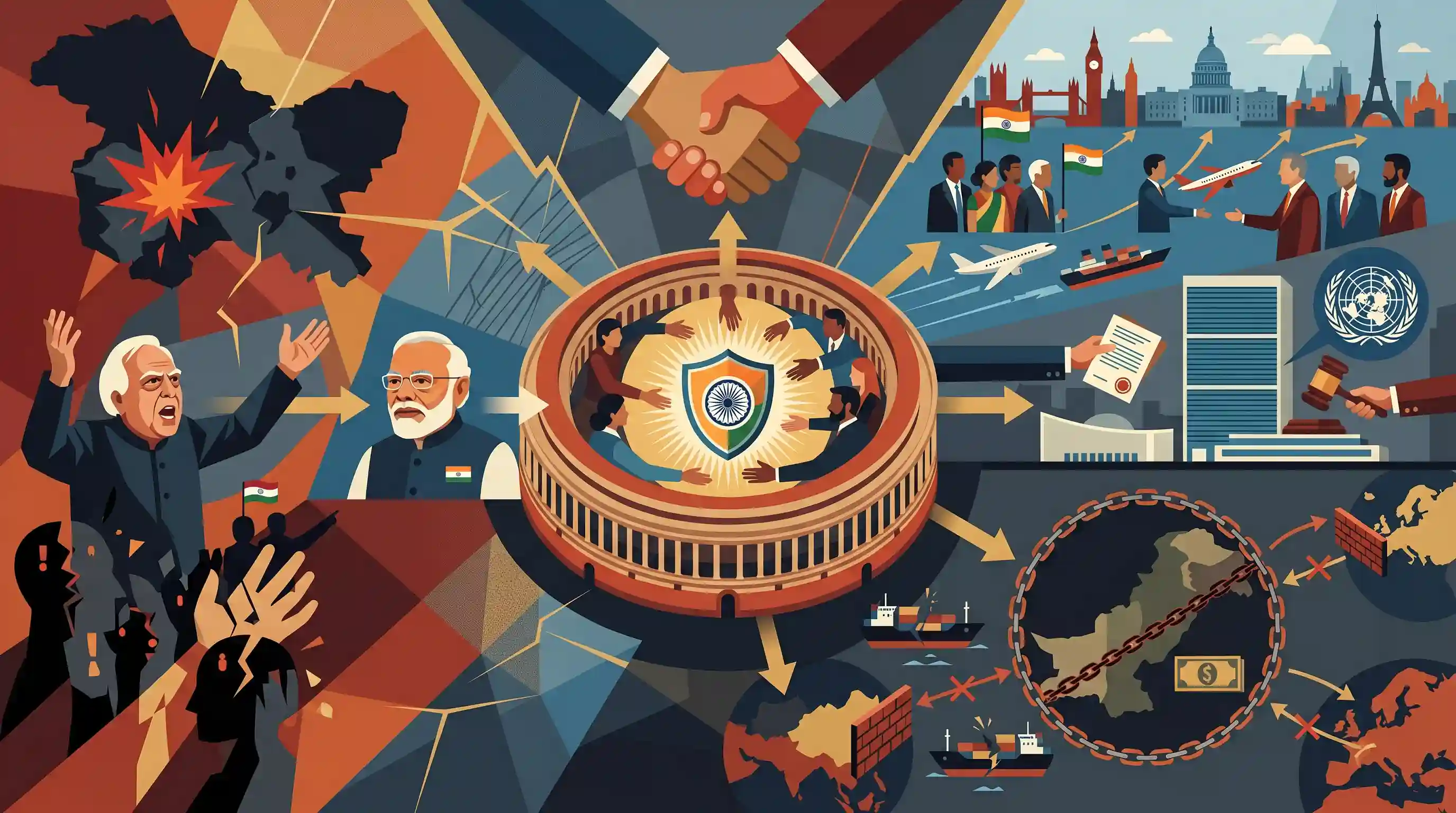
Following the tragic Pahalgam terror attack in Jammu & Kashmir that claimed 26 lives, Rajya Sabha MP Kapil Sibal has called upon Prime Minister Narendra Modi to hold a special session of Parliament. Sibal emphasized the need for a unanimous parliamentary resolution to showcase national unity against terrorism. Furthermore, he recommended robust diplomatic and economic strategies, including sending cross-party delegations abroad, pushing for a UNSC resolution, and imposing secondary trade sanctions on countries dealing with Pakistan to isolate it globally.
Key Points
- Rajya Sabha MP Kapil Sibal has urged PM Modi to convene a special session of Parliament to pass a unanimous resolution condemning the Pahalgam terror attack.
- He proposed sending multi-party parliamentary delegations to various countries to globally expose Pakistan\'s role in state-sponsored terrorism.
- Suggested utilizing secondary trade sanctions, modeled on US practices, against nations that continue to trade with Pakistan, effectively isolating it economically.
- Emphasized the need for India to push for a United Nations Security Council (UNSC) resolution to build international pressure against cross-border terrorism.
- Highlighted that the persistent nature of such attacks requires a united, non-partisan national front to demonstrate strong resolve to the international community.
Important Terms
Pahalgam Terror Attack

A major terror incident on April 22, 2025, in Jammu & Kashmir, where terrorists killed 26 people, primarily tourists. It triggered a massive military and diplomatic response from India.
UPSC context
GS Paper III (Internal Security). Tests understanding of cross-border terrorism, its impact on regional stability, and the state's multi-dimensional response.
Special Session of Parliament
A non-regular meeting of Parliament convened by the government for urgent or specific national matters. While not defined in the Constitution, it is summoned by the President under Article 85(1).
UPSC context
GS Paper II (Indian Polity). Tests knowledge of parliamentary procedures, constitutional provisions (Article 85), and the executive's power to summon the legislature.
Operation Sindoor
India's military retaliation against terror infrastructure following the 2025 Pahalgam attack. It aimed to neutralize cross-border threats and demonstrate a zero-tolerance policy toward terrorism.
UPSC context
GS Paper III (Internal Security). Relevant for analyzing India's counter-terrorism doctrine, military preparedness, and the "right of self-defense" under international law.
All-Party Delegation
A diplomatic outreach group comprising members from both ruling and opposition parties. It is used to project a unified national front on critical foreign policy issues like terrorism.
UPSC context
GS Paper II (International Relations). Tests understanding of "parliamentary diplomacy" and the importance of political consensus in shaping India's global narrative.
United Nations Security Council (UNSC)
The principal UN organ responsible for international peace. India frequently utilizes this forum to push for global counter-terrorism frameworks and the listing of cross-border terror entities.
UPSC context
GS Paper II (International Institutions). Tests knowledge of global security governance and India’s efforts to strengthen international law against terrorism.
Secondary Sanctions
Trade penalties imposed on third-party countries or entities that continue to do business with a sanctioned nation, aimed at achieving total economic isolation of the target state.
UPSC context
GS Paper II (Foreign Policy/IR). Tests understanding of coercive diplomacy, economic statecraft, and India’s potential strategies to isolate sponsors of terrorism.
Prelims Trap
"The Constitution of India explicitly defines the procedure to convene a 'Special Session' of Parliament."
The Constitution (Article 85) only mandates a maximum six-month gap between sessions. "Special Session" is merely a parliamentary convention and a government term, not a constitutional provision.
Static Concepts Connected
What is the constitutional basis for summoning a Special Session of Parliament?
- Article 85(1): Empowers the President to summon Parliament, provided the gap between two sessions does not exceed six months.
- No constitutional mention: The term "Special Session" is a political convention. It is not found in the Constitution or the parliamentary Rules of Procedure.
- CCPA role: The decision to convene any session is taken by the Cabinet Committee on Parliamentary Affairs, formalized by the President.
How do secondary trade sanctions differ from standard UN measures?
- Unilateral vs Multilateral: UNSC sanctions (like the 1267 regime) are binding multilateral resolutions, whereas secondary sanctions are usually unilateral domestic laws applied extraterritorially.
- Third-party targeting: Secondary sanctions penalize neutral third-party countries or firms for trading with the primary sanctioned nation.
- India's official stance: India legally recognizes only UN-mandated multilateral sanctions, typically rejecting unilateral secondary sanctions (like US CAATSA) to maintain its strategic autonomy.
Cross-Topic Patterns
Parliamentary diplomacy + Soft Power
Using multi-party delegations for diplomatic outreach blends domestic legislative structures with executive foreign policy, often utilized to build non-partisan international consensus on issues like state-sponsored terrorism.
UNSC resolutions vs CCIT deadlock
Calls for new UNSC resolutions against state-sponsored terror highlight the continued gridlock on India's 1996 proposal for a Comprehensive Convention on International Terrorism (CCIT) over definitional disputes.

UPSC 2026 could merge Art 85 (Parliamentary sessions) and extraterritorial secondary sanctions into a multi-statement conceptual question.
Linked PYQs · 3
Linked PYQs · 3
- 2023MainsGS3
Winning of 'Hearts and Minds' in terrorism-affected areas is an essential step in restoring the trust of the population. Discuss the measures adopted by the Government in this respect as part of the conflict resolution in Jammu and Kashmir.
- 2024MainsGS2
‘Terrorism has become a significant threat to global peace and security.’ Evaluate the effectiveness of the United Nations Security Council's Counter Terrorism Committee (CTC) and its associated bodies in addressing and mitigating this threat at the international level.
- 2016MainsGS2
Increasing cross-border terrorist attacks in India and growing interference in the internal affairs of several member-states by Pakistan are not conducive for the future of SAARC (South Asian Association for Regional Cooperation)." Explain with suitable examples.
