Government Evaluates Strategic Retaliatory Options Post Pahalgam
Source:Indian Express ↗
Why It Matters
Understanding the spectrum of state responses to terrorism—ranging from diplomatic isolation to military retaliation (like surgical strikes)—is crucial for the Internal Security and International Relations syllabus, frequently tested in UPSC GS3 and GS2.
Summary
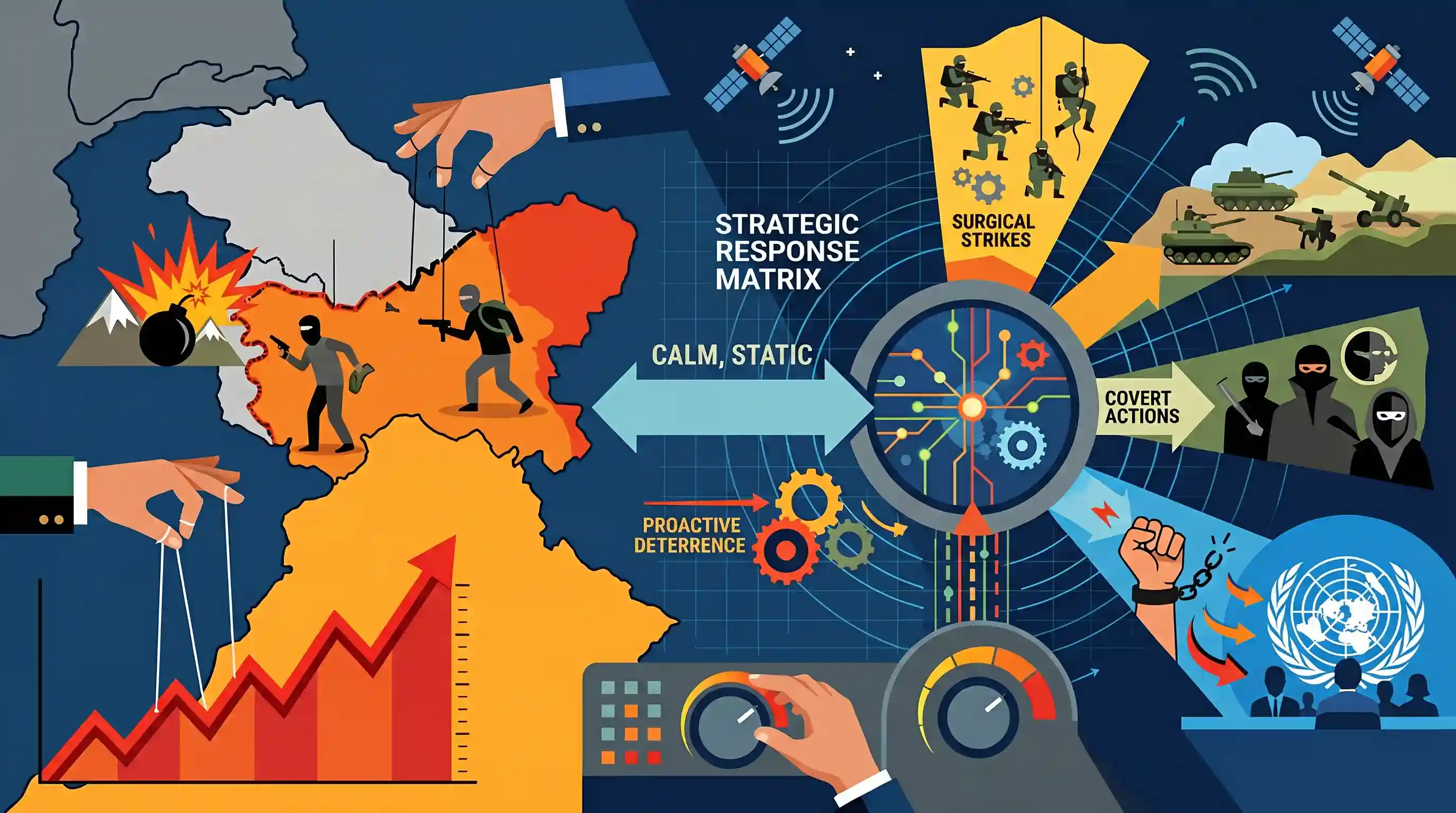
The article details the Indian government's strategic response matrix following the Pahalgam terrorist attack in Jammu & Kashmir. Having initiated diplomatic actions to isolate the orchestrators internationally, the government is now weighing a range of retaliatory options. These options potentially include surgical strikes, cross-border kinetic operations, and covert actions aimed at neutralizing terrorist infrastructure. The situation highlights India's evolving strategic posture towards cross-border terrorism—shifting from strategic restraint to proactive deterrence—while managing the complex escalatory dynamics of the India-Pakistan relationship.
Key Points
- The government is evaluating a spectrum of retaliatory options, potentially including cross-border kinetic actions or surgical strikes, in response to the Pahalgam terrorist attack.
- Diplomatic maneuvers are being executed in tandem to internationally isolate the state and non-state actors responsible for orchestrating the attack.
- The incident emphasizes the persistent internal security challenge of cross-border and state-sponsored terrorism in Jammu & Kashmir.
- Any retaliatory military action requires a careful strategic calculus, balancing the need for strong deterrence against the risks of broader regional escalation.
Prelims Trap
The Financial Action Task Force (FATF) is a specialized agency of the United Nations.
FATF is an intergovernmental body established by the G7, not a UN agency. Aspirants often confuse its mandate with the UN Security Council's 1267 Sanctions Committee.
Static Concepts Connected
What is 'Grey-Zone Warfare' in the context of internal security?
- Asymmetric tactics: It utilizes non-state proxies, cyberattacks, and targeted disinformation to achieve geopolitical objectives.
- Below conventional threshold: Operations are carefully calibrated to remain below the threshold of formal armed conflict, preventing traditional military retaliation.
- Plausible deniability: Sponsor states deliberately maintain distance from their proxies to evade direct international legal accountability.
Which key international mechanisms are leveraged to isolate state-sponsored terrorism?
- UNSC 1267 Committee: Imposes targeted global sanctions, including asset freezes and travel bans, on designated terrorist individuals and proxy organizations.
- FATF Standards: An intergovernmental policy-making body that sets global standards to combat money laundering and terror financing.
- CCIT Proposal: India's long-pending proposed UN treaty aimed at providing a universal, legally binding definition of terrorism.
Cross-Topic Patterns
Counter-terror + WHAM governance
Kinetic operations provide short-term deterrence, but long-term internal security relies on 'Winning Hearts and Minds' (WHAM) through socio-economic schemes like HIMAYAT to sever local insurgent support.
FATF sanctions + Economic shockwaves
Diplomatic efforts to push a sponsor state onto the FATF grey-list severely cripple its economy by downgrading sovereign ratings and restricting access to IMF/World Bank bailout packages.

Expect a GS3 Mains question evaluating India's shift from strategic restraint to proactive deterrence in managing proxy grey-zone warfare.
Linked PYQs · 5
Linked PYQs · 5
- 2016MainsGS3
The terms 'Hot Pursuit' and 'Surgical Strikes' are often used in connection with armed action against terrorist attacks. Discuss the strategic impact of such actions.
- 2025MainsGS3
Terrorism is a global scourge. How has it manifested in India? Elaborate with contemporary examples. What are the counter measures adopted by the State? Explain.
- 2023MainsGS3
Winning of 'Hearts and Minds' in terrorism-affected areas is an essential step in restoring the trust of the population. Discuss the measures adopted by the Government in this respect as part of the conflict resolution in Jammu and Kashmir.
- 2016MainsGS2
Increasing cross-border terrorist attacks in India and growing interference in the internal affairs of several member-states by Pakistan are not conducive for the future of SAARC (South Asian Association for Regional Cooperation)." Explain with suitable examples.
- 2015MainsGS2
Terrorist activities and mutual distrust have clouded India-Pakistan relations. To what extent the use of soft power like sports and cultural exchanges could help generate goodwill between the two countries? Discuss with suitable examples.
