President Droupadi Murmu Confers Sixty Six Padma Awards for 2026
Source:The Hindu ↗
Why It Matters
Padma awards highlight India's highest civilian honors (post-Bharat Ratna), reflecting the state's recognition of exceptional service and achievements across art, social work, public affairs, science, trade, medicine, literature, sports, and civil service. For UPSC, the specific contributions of the awardees, especially in art, culture (e.g., 'Gayaki Ang', 'Avadhana', Silambam, Kantha embroidery), and social service, often form the basis for Prelims questions on traditional heritage or current events. The constitutional aspects of these awards (Article 18) are also a classic polity topic.
Summary
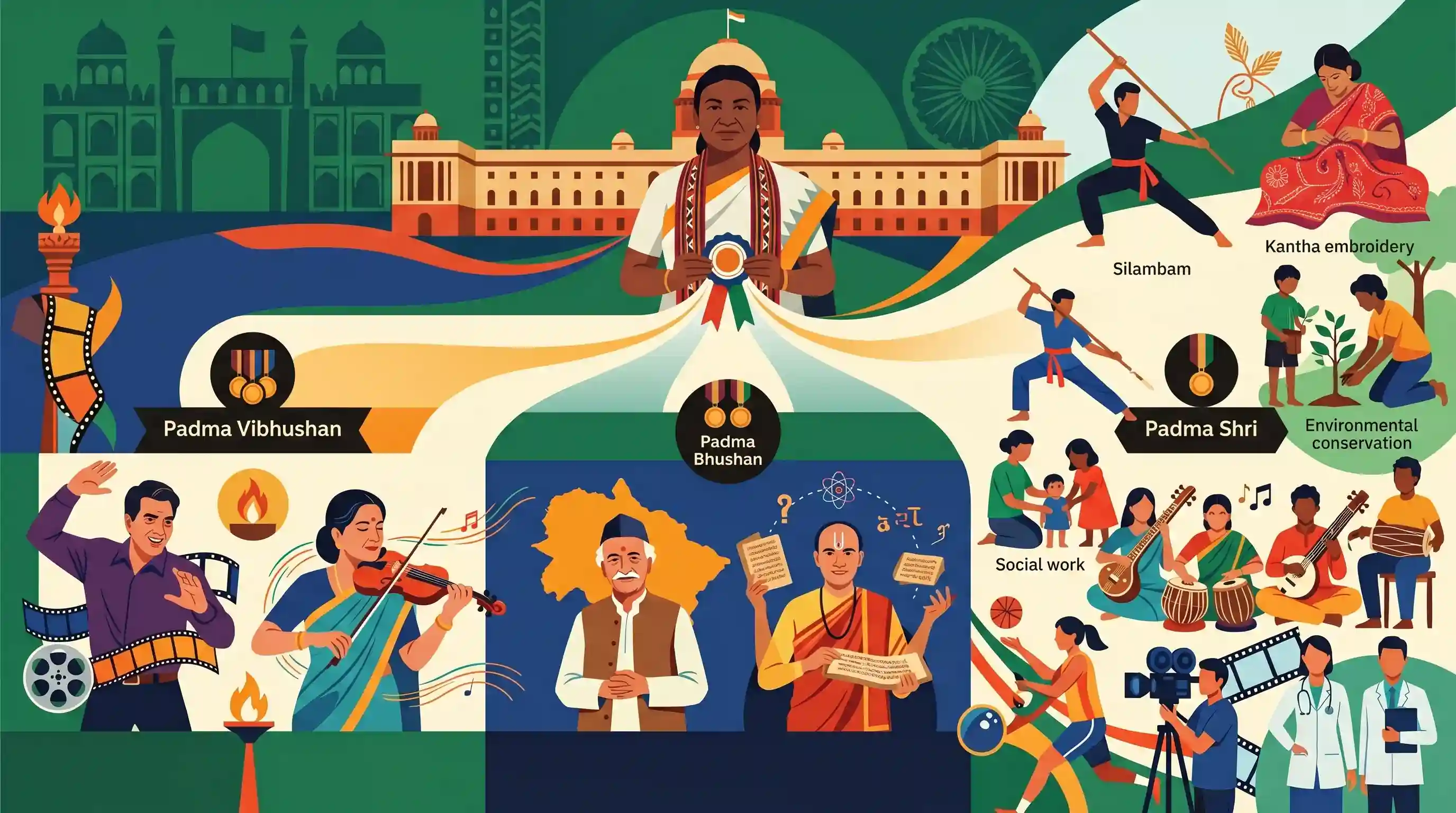
President Droupadi Murmu conferred 66 of the 131 Padma awards for 2026 at Rashtrapati Bhavan. The awards honored notable figures across various disciplines. Padma Vibhushans were awarded to actor Dharmendra (posthumously) and violin virtuoso N. Rajam (who pioneered 'Gayaki Ang'). Padma Bhushans were given to individuals like former Uttarakhand CM Bhagat Singh Koshyari and 'Avadhana' revivalist Shatavadhani R. Ganesh. The Padma Shri recognized grassroots achievers in traditional arts (like Silambam and Kantha embroidery), social work, environment, and classical and folk music, as well as prominent figures in sports, cinema, and public service.
Key Points
- President Droupadi Murmu presented 66 Padma awards at the Civil Investiture Ceremony-I held at Rashtrapati Bhavan.
- For 2026, 131 Padma awards were approved, including five Padma Vibhushan, 13 Padma Bhushan, and 113 Padma Shri.
- Actor Dharmendra (posthumously) and violinist N. Rajam received the Padma Vibhushan.
- N. Rajam is known for introducing the 'Gayaki Ang' technique in violin, earning the title 'Singing Violin'.
- Padma Bhushan awardees included Bhagat Singh Koshyari, Shatavadhani R. Ganesh, Uday Suresh Kumar Kotak, Kallipatti Ramasamy Palaniswamy, Vijay Kumar Malhotra (posthumously), and Piyush Pandey (posthumously).
- Shatavadhani R. Ganesh was recognized for reviving the classical art form of 'Avadhana'.
- Padma Shri recipients represented various fields including cinema (Prosenjit Chatterjee), sports (Harmanpreet Kaur Bhullar, Praveen Kumar, Baldev Singh), administration (K. Vijay Kumar), music and art (Mir Haji Kasam, N. Swaminathan, Taga Ram Bheel, Tripti Mukherjee), martial arts (K. Pajanivel for Silambam), social work (Janardan Bapurao Bothe, Dr. Ramchandra Godbole, Suneeta Godbole), environment (Devaki Amma G., Hally War), literature/education (Ankegowda M., Vempaty Kutumba Shastry), and botany (Gambir Singh Yonzone).
Important Terms
Padma Awards

India's highest civilian honors (Vibhushan, Bhushan, Shri) announced annually on Republic Day for distinguished service in various fields like arts, social work, and public affairs.
UPSC context
GS Paper II (Governance) and GS Paper I (Art and Culture); tests knowledge of national recognition and institutional honors.
Padma Vibhushan
The second-highest civilian award in India, conferred for 'exceptional and distinguished service.' It ranks just below the Bharat Ratna.
UPSC context
Prelims (Current Affairs) and GS II (Awards and Honors); identifies the hierarchy and criteria for top national honors.
Padma Bhushan
The third-highest civilian award in India, presented for 'distinguished service of a high order' across various disciplines.
UPSC context
Prelims and GS I/II; relevant for tracking prominent personalities and their contributions to Indian society.
Padma Shri
The fourth-highest civilian award in India, recognizing 'distinguished service' in any field. It is frequently awarded to grassroots 'unsung heroes.'
UPSC context
Prelims and GS I; tests awareness of significant cultural, social, and professional achievements by diverse citizens.
Gayaki Ang
A style in Indian classical instrumental music that replicates the emotional range, microtonal nuances, and intonations of the human voice.
UPSC context
GS Paper I (Indian Culture - Music); tests understanding of technical nuances in Hindustani classical music traditions.
Silambam
An ancient weapon-based martial art from Tamil Nadu, primarily utilizing a bamboo staff (Silambu). It is mentioned in Sangam literature.
UPSC context
GS Paper I (Art and Culture); important for regional martial arts, ancient traditions, and Sangam-era cultural history.
Kantha
A traditional running-stitch embroidery from Bengal and Odisha, historically used to repurpose old fabrics like dhotis and saris into quilts.
UPSC context
GS Paper I (Art and Culture - Handicrafts); relevant for folk traditions, textile heritage, and socio-economic history of rural women.
Prelims Trap
Padma Awards are considered 'titles' under Article 18(1) of the Constitution.
The Supreme Court (Balaji Raghavan vs UoI, 1995) explicitly ruled that National Awards are civilian honors, not titles, and cannot be used as prefixes/suffixes.
Static Concepts Connected
How does Article 18 regulate titles and civilian awards?
- State Prohibition: Article 18 prohibits the State from conferring titles, excluding military and academic distinctions.
- Foreign Titles: Citizens of India are constitutionally barred from accepting any title from a foreign State.
- SC Ruling: The 1995 Balaji Raghavan judgment upheld Padma awards as valid, provided they aren't used as name prefixes or suffixes.
What are the cultural traditions recognized in recent Padma awards?
- Gayaki Ang: A Hindustani instrumental technique replicating the fluid, expressive nuances of human vocals, particularly glides (meend).
- Avadhana: A cognitive performance art (prominent in Telugu/Kannada) involving simultaneous poetic composition and complex Q&A from scholars.
- Silambam: An ancient staff-based martial art from Tamil Nadu with roots in the Sangam era (mentioned in Silappadikaram).
Cross-Topic Patterns
Padma Shri + Intangible Heritage mapping
UPSC routinely extracts regional crafts and martial arts (like Kantha and Silambam) from grassroots Padma awardee profiles to frame 'match-the-following' cultural heritage questions.
Civilian Honors + Fundamental Duties
Recognition of grassroots innovators is often linked conceptually to Article 51A(j) — the fundamental duty to strive towards excellence in all spheres of individual and collective activity.

Expect a "Pairs" question in Prelims 2026 matching specific traditional arts (Silambam, Avadhana, Kantha) to their home states/regions.
Linked PYQs · 3
Linked PYQs · 3
- 2021PrelimsGS1
Consider the following statements in respect of Bharat Ratna and Padma Awards : 1. Bharat Ratna and Padma Awards are titles under the Article 18(1) of the Constitution of India. 2. Padma Awards, which were instituted in the year 1954, were suspended only once. 3. The number of Bharat Ratna Awards is restricted to a maximum of five in a particular year. Which of the above statements are not correct?
- 2000PrelimsGS1
Match List I with List II and select the correct answer using the codes given below the Lists: List I (Artist) (Medium of music delivery) I. Balamurali Krishna A) Hindustani vocal II. Mita Pandit B) Ghatam III. Kanyakumari C) Sitar IV. Nikhil Bannerjee D) Violin E) Carnatic vocal Codes:
- 2023PrelimsGS1
Consider the following pairs with regard to sports awards: 1. Major Dhyan Chand Khel Ratna Award : For the most spectacular and outstanding performance by a sportsperson over period of last four years 2. Arjuna Award : For the lifetime achievement by a sportsperson 3. Dronacharya Award : To honour eminent coaches who have successfully trained sportspersons or teams 4. Rashtriya Khel Protsahan Puraskar : To recognize the contribution made by sportspersons even after their retirement How many of the above pairs are correctly matched?
