Haryana Paddy Procurement Schedule and Rice Miller Relief Measures
Source:Indian Express ↗
Why It Matters
Provides a practical case study of agricultural supply chain management, highlighting how state policies, miller logistics, and central procurement agencies like FCI intersect. Useful for understanding MSP implementation challenges and post-harvest management in GS3.
Summary
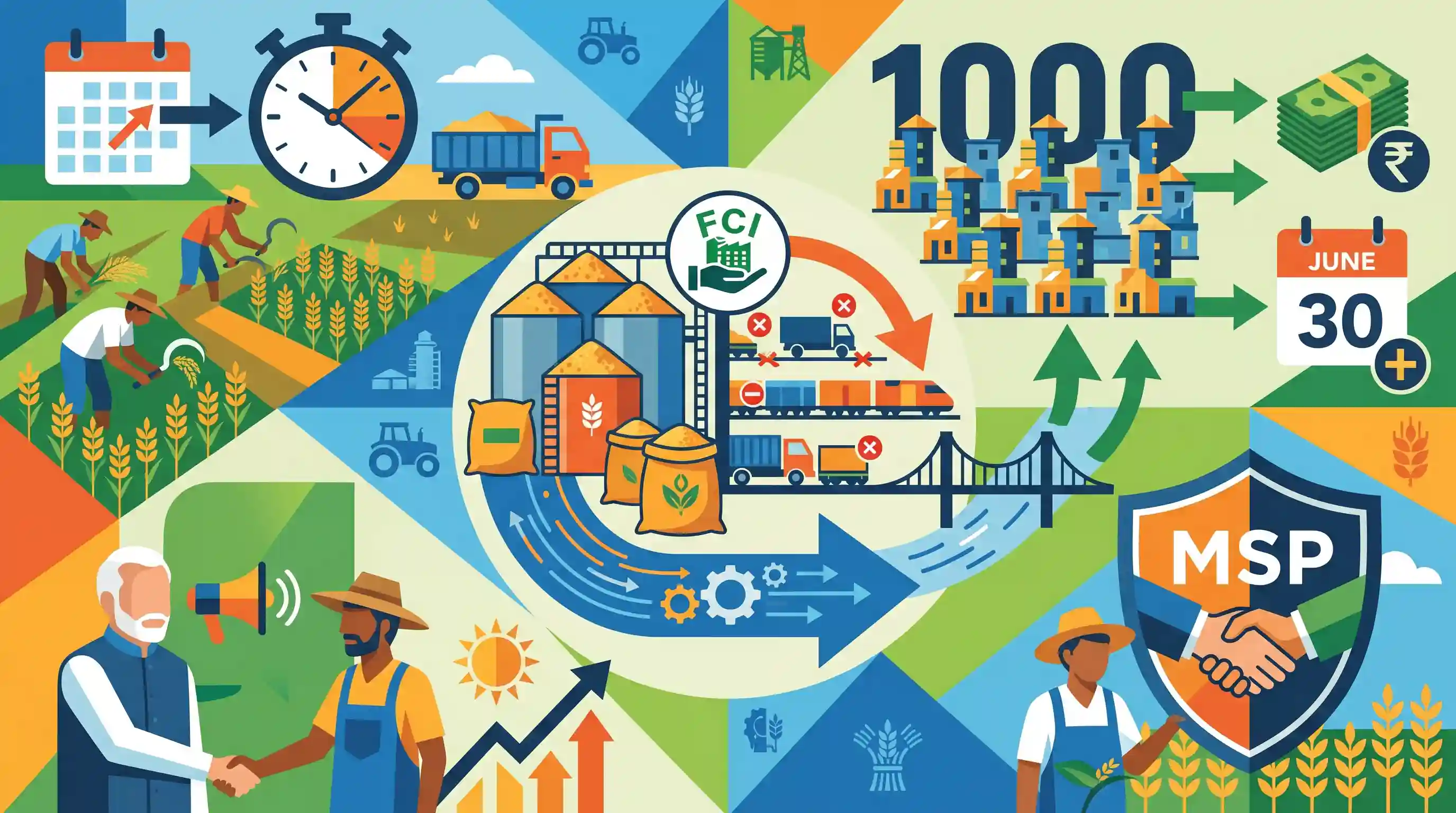
The Haryana government has advanced the paddy procurement date for the upcoming kharif season to September 22. In a move benefiting roughly 1,000 rice mills, the state extended the rice delivery and holding charge bonus period to June 30, saving millers an estimated Rs 50 crore. The decision addresses logistical bottlenecks where the Food Corporation of India (FCI) was reportedly delaying rice delivery. Chief Minister Nayab Singh Saini also defended the government\'s record on Minimum Support Price (MSP), assuring farmers of its continuation and noting historical price hikes.
Key Points
- Haryana CM Nayab Singh Saini advanced the state\'s paddy procurement start date from October 1 to September 22 to accommodate early crop arrivals.
- The delivery period for rice and the bonus period for holding charges have been extended from March 15 to June 30, providing a Rs 50 crore relief to nearly 1,000 mills.
- The extension addresses grievances from the Rice Millers Association regarding delayed physical delivery of rice by the Food Corporation of India (FCI).
- The CM countered opposition claims that MSP would end, highlighting significant historical increases in the MSP for common and Grade-A paddy since 2014.
Important Terms
Minimum Support Price (MSP)

A price floor set by the government to purchase crops from farmers, ensuring a minimum profit margin and protecting against market price crashes.
UPSC context
GS3 (Agriculture): Vital for understanding price support, farm income, and government intervention in agricultural markets.
Food Corporation of India (FCI)
A statutory body under the Ministry of Consumer Affairs responsible for procuring, storing, and distributing foodgrains to ensure national food security.
UPSC context
GS3 (Food Security): Central to PDS, logistics management, and the statutory framework of India's food economy.
Kharif Season
India's monsoon cropping season (June–October), featuring crops like paddy and maize that require significant rainfall and warm temperatures.
UPSC context
GS1 (Geography): Fundamental for understanding Indian cropping patterns, monsoon timing, and climatic requirements of staple crops.
Commission for Agricultural Costs and Prices (CACP)
An expert advisory body under the Ministry of Agriculture that recommends MSP for mandated crops based on comprehensive production cost analysis.
UPSC context
GS3 (Agriculture): Essential for understanding the institutional process of setting floor prices and agricultural economic policy.
Buffer Stock
A government-held reserve of essential foodgrains used to meet national food security requirements and stabilize market prices during production shortfalls.
UPSC context
GS3 (Food Security): Crucial for studying inflation control, food security norms, and disaster management reserves.
Prelims Trap
The government undertakes open-ended procurement for all 23 crops under the Minimum Support Price (MSP) regime.
While the government declares MSP for 23 commodities, open-ended procurement (buying unlimited quantities at MSP) is practically restricted to wheat and paddy.
Static Concepts Connected
What constitutes the 'Economic Cost' of food grains for FCI?
- Pooled Cost: Includes the Minimum Support Price (MSP) paid to farmers plus any additional bonus declared by state governments.
- Procurement Incidentals: Covers mandi charges, taxes, labor, transportation, and holding charges paid to millers and state agencies.
- Distribution Costs: Freight, handling, storage, and interest charges incurred during the movement of grains to PDS depots.
How does the Decentralised Procurement Scheme (DCP) work?
- Direct State Action: State governments directly procure, store, and distribute foodgrains under targeted PDS and other welfare schemes on behalf of the Centre.
- Central Reimbursement: The Central Government reimburses the entire expenditure incurred by the state based on an approved costing mechanism.
- Logistical Relief: Aims to reduce the Food Corporation of India's transit losses, overall operational burden, and food subsidy costs.
Cross-Topic Patterns
Procurement Policies vs. Crop Diversification
Guaranteed open-ended procurement for paddy in states like Haryana directly contradicts their own water conservation and crop diversification schemes (e.g., Mera Pani Meri Virasat).
Agri-Logistics and Fiscal Deficit
Logistical bottlenecks like delayed FCI lifting increase 'holding charges' paid to millers, subsequently inflating the Centre's total food subsidy bill.

FCI's operational mechanics—specifically components of the 'economic cost' like holding charges and incidentals—are ripe for 2026.
Linked PYQs · 4
Linked PYQs · 4
- 2018MainsGS3
What do you mean by Minimum Support Price (MSP)? How will MSP rescue the farmers from the low income trap?
- 2024MainsGS3
Elucidate the importance of buffer stocks for stabilizing agricultural prices in India. What are the challenges associated with the storage of buffer stock? Discuss.
- 2020PrelimsGS1
Consider the following statements: 1. In the case of all cereals, pulses and oil-seeds, the procurement at Minimum Support Price (MSP) is unlimited in any State/UT of India. 2. In the case of cereals and pulses, the MSP is fixed in any State/UT at a level to which the market price will never rise. Which of the statements given above is/are correct?
- 2019PrelimsGS1
The economic cost of food grains to the Food Corporation of India is Minimum Support Price and bonus (if any) paid to the farmers plus
