Paddy procurement challenges and delays in Kerala
Source:The Hindu ↗
Why It Matters
Highlights systemic bottlenecks in the agricultural supply chain and the critical role of efficient state procurement mechanisms. It serves as a strong case study for GS3 answers on agricultural marketing, the transition to cooperative-led procurement, and the exploitation of farmers by middlemen during administrative delays.
Summary
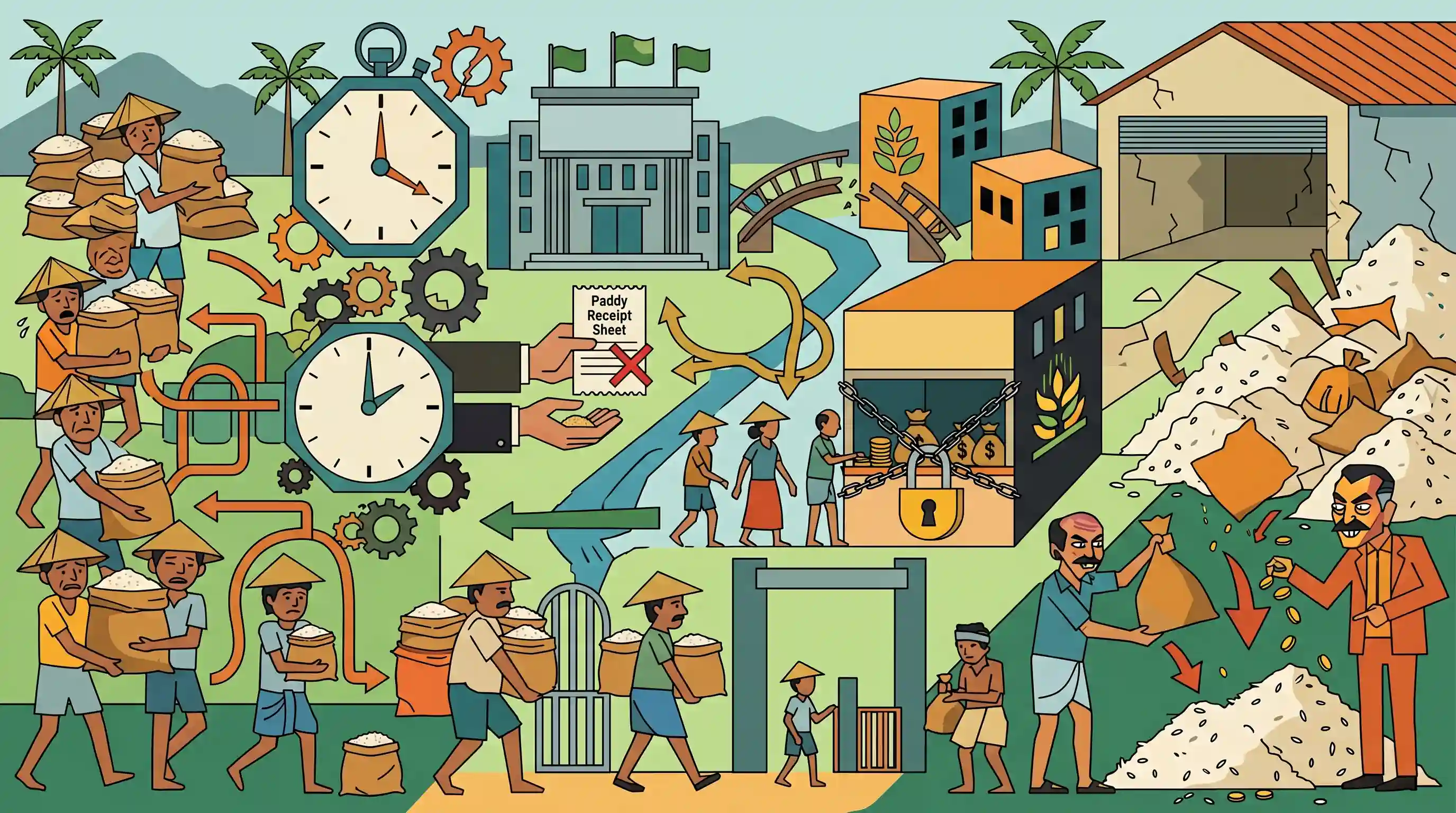
The paddy procurement process in Palakkad, Kerala, has descended into chaos due to administrative delays and a poorly executed transition of procurement duties from the Kerala State Civil Supplies Corporation (Supplyco) to local cooperative societies. Although the government proposed this shift on a pilot basis to streamline payments and eliminate PRS-based bank loans, the absence of formal orders has left cooperative banks unable to disburse funds. Meanwhile, Supplyco has procured grain in some areas but failed to issue the necessary Paddy Receipt Sheets (PRS). Adding to the farmers' distress are discriminatory procurement caps in certain panchayats and increasing exploitation by middlemen, who are leveraging the uncertainty to siphon off a percentage of the harvest.
Key Points
- Paddy farmers in Palakkad face severe distress due to procurement delays and a confusing administrative shift from Supplyco to cooperative societies.
- The Kerala government proposed routing procurement through cooperatives on a pilot basis to bypass PRS-based loans, but a lack of formal orders has stalled payments.
- Supplyco has procured paddy in some regions without issuing the mandatory Paddy Receipt Sheets (PRS), leaving farmers unable to claim their dues.
- Discriminatory government procurement caps—1,700 kg per acre in Kappur panchayat versus 2,200 kg elsewhere in the state—have triggered local protests.
- Middlemen are exploiting the chaotic transition, pressuring financially strained farmers to part with 1% to 3% of their produce at unfavorable terms.
Important Terms
Paddy Receipt Sheets (PRS)

Official acknowledgment issued by Supplyco to farmers upon paddy delivery. It acts as a security for bank loans equivalent to the procurement price, where the government later repays the bank.
UPSC context
GS3: Agriculture. Illustrates bottlenecks in decentralized procurement and financial inclusion challenges (e.g., CIBIL score impacts) for smallholders.
Minimum Support Price (MSP)
Guaranteed price for agricultural produce fixed by the Union Government. In Kerala, paddy procurement combines the Central MSP with a State Incentive Bonus (SIB) to support local farmers.
UPSC context
GS3: Agriculture. Core concept for food security, price stability, and government intervention in agricultural markets.
Kerala State Civil Supplies Corporation (Supplyco)
The nodal state agency in Kerala responsible for paddy procurement and distributing essential commodities through the Public Distribution System (PDS).
UPSC context
GS3: PDS and Food Security. Tests understanding of state-level implementation agencies in decentralized procurement models.
Cooperative societies
People-centered enterprises that, in the context of Kerala's new model, directly purchase paddy from farmers to ensure faster payments and reduce dependence on PRS-based bank loans.
UPSC context
GS3: Agriculture/Cooperatives. Evaluates the role of grassroots institutions in streamlining supply chains and eliminating middlemen.
Cooperative banks
Financial institutions like Kerala Bank that provide working capital and credit support to cooperative societies for large-scale agricultural procurement operations.
UPSC context
GS3: Agriculture/Institutional Credit. Relevant for questions on rural credit infrastructure and agricultural financing models.
Prelims Trap
"Under the Decentralised Procurement Scheme (DCP), FCI directly handles all procurement and states play no role."
Under DCP, state government agencies (not FCI) directly procure, store, and distribute grains. The Centre reimburses the state for MSP and operational costs.
Static Concepts Connected
How does the Decentralised Procurement Scheme (DCP) function?
- State Execution: State government agencies procure, store, and distribute foodgrains for the Public Distribution System (PDS) and other welfare schemes.
- Central Reimbursement: The Central Government reimburses states for the entire expenditure incurred on procurement at MSP, including incidental costs.
- Surplus Handover: Any surplus grain procured beyond the state's PDS requirement is handed over to the FCI for the Central Pool.
What is the constitutional and functional status of Cooperatives in Ag-marketing?
- Constitutional Status: 'Cooperative Societies' is a State subject (Entry 32, State List), but multi-state cooperatives are governed by the Centre.
- Market Linkage: Cooperatives reduce middleman exploitation by pooling farm produce and functioning as decentralized procurement centers for state agencies.
- Credit-Procurement Synergy: By linking procurement with PACS, farmers bypass delayed government bills and receive immediate credit adjustments or liquidity.
Cross-Topic Patterns
PACS integration into food security
State-led transitions from state civil supplies to Primary Agricultural Credit Societies (PACS) for procurement highlight the expanding administrative footprint of cooperatives in rural credit and food security.
Procurement caps and WTO AoA limits
State-imposed per-acre procurement caps serve as a domestic mechanism to manage ballooning MSP bills, inadvertently aligning with efforts to navigate WTO's Aggregate Measurement of Support (AMS) subsidy limits.

Expect a multi-statement Prelims question comparing Decentralised Procurement (DCP) with FCI operations, focusing on the role of PACS.
Linked PYQs · 5
Linked PYQs · 5
- 2018MainsGS3
What do you mean by Minimum Support Price (MSP)? How will MSP rescue the farmers from the low income trap?
- 2022MainsGS3
What are the major challenges of Public Distribution System (PDS) in India ? How can it be made effective and transparent ?
- 2014MainsGS3
In the villages itself no form of credit organization will be suitable except the cooperative society. -All India Rural Credit Survey. Discuss this statement in the background of agricultural finance in India. What constraints and challenges do financial institutions supplying agricultural finance face? How can technology be used to better reach and serve rural clients?
- 2020PrelimsGS1
Which of the following factors/policies were affecting the price of rice in India in the recent past? 1. Minimum Support Price 2. Government's trading 3. Government's stockpiling 4. Consumer subsidies Select the correct answer using the code given below:
- 2019PrelimsGS1
The economic cost of food grains to the Food Corporation of India is Minimum Support Price and bonus (if any) paid to the farmers plus
