Agricultural Credit Constraints on Paddy Receipt Sheets
Source:The Hindu ↗
Why It Matters
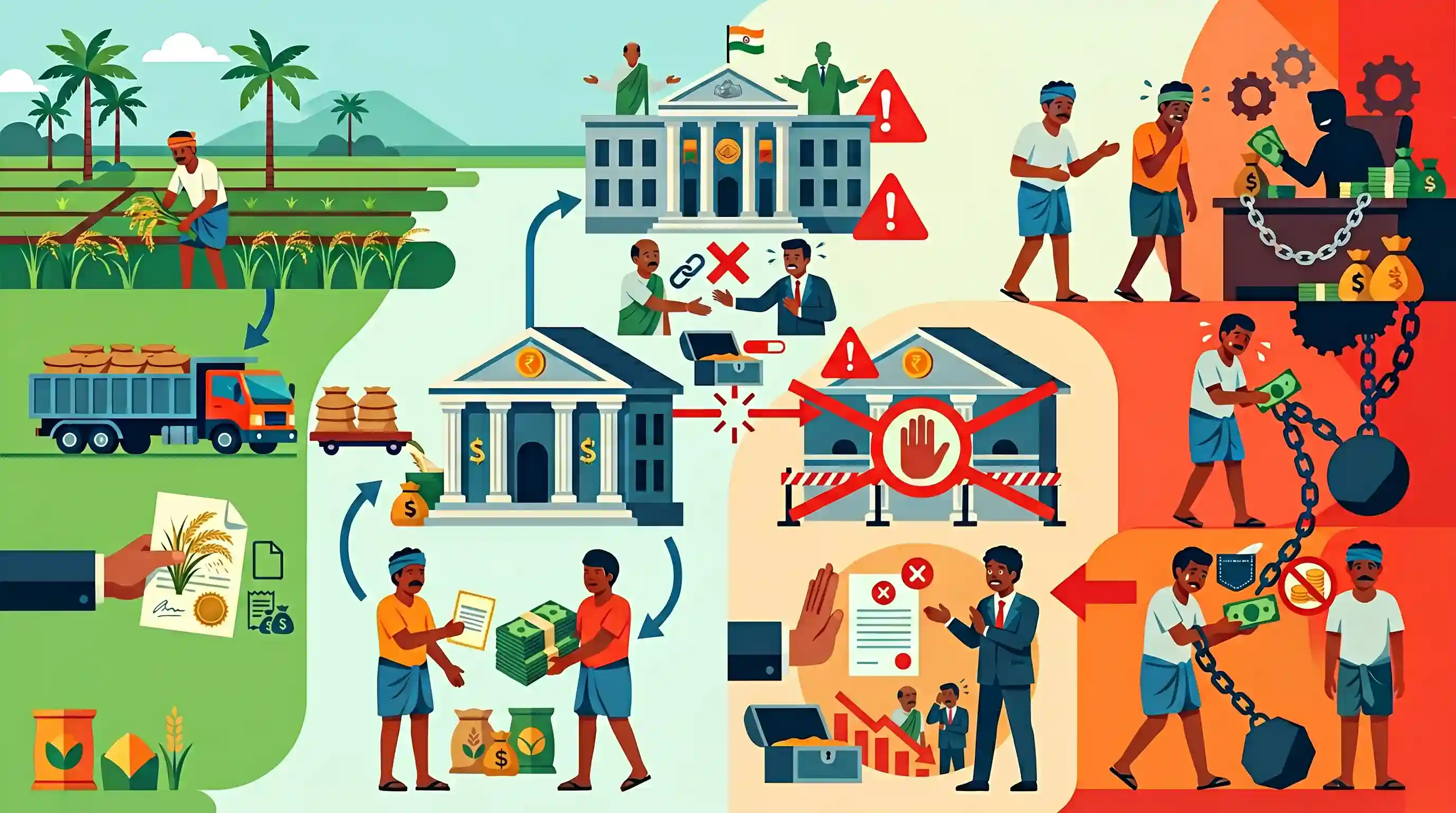
Demonstrates the practical challenges in agricultural finance where state procurement payment delays disrupt the institutional credit cycle, forcing farmers into debt traps and threatening subsequent crop production. Highly relevant for GS-3 Agriculture topics.
Summary
Paddy farmers in Kottayam, Kerala, are facing a severe capital crunch for the upcoming 'Puncha' cultivation season as major banks like SBI and Canara Bank refuse to disburse loans against Paddy Receipt Sheets (PRS). The PRS are issued by the state procurement agency Supplyco. Farmers use these receipts to secure bank loans, effectively receiving their procurement payments in advance. However, due to the state government's failure to repay the banking consortium for previous loans, banks have halted fresh disbursements. This delay in institutional credit delivery is pushing farmers toward high-interest informal lenders, highlighting the vulnerabilities in state agricultural procurement and financing mechanisms.
Key Points
- Paddy farmers in Kerala are facing financial distress due to the refusal by major banks, including SBI and Canara Bank, to issue loans against Paddy Receipt Sheets (PRS).
- PRS are issued by Supplyco upon procuring paddy, and farmers rely on bank loans against these receipts to fund their next cropping cycle (the Puncha season).
- The banks' reluctance stems from delays by the Kerala state government in clearing previous dues owed to the banking consortium under the PRS scheme.
- The lack of timely institutional credit forces farmers to either delay cultivation or rely on informal lenders at exorbitant interest rates, exacerbating rural indebtedness.
- The crisis underscores systemic flaws in state-managed procurement payment systems and their direct impact on agricultural credit flow.
Important Terms
Paddy Receipt Sheets (PRS) loan scheme

A financial mechanism where Kerala farmers receive their paddy procurement price as bank loans against acknowledgment receipts (PRS). The state government subsequently settles the principal and interest with the banks.
UPSC context
GS Paper III: Agricultural Credit and Subsidies. Tests understanding of innovative but risky financing models and their impact on farmer debt.
Supplyco (Kerala State Civil Supplies Corporation)
The nodal agency in Kerala responsible for procuring paddy from farmers, issuing Paddy Receipt Sheets, and distributing rice through the Public Distribution System (PDS).
UPSC context
GS Paper III: Food Security and PDS. Focuses on the role of state-level agencies in decentralized procurement.
Consortium of Banks
A group of financial institutions (e.g., SBI, Canara Bank) that pools resources to provide large-scale credit for state agricultural procurement when government funds are insufficient.
UPSC context
GS Paper III: Indian Economy and Mobilization of Resources. Relevant for understanding institutional credit frameworks and public-private financial cooperation.
Decentralized Procurement (DCP) System
A system where State governments (e.g., Kerala) procure, store, and distribute foodgrains directly, rather than through the Food Corporation of India (FCI), to improve PDS efficiency.
UPSC context
GS Paper III: Storage, Transport and Marketing of Agricultural Produce. Tests knowledge of alternative procurement models to the FCI-centralized system.
Institutional Credit
Loans provided by formal financial institutions like banks and cooperatives to farmers at regulated interest rates, intended to replace high-interest informal money lending.
UPSC context
GS Paper III: Issues related to direct and indirect farm subsidies. Core concept for farmer distress and agricultural finance.
Puncha Cultivation
One of the three main rice-growing seasons in Kerala (Kuttanad region), typically sown in November/December and harvested in March/April, relying on dewatering techniques.
UPSC context
GS Paper I: Geography - Major crops/cropping patterns. Relevant for regional agricultural practices and specific geographical challenges (below sea-level farming).
Prelims Trap
"Under state-mediated agricultural credit schemes, government repayment defaults do not negatively impact the individual farmer's credit score."
Although the state government promises to repay the bank, the loan is issued in the farmer's name against their receipt. A state default ruins the farmer's CIBIL score.
Static Concepts Connected
How does the Decentralised Procurement Scheme (DCP) operate?
- State Procurement: State-designated nodal agencies (like Kerala's Supplyco) procure foodgrains directly from farmers at MSP.
- Local Distribution: The state processes, stores, and distributes these procured grains directly through its Public Distribution System (PDS).
- Central Subsidy: The Central Government retroactively reimburses the state for the economic cost of procurement and distribution as a food subsidy.
What is unique about the Kuttanad agricultural system?
- Below Sea Level: It is one of the few places globally where farming is carried out 1.2 to 3 metres below sea level.
- GIAHS Tag: Recognized by the UN FAO as a Globally Important Agricultural Heritage System (GIAHS) for its unique ecological adaptation.
- Puncha Season: 'Puncha' is the primary summer/spring paddy cultivation season, highly dependent on precise flood and salinity control.
Cross-Topic Patterns
State MSP Bonuses vs. Fiscal Health
States offering bonuses over the central MSP strain their own finances. When state agencies default on procurement loans, institutional credit pipelines to farmers freeze, causing rural distress.
Institutional Failure & Informal Credit
Delays in formalized agricultural credit (like PRS loans) directly drive farmers back to high-interest informal lenders, undermining the objectives of Priority Sector Lending (PSL) and financial inclusion.

Expect a prelims question combining Decentralised Procurement (DCP), state-level MSP bonuses, and their downstream impact on agricultural credit.
Linked PYQs · 3
Linked PYQs · 3
- 2018MainsGS3
What do you mean by Minimum Support Price (MSP)? How will MSP rescue the farmers from the low income trap?
- 2014MainsGS3
In the villages itself no form of credit organization will be suitable except the cooperative society. -All India Rural Credit Survey. Discuss this statement in the background of agricultural finance in India. What constraints and challenges do financial institutions supplying agricultural finance face? How can technology be used to better reach and serve rural clients?
- 2020PrelimsGS1
In India, which of the following can be considered as public investment in agriculture? 1. Fixing Minimum Support Price for agricultural produce of all crops 2. Computerization of Primary Agricultural Credit Societies 3. Social Capital development 4. Free electricity supply to farmers 5. Waiver of agricultural loans by the banking system 6. Setting up of cold storage facilities by the governments Select the correct answer using the code given below:
