US Military Command Renaming Signals Indo Pacific Shift
Source:The Hindu ↗
Why It Matters
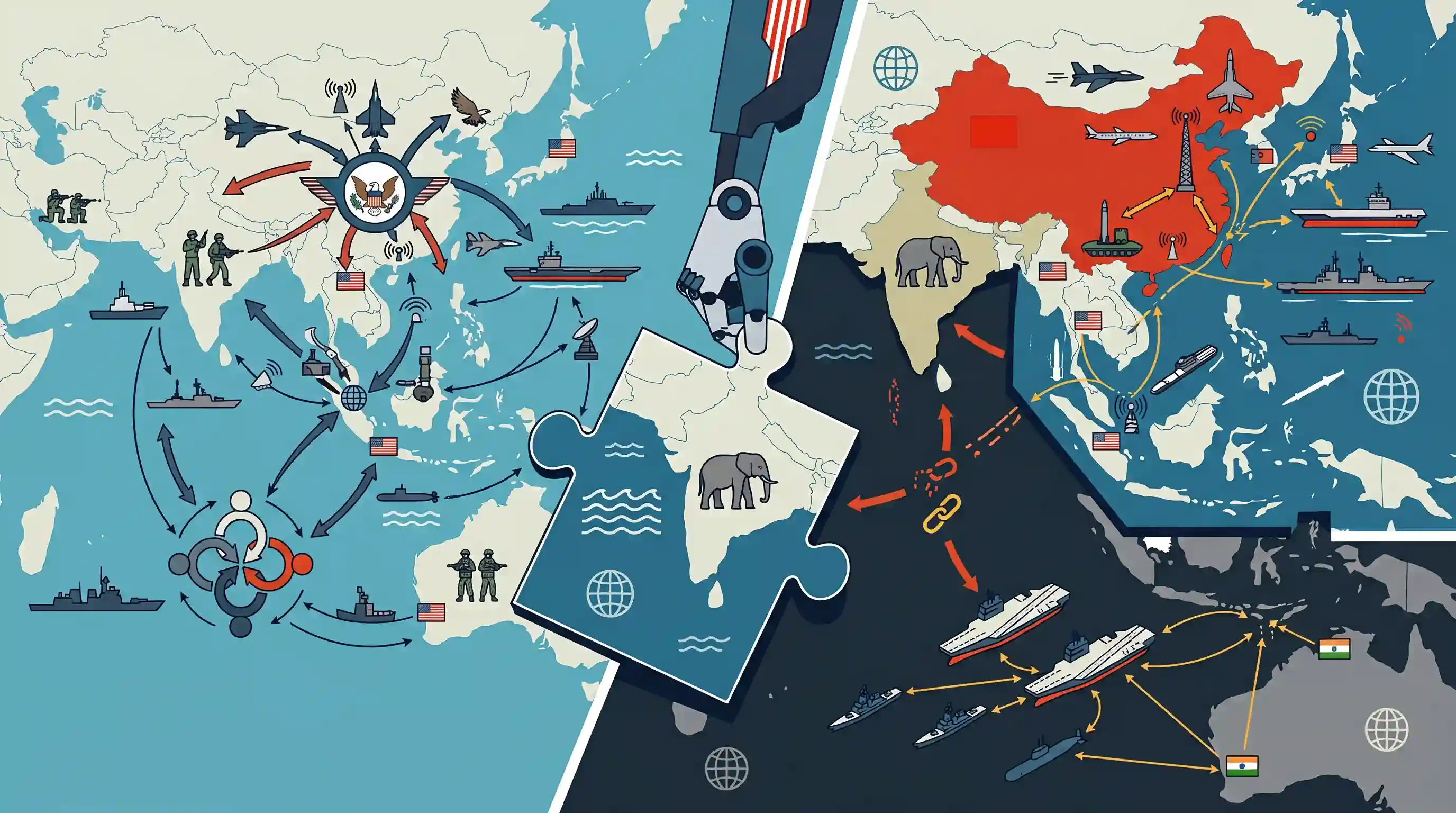
The renaming reflects a potential fundamental shift in US foreign policy and military strategy, transitioning away from the 'Indo-Pacific' construct that heavily favored India's strategic rise. Understanding this shift is crucial for analyzing the future of India-US defense cooperation, the relevance of the Quad, and India's strategic imperatives in the Indian Ocean Region.
Summary
The article analyzes the profound geopolitical implications of the United States dropping the 'Indo' prefix from its regional military command, reverting from USINDOPACOM to USPACOM. This shift marks a strategic departure from the broad 'Indo-Pacific' framework, indicating a US pivot toward a more concentrated focus on the Pacific theater, specifically concerning China, Taiwan, and the South China Sea. For India, this semantic and structural downgrade signals that the Indian Ocean Region (IOR) may no longer hold the same integrated priority in Washington's defense posture. The move challenges the underlying premise of the Quad and compels India to rely more on its own maritime capabilities and independent plurilateral partnerships to secure the IOR, rather than depending on a unified US-led Indo-Pacific security umbrella.
Key Points
- The US military's decision to drop the 'Indo' prefix from its command, effectively reverting from INDOPACOM back to PACOM, signifies a major recalibration in American geopolitical and military strategy.
- This semantic shift suggests a structural retreat from the expansive 'Indo-Pacific' construct back to a narrower 'Pacific' or 'Asia-Pacific' focus, prioritizing primary threat theaters like Taiwan and the South China Sea over the broader Indian Ocean.
- For New Delhi, the renaming indicates a potential decoupling of the Indian Ocean from Washington's core strategic calculations, reducing India's centrality in the US's primary regional security architecture.
- The strategic pivot raises critical questions regarding the future utility of the Quad and the durability of the US commitment to a 'free and open Indo-Pacific'.
- India will need to adapt by accelerating its own naval modernization, assuming greater responsibility as the net security provider in the IOR, and forging deeper plurilateral maritime partnerships with regional powers like Japan, Australia, and France.
Important Terms
USPACOM (United States Pacific Command)

The oldest and largest US unified combatant command, headquartered in Hawaii. In June 2026, it reverted to this legacy name from USINDOPACOM, signaling a focus on the Pacific theater.
UPSC context
GS Paper 2 (International Relations); tests understanding of shifting US global defense posture and its impact on India's strategic salience.
USINDOPACOM
The designation used from 2018 to 2026 for the US military command, explicitly integrating the Indian and Pacific Oceans to recognize India's rising role in regional security.
UPSC context
GS Paper 2; relevant for tracing the evolution of India-US defense ties and the Indo-Pacific strategy.
Quad (Quadrilateral Security Dialogue)
An informal strategic forum of India, the US, Japan, and Australia dedicated to a 'free and open Indo-Pacific' through maritime cooperation, climate action, and technology.
UPSC context
GS Paper 2 (Global Groupings); tests India's ability to balance minilateral cooperation with strategic autonomy.
Indian Ocean Region (IOR)
A vital maritime theater for global trade and energy security. For India, it is the primary zone for exercising naval influence and safeguarding national interests.
UPSC context
GS Paper 3 (Security); essential for discussing maritime security, piracy, and India's 'net security provider' role.
SAGAR (Security and Growth for All in the Region)
The strategic vision launched in 2015 to promote maritime cooperation, stability, and sustainable economic development among Indian Ocean littoral states.
UPSC context
GS Paper 2; tests knowledge of India's maritime diplomacy and neighborhood policy in the maritime domain.
Strategic Autonomy
The fundamental foreign policy principle of maintaining independent decision-making power without joining formal military alliances, allowing India to engage with diverse global partners.
UPSC context
GS Paper 2; central theme in analyzing India's multi-alignment strategy and response to great power competition.
Maritime Domain Awareness (MDA)
The effective understanding and monitoring of activities in the maritime environment to ensure security, safety, and economic stability through surveillance and information sharing.
UPSC context
GS Paper 3 (Security/Internal Security); critical for discussions on coastal defense and monitoring regional naval movements.
Prelims Trap
The USPACOM's geographical Area of Responsibility (AOR) no longer includes the Indian Ocean.
While the 'Indo' prefix was dropped to signal strategic priorities, USPACOM's actual geographic Area of Responsibility (AOR) remains unchanged, reaching India's western border.
Static Concepts Connected
How is the Indian Ocean divided among US Geographic Combatant Commands?
- USPACOM: Covers the eastern Indian Ocean up to the western maritime border of India.
- USCENTCOM: Covers the Middle East, Central Asia, and the north-western Indian Ocean (including the Arabian Sea).
- USAFRICOM: Covers the western Indian Ocean along the eastern and southern African coastlines.
What does India's role as a 'Net Security Provider' entail?
- Definition: A state deploying its national resources and capabilities to enhance the maritime and regional security of other countries.
- Scope: Includes capacity building, military diplomacy, HADR (Humanitarian Assistance and Disaster Relief), and anti-piracy operations.
- Guiding Doctrine: Driven by the SAGAR (Security and Growth for All in the Region) vision to ensure a free and inclusive Indian Ocean.
Cross-Topic Patterns
Shift from Quad to Minilaterals
A weakened US Indo-Pacific commitment will likely push India toward maritime trilaterals (e.g., India-France-Australia) and regional architectures like the Colombo Security Conclave to secure the IOR.
Naval Modernization & Defense Indigenization
The US strategic retreat amplifies the urgency of India's naval self-reliance, directly linking to delays in Project 75I (submarines) and the debate over a third indigenous aircraft carrier.

Expect a 2026 Mains question on the strategic decoupling of the 'Indo-Pacific' construct and its impact on India's Quad & SAGAR doctrines.
Linked PYQs · 4
Linked PYQs · 4
- 2020MainsGS2
What is the significance of Indo-US defence deals over Indo-Russian defence deals? Discuss with reference to stability in the Indo-Pacific region.
- 2019MainsGS2
‘What introduces friction into the ties between India and the United States is that Washington is still unable to find for India a position in its global strategy, which would satisfy India's national self-esteem and ambitions.’ Explain with suitable examples.
- 2020MainsGS2
Quadrilateral Security Dialogue (Quad)' is transforming itself into a trade bloc from a military alliance, in present times - Discuss.
- 2021MainsGS2
The newly tri-nation partnership AUKUS is aimed at countering China's ambitions in the Indo-Pacific region. Is it going to supersede the existing partnerships in the region? Discuss the strength and impact of AUKUS in the present scenario.
