PAC Launches Shivalik Morcha to Protect Punjab Foothills
Source:Indian Express ↗
Why It Matters
It provides a concrete case study of civil society action (environmental pressure groups) challenging urbanization policies that threaten fragile ecosystems. It is highly relevant for GS2 (role of NGOs/pressure groups) and GS3 (environmental conservation, groundwater recharge, and the role of NGT).
Summary
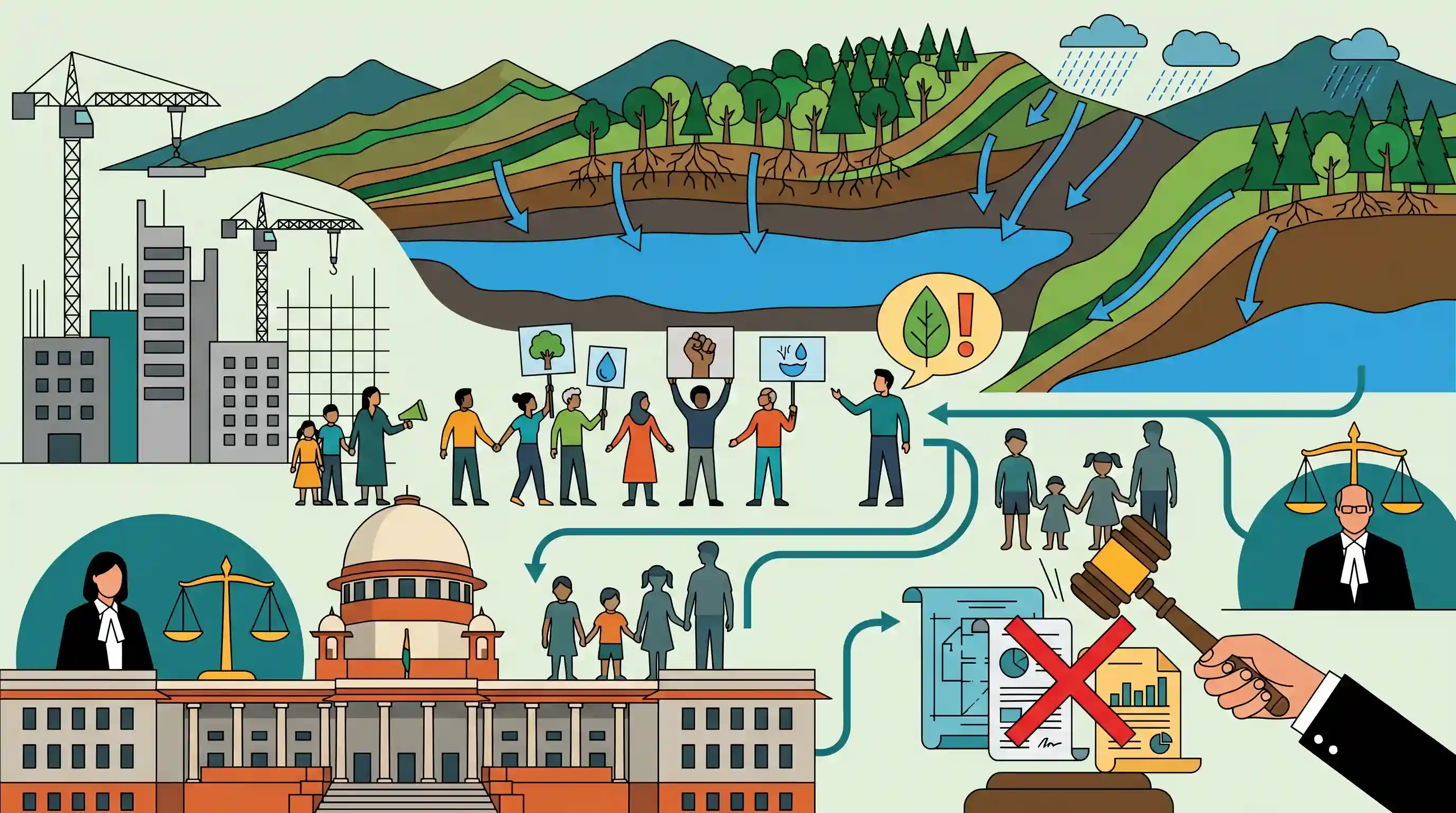
The Public Action Committee (PAC) has launched the 'Shivalik Morcha' to protect Punjab's ecologically sensitive Shivalik foothills from degradation caused by construction and land regularisation. The Shivaliks act as a natural barrier against soil erosion, aid vital groundwater recharge, and support biodiversity. The region was historically protected under the British-era Punjab Land Preservation Act (PLPA). Recent policy changes allowing construction have prompted PAC to advocate for strict environmental compliance, citing intergenerational risks. The issue is currently under judicial scrutiny, with the National Green Tribunal (NGT) halting allotments and a writ petition pending in the High Court.
Key Points
- The 'Shivalik Morcha' is a citizen-led campaign aimed at halting ecological degradation in Punjab's Shivalik foothills caused by recent land regularisation and construction policies.
- The Shivalik hills serve as a critical natural barrier against soil erosion, aid in vital groundwater recharge, and support a rich biodiversity.
- Activists are leveraging the Punjab Land Preservation Act (PLPA), an over century-old British-era law intended to protect the ecological integrity of these fragile areas.
- Unregulated infrastructure development, including permanent structures and paved roads, threatens the slope stability and fragmented land ecology of the region.
- The conflict highlights the interplay between policy, civil society, and environmental governance, with the matter currently under judicial review by the NGT and High Court.
Important Terms
Punjab Land Preservation Act (PLPA)

A 1900 colonial-era legislation designed to prevent soil erosion and land degradation. It empowers the state government to notify fragile areas and restrict land-use activities to conserve subsoil water.
UPSC context
GS Paper 2 (Land Laws) and Paper 3 (Conservation). Tests understanding of historical environmental frameworks and modern land-use conflicts.
Shivalik Range
The southernmost, youngest range of the Himalayas, composed of unconsolidated sedimentary rocks. They serve as critical groundwater recharge zones and a natural barrier against soil erosion for the plains.
UPSC context
GS Paper 1 (Geography). Important for understanding Himalayan geology, its role in water security, and vulnerability to erosion/landslides.
National Green Tribunal (NGT)
A specialized judicial body established under the NGT Act 2010 for the effective and expeditious disposal of cases relating to environmental protection and conservation of forests.
UPSC context
GS Paper 2 (Statutory Bodies) and Paper 3 (Environmental Governance). Focuses on judicial oversight and the "Polluter Pays Principle."
Shivalik Morcha
A 2026 environmental campaign launched by the Public Action Committee (PAC) to protect Punjab's Shivalik foothills from construction and land-use changes that threaten the state's ecological stability.
UPSC context
GS Paper 2 (Social Movements/Civil Society). Case study on how non-state actors mobilize for environmental protection and intergenerational equity.
Public Action Committee (PAC)
A citizen-led collective of NGOs and environmentalists in Punjab. It uses public advocacy, legal petitions, and protests to challenge policies that risk irreversible environmental damage.
UPSC context
GS Paper 2 (Civil Society/NGOs). Illustrates the role of pressure groups in influencing environmental governance and policy-making.
Kandi Region
The semi-hilly transitional tract between the Shivalik hills and the plains in Punjab. It is geologically fragile and highly prone to erosion caused by seasonal streams known as 'choes.'
UPSC context
GS Paper 1 (Regional Geography) and Paper 3 (Disaster Management). Relevant for understanding the ecological challenges of the Himalayan foothills transition.
Prelims Trap
"The Punjab Land Preservation Act (PLPA) is a post-independence environmental law enacted specifically to combat climate change."
The PLPA is not a modern environmental law. It is a 1900 British-era legislation initially designed to prevent soil erosion and conserve sub-soil water in the fragile foothills.
Static Concepts Connected
Why are the Shivalik ranges highly prone to soil erosion and landslides?
- Geological Youth: They are the outermost and youngest ranges of the Himalayas, formed much later by the folding of fluvial (river) sediments.
- Unconsolidated Material: Composed mostly of loose sand, gravel, and conglomerates (molasse deposits), lacking the hard, consolidated crystalline structure of older ranges.
- Anthropogenic Vulnerability: Unregulated construction and hill-leveling easily destabilize this fragile slope barrier, exacerbating flash floods and topsoil loss in the adjoining plains.
How does NGT jurisdiction differ from High Courts in environmental disputes?
- Statutory vs Constitutional: The NGT is a statutory body whose jurisdiction is strictly limited to civil cases under seven specific environmental laws (e.g., Water Act, Forest Act).
- Writ Jurisdiction: High Courts exercise broader constitutional writ powers under Article 226 and can hear environmental matters intersecting with fundamental rights (Article 21) outside those 7 laws.
Cross-Topic Patterns
PLPA linking Aravallis and Shivaliks
The 1900 PLPA is central to ecological conservation in northwestern India, repeatedly invoked by courts to halt real estate encroachment in both Haryana's Aravalli range and Punjab's Shivalik foothills.
State regularisation vs. Green Tribunals
Movements like Shivalik Morcha reflect a growing trend where citizen groups bypass state executives, relying on the NGT's statutory powers to enforce compliance against localized land monetization and regularisation policies.

Expect a multi-statement prelims question on the Shivaliks, testing its unconsolidated lithology alongside the PLPA's conservation role.
Linked PYQs · 5
Linked PYQs · 5
- 2025MainsGS2
What are environmental pressure groups? Discuss their role in raising awareness, influencing policies and advocating for environmental protection in India.
- 2015MainsGS2
How can the role of NGOs be strengthened in India for development works relating to protection of the environment? Discuss throwing light on the major constraints.
- 2024MainsGS3
What role do environmental NGOs and activists play in influencing Environmental Impact Assessment (EIA) outcomes for major projects in India? Cite four examples with all important details.
- 2021MainsGS1
Differentiate the causes of landslides in the Himalayan region and Western Ghats.
- 2025MainsGS3
Examine the factors responsible for depleting groundwater in India. What are the steps taken by the government to mitigate such depletion of groundwater?
