P4M Coalition and the Future of Multilateralism
Source:Indian Express ↗
Why It Matters
Essential for understanding emerging minilateral and multilateral coalitions, India's foreign policy stance on global governance, and reforms of international institutions.
Summary
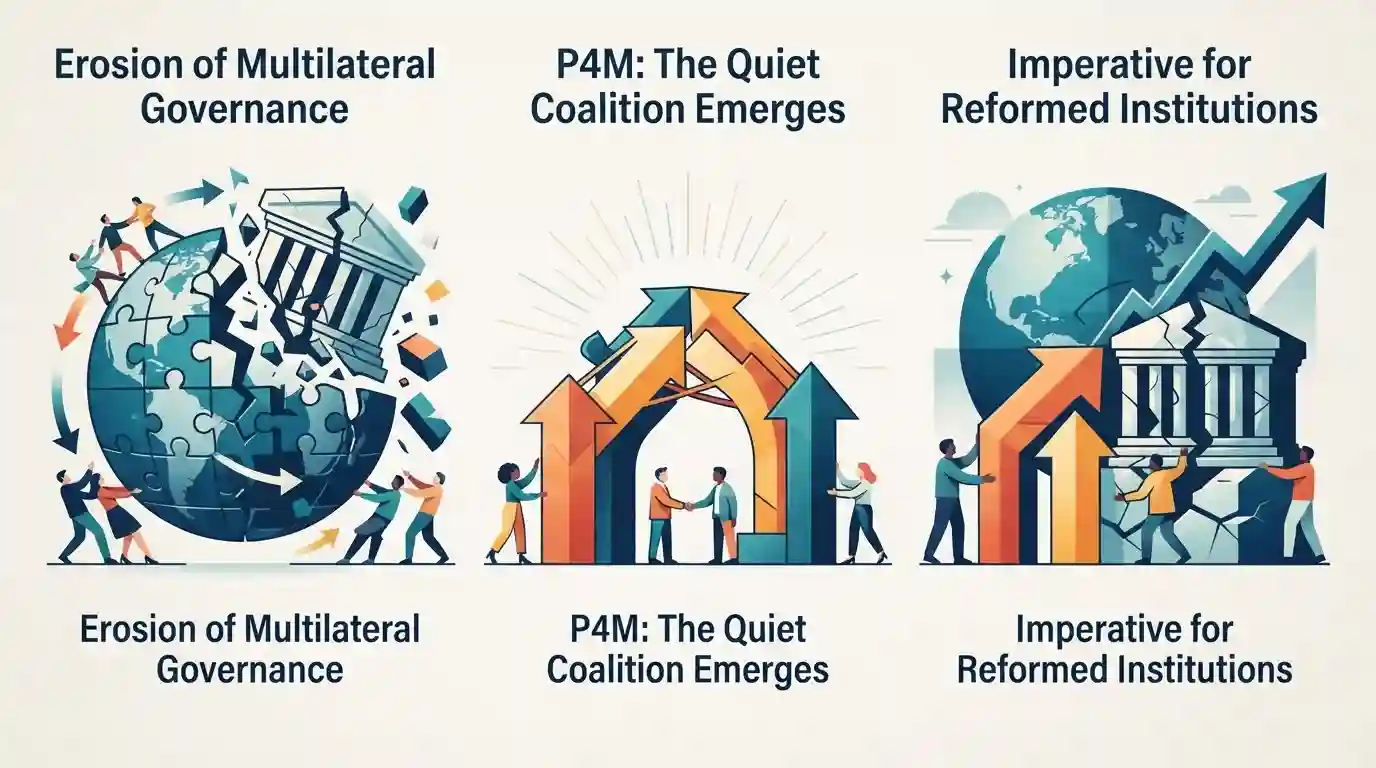
The article discusses the emergence of P4M (Partnership for Multilateralism) as a quiet coalition addressing the erosion of global multilateral governance, highlighting the challenges of geopolitical fragmentation and the imperative for reformed international institutions.
Key Points
- P4M (Partnership for Multilateralism) represents a quiet coalition aimed at preserving and revitalizing multilateral institutions amidst rising geopolitical fragmentation and unilateralism.
- Multilateral governance structures face severe strains due to gridlock in organizations like the UN Security Council and great power rivalries.
- Middle powers and developing nations like India have a critical stakes in strengthening rules-based international order and reformed multilateralism.
Important Terms
P4M

An international initiative launched in September 2026 by diverse nations like India, Brazil, and the EU to safeguard the rules-based multilateral order, uphold international law, and reform global institutions.
UPSC context
UPSC Mains GS Paper II: Important International institutions, agencies and fora - their structure, mandate, and evolving coalitions of middle powers.
United Nations
An international organization established in 1945 under its Charter to maintain international peace and security, protect human rights, and promote sustainable development globally.
UPSC context
UPSC Mains GS Paper II: Structure, organization and functioning of the United Nations and other international bodies.
UN Security Council
The principal crisis-management organ of the United Nations charged with the maintenance of international peace and security, featuring five permanent members with veto power.
UPSC context
UPSC Mains GS Paper II: Global governance reforms, UN restructuring, and India's bid for permanent membership.
G20
A premier forum for international economic cooperation comprising 19 countries, the European Union, and the African Union, addressing global financial stability and governance.
UPSC context
UPSC Mains GS Paper II & III: Important international groupings, global economic architecture, and multilateral diplomacy.
Prelims Trap
P4M is a binding security alliance formed to counter specific military threats in the Indo-Pacific region.
Aspirants often confuse P4M with exclusive minilateral security alliances (like AUKUS or Quad). P4M is an open, cross-regional diplomatic coalition focused strictly on multilateral institutional reform and UN Charter norms.
Static Concepts Connected
What are the primary institutional mechanisms and groupings associated with UN Security Council reform?
- G4 Bloc: G4 Nations: India, Brazil, Germany, and Japan mutually support each other's bids for permanent UNSC seats.
- Coffee Club: Uniting for Consensus (Coffee Club): Led by countries like Italy, Pakistan, and Argentina, opposing the expansion of permanent seats and favoring non-permanent expansion.
- African Union: Ezulwini Consensus: The African Union's official position demanding at least two permanent seats with veto power and five non-permanent seats for Africa.
Cross-Topic Patterns
Multilateral Minilateralism vs UN Reform
P4M complements traditional minilateral bodies like G4 and BRICS by uniting cross-regional middle powers specifically to advocate for UNSC expansion and UN Charter defense.
Middle Powers and Global South Diplomacy
The coalition bridges the Global South's developmental demands with middle power diplomacy, echoing India's Voice of Global South Summits.

P4M's founding composition, objectives, and divergence from traditional blocs like G4/P5 will likely feature in IR matching sets.
Linked PYQs · 2
Linked PYQs · 2
- 2025MainsGS2
"The reform process in the United Nations remains unresolved, because of the delicate imbalance of East and West and entanglement of the USA vs. Russo-Chinese alliance.” Examine and critically evaluate the East-West policy confrontations in this regard.
- 2015MainsGS2
Discuss the impediments India is facing in its pursuit of a permanent seat in UN Security Council.
