Structural Skill Mismatches Drive Persistent Youth Unemployment
Source:Indian Express ↗
Why It Matters
Youth unemployment is a foundational macroeconomic challenge for India. UPSC frequently tests the dichotomy between GDP growth and job creation, the structural nature of Indian unemployment, and the effectiveness of skilling initiatives in GS2, GS3, and Essay papers.
Summary
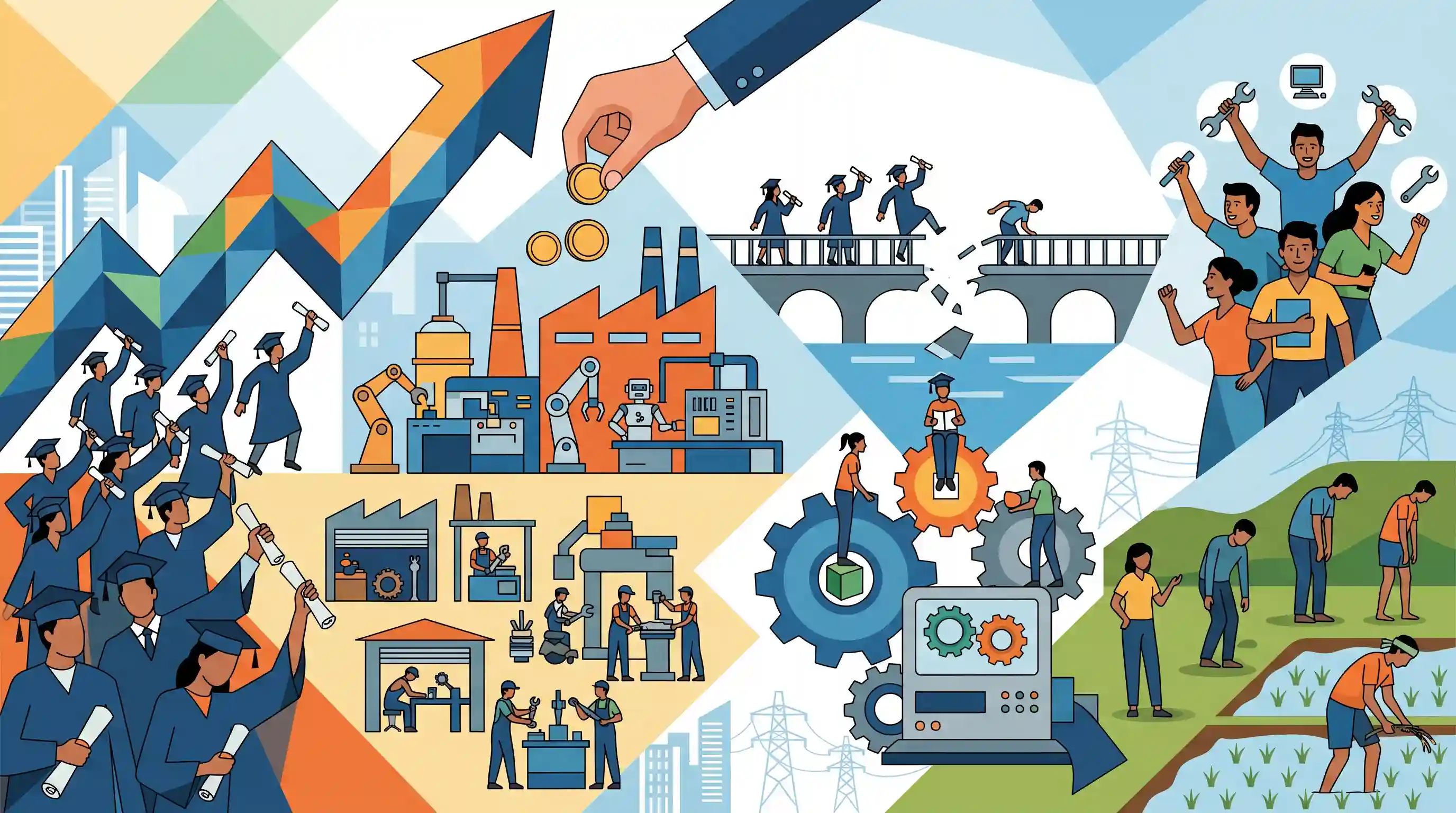
The article by P Chidambaram critically examines the persistent crisis of youth unemployment in India, characterizing the current economic trajectory as 'jobless growth'. Despite favorable GDP figures, the economy is failing to absorb the millions of youth entering the workforce annually. The author identifies structural flaws, including a severe skill-education mismatch that leads to high educated unemployment, and a policy bias toward capital-intensive industries at the expense of labor-intensive MSMEs. The piece warns that without an urgent pivot to support small enterprises and revamp vocational training, India risks turning its demographic dividend into a demographic disaster, evidenced by the anomalous shift of the workforce back into agriculture.
Key Points
- Highlights the paradox of 'jobless growth' in India, where headline GDP growth fails to translate into adequate employment opportunities for the youth.
- Points out the severe crisis of educated unemployment, driven by a structural mismatch between the skills imparted by the education system and the requirements of modern industries.
- Criticizes the over-reliance on capital-intensive sectors for economic growth while labor-intensive sectors like MSMEs face severe operational stress.
- Notes the concerning trend of labor shifting back to agriculture, reversing the traditional development trajectory of moving from primary to secondary and tertiary sectors.
- Argues that India is at risk of squandering its demographic dividend if urgent policy shifts toward labor-intensive manufacturing and meaningful skill development are not undertaken.
Important Terms
Demographic Dividend

Economic growth potential resulting from a shift in population structure where the working-age population (15-64) is larger than the dependent population.
UPSC context
GS-1 (Population) and GS-3 (Employment); tests understanding of India's labor potential and socioeconomic challenges.
Jobless Growth
An economic phenomenon where GDP expands while employment levels remain stagnant or decline, failing to generate proportional job opportunities for the growing workforce.
UPSC context
GS-3 (Indian Economy); tests analysis of structural flaws in India's growth trajectory and industrial policy.
MSME Sector
Enterprises defined by specific investment and turnover limits. They are labor-intensive, vital for regional development, and considered the backbone of the Indian economy.
UPSC context
GS-3 (Inclusive Growth); tests knowledge of sectors critical for absorbing surplus labor and boosting exports.
Production Linked Incentive (PLI) Scheme
A flagship industrial policy providing financial incentives to companies based on incremental sales from products manufactured in domestic units to boost manufacturing and self-reliance.
UPSC context
GS-3 (Industrial Policy); tests strategies for 'Make in India' and reducing import dependency in key sectors.
Skill India Mission
An umbrella initiative launched in 2015 to provide market-relevant vocational training to millions of youth, bridging the gap between industry demand and workforce capability.
UPSC context
GS-2/3 (Human Resource Development); tests government interventions to address youth unemployment and skill mismatches.
Periodic Labour Force Survey (PLFS)
A nationwide survey by the National Statistical Office (NSO) providing annual and quarterly data on key indicators like the Unemployment Rate and Labor Force Participation.
UPSC context
GS-3 (Economic Data); tests ability to interpret official statistics on employment trends and labor market dynamics.
Prelims Trap
The share of workforce in Indian agriculture has steadily and continuously declined over the last decade.
PLFS data revealed a 'reverse migration' back to agriculture post-2020, breaking the historical trend of continuous transition to secondary/tertiary sectors.
Static Concepts Connected
What are Structural and Disguised Unemployment in the Indian context?
- Structural Unemployment: Arises from a mismatch between available worker skills and industry needs, directly driving India's educated youth unemployment crisis.
- Disguised Unemployment: Occurs when more people are employed than necessary (zero marginal productivity), predominantly seen in Indian agriculture.
What is the Lewis Model of Structural Transformation?
- Core Theory: Economic development occurs as surplus labor shifts from low-productivity traditional agriculture to a higher-productivity modern industrial sector.
- Indian Anomaly: India's recent 'reverse migration' back to agriculture contradicts this model, indicating a failure to absorb labor in modern manufacturing.
Cross-Topic Patterns
PLI Scheme vs MSME job creation
The PLI scheme incentivizes capital-intensive manufacturing, whereas India's acute need is labor-intensive growth via MSMEs to absorb surplus agricultural labor.
Skill India and the Demographic Dividend
Connect the 'jobless growth' phenomenon and gaps in the 'Skill India Mission' to GS1 demography, where the demographic dividend risks becoming a demographic disaster.

Expect a 2026 Mains question contrasting high GDP growth with 'structural retrogression' (labor shifting back to agriculture in PLFS data).
Linked PYQs · 4
Linked PYQs · 4
- 2014MainsGS3
While we flaunt India's demographic dividend, we ignore the dropping rates of employability. What are we missing while doing so? Where will the jobs that India desperately needs come from? Explain.
- 2022MainsGS3
Economic growth in the recent past has been led by increase in labour productivity." Explain this statement. Suggest the growth pattern that will lead to creation of more jobs without compromising labour productivity.
- 2023MainsGS3
Most of the unemployment in India is structural in nature. Examine the methodology adopted to compute unemployment in the country and suggest improvements.
- 2023MainsGS2
Skill development programmes have succeeded in increasing human resources supply to various sectors. In the context of the statement analyse the linkages between education, skill and employment.
