US Tariff Demands Reflect Unfair Pressure on India
Source:Indian Express ↗
Why It Matters
US-India trade friction (tariffs, protectionism) is a recurring theme in international relations. Understanding the nuances of "reciprocity" vs "Special and Differential Treatment" is crucial for Mains answers on WTO reforms, global trade wars, and managing bilateral economic disputes.
Summary
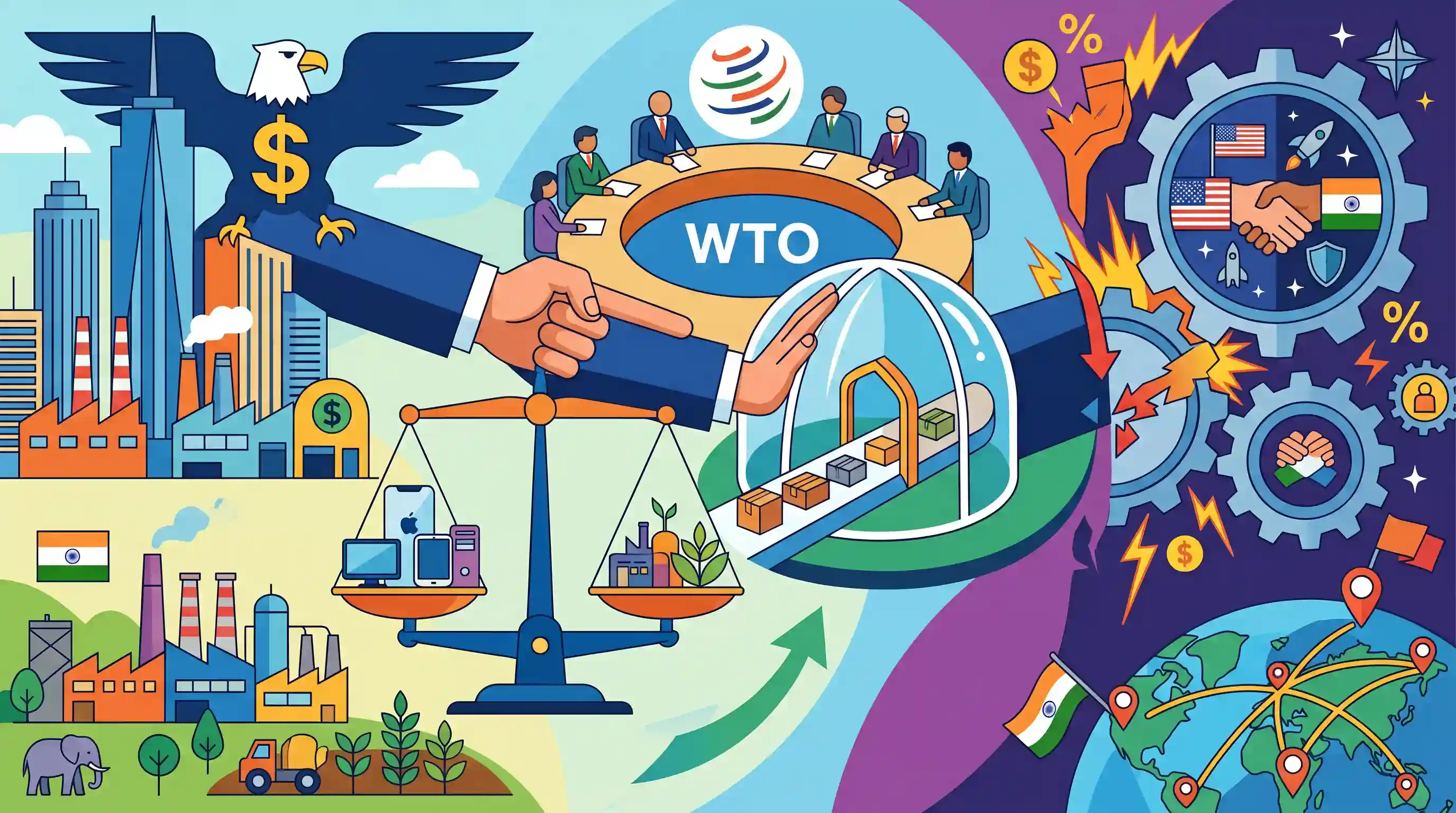
In this opinion piece, P. Chidambaram critiques the United States' persistent demands for absolute 'reciprocity' in tariffs from India. He argues that demanding equal tariffs between two vastly unequal economies—a developed superpower and a developing nation—is an act of 'audacity' rather than a pursuit of fair trade. The article emphasizes that under the World Trade Organization (WTO) framework, developing countries are rightfully entitled to Special and Differential Treatment (S&DT) to protect their nascent domestic industries. By pushing for strict reciprocity, the US ignores these structural realities and leverages protectionist tactics that challenge the multilateral trading order, thereby injecting economic friction into the otherwise deepening India-US strategic partnership.
Key Points
- The article critiques the US demand for exact tariff reciprocity from developing countries like India, labeling it as 'audacity' rather than genuine fairness.
- Highlights the structural disparities between the US (a developed economy) and India (a developing economy), asserting that unequal economies cannot be subjected to identical tariff rules.
- Underscores the importance of the WTO's Special and Differential Treatment (S&DT) provision, which allows developing nations to maintain higher tariffs to protect nascent domestic industries.
- Argues that aggressive US trade posturing and protectionism threaten the multilateral trading system and complicate the broader India-US strategic partnership.
Important Terms
Special and Differential Treatment (S&DT)

WTO provisions granting developing nations flexibility, such as longer implementation periods and softer obligations, to address economic disparities and ensure trade supports their development.
UPSC context
GS Paper 2 (International Relations) and GS Paper 3 (Economy); critical for India's stance on global trade equity.
World Trade Organization (WTO)
The global body regulating international trade rules. It promotes a rules-based system, though its authority is currently challenged by unilateral trade actions and a paralyzed dispute settlement mechanism.
UPSC context
GS Paper 2 (Important International Institutions); tests understanding of global trade governance and India's advocacy for multilateralism.
Reciprocity (Trade)
A trade principle where nations grant mutual concessions. The US demands 'absolute' reciprocity (equal tariffs), while India defends 'relative' reciprocity based on developmental stages.
UPSC context
GS Paper 2 (Bilateral Relations - US-India); relevant for analyzing trade friction and the 'America First' policy impact.
Most-Favoured-Nation (MFN) Principle
A cornerstone WTO rule requiring members to treat all trading partners equally; any favor granted to one member must be extended to all others.
UPSC context
GS Paper 3 (Economy); essential for understanding non-discrimination in international trade and challenges posed by bilateralism.
General Agreement on Tariffs and Trade (GATT)
The 1947 legal agreement that preceded the WTO; it established the initial framework for reducing trade barriers and introduced early concepts of preferential treatment.
UPSC context
GS Paper 3 (Economy/Trade); provides the historical evolution of the multilateral trading system and trade liberalization.
Protectionism
Government actions and policies, such as high tariffs or quotas, that restrict international trade to protect domestic industries from foreign competition.
UPSC context
GS Paper 3 (Economy); relevant for discussing global trade wars and their impact on India’s export-led growth.
Prelims Trap
The WTO classifies members as developed or developing countries based on a strict per capita GDP formula.
The WTO does not define 'developed' or 'developing' countries. Members 'self-declare' their developing status to claim S&DT benefits, though other nations can challenge this.
Static Concepts Connected
What is the significance of the 1979 GATT Enabling Clause?
- GSP Foundation: It provides the permanent legal framework for the Generalized System of Preferences (GSP), allowing developed countries to grant asymmetric tariff preferences to developing nations.
- Non-reciprocity principle: It formally embeds the principle of non-reciprocity, stating developed nations should not expect matching trade concessions from developing and least-developed economies.
What are the core benefits of WTO's Special and Differential Treatment (S&DT)?
- Implementation flexibility: Grants developing and least-developed nations significantly longer transition periods to fully comply with and implement WTO agreements.
- Tariff protection: Allows developing nations to maintain higher tariff ceilings and provide greater domestic support (like agricultural subsidies) to safeguard vulnerable, nascent domestic industries.
Cross-Topic Patterns
Strategic warmth vs Trade friction
While India-US defense ties (iCET, Quad) are rapidly strengthening, economic relations remain highly transactional, marked by disputes over S&DT, agricultural subsidies, and the US revocation of India's GSP status.
Contested WTO developing status
Developed nations seek to overhaul WTO rules to graduate large emerging economies like India and China out of S&DT, reflecting how trade classifications are weaponized amid shifting geopolitical power.

Expect a Prelims question distinguishing between WTO’s 'self-declared' developing status, S&DT, and the GATT Enabling Clause in 2026.
Linked PYQs · 4
Linked PYQs · 4
- 2019MainsGS2
‘What introduces friction into the ties between India and the United States is that Washington is still unable to find for India a position in its global strategy, which would satisfy India's national self-esteem and ambitions.’ Explain with suitable examples.
- 2018MainsGS2
What are the key areas of reform if the WTO has to survive in the present context of "Trade War', especially keeping in mind the interest of India?
- 2016MainsGS2
The broader aims and objectives of WTO are to manage and promote international trade in the era of globalization. But the Doha round of negotiations seem doomed due to differences between the developed and the developing countries." Discuss in the Indian perspective.
- 2012MainsGS2
Discuss the likely negative impact of the protectionist measures proposed by the US on India's software industry.
