Geopolitical implications of US China relations for India
Source:Indian Express ↗
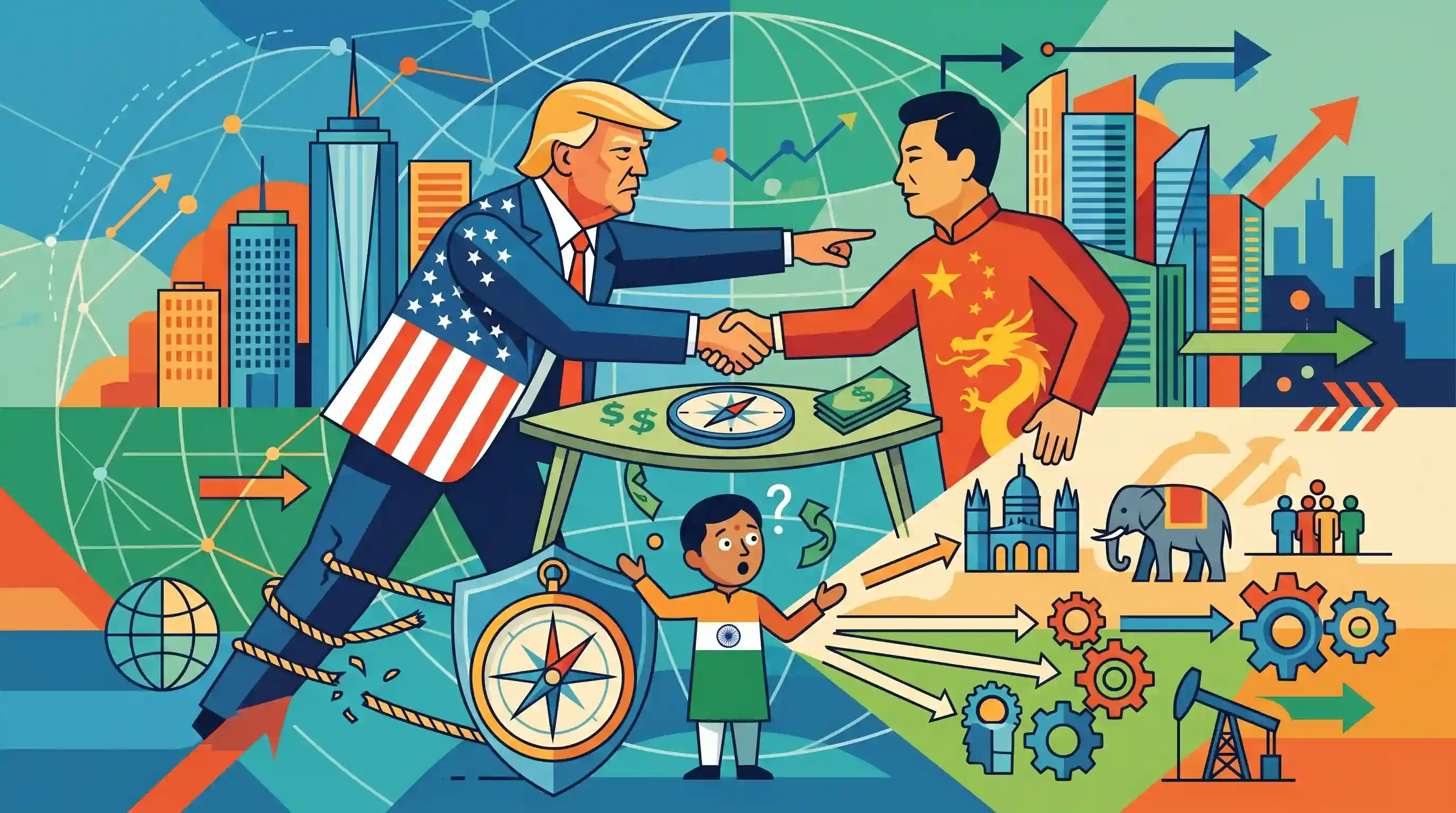
Why It Matters
Understanding the fluid dynamics between the US, China, and India is crucial for UPSC aspirants, as it directly impacts India's foreign policy choices, the relevance of groupings like the Quad, and New Delhi's pursuit of strategic autonomy in a multipolar world.
Summary
In this opinion piece, P. Chidambaram critically evaluates the evolving geopolitical triangle between the US, China, and India under Donald Trump's administration. He argues that Trump's transactional approach to foreign policy might lead to an unexpected accommodation with Chinese President Xi Jinping, potentially sidelining India. This scenario challenges New Delhi's strategic calculus, which has increasingly relied on the US as a counterweight to China's regional dominance. The article highlights the vulnerabilities of India's current diplomatic posture and underscores the necessity for New Delhi to maintain robust strategic autonomy and diversify its partnerships rather than over-depending on a potentially unpredictable US administration.
Key Points
- The article explores the geopolitical implications of a potential transactional relationship between US President Donald Trump and Chinese President Xi Jinping.
- A US-China detente or accommodation risks marginalising India, leaving it strategically 'in the cold' and diminishing its leverage as the West's primary counterweight to Beijing.
- The author critiques New Delhi's heavy reliance on the US partnership to balance China, warning against the vulnerabilities of an over-dependent foreign policy.
- India is advised to recalibrate its diplomatic strategy, ensuring robust strategic autonomy and diversifying its alliances in a highly unpredictable global order.
Important Terms
Quad

An informal strategic forum comprising India, USA, Japan, and Australia aimed at ensuring a free and open Indo-Pacific. It focuses on maritime security, infrastructure, and countering regional assertiveness.
UPSC context
GS Paper-II: Bilateral/regional groupings. Tests understanding of India’s role in maritime security and balancing China's influence in the Indo-Pacific.
Strategic Autonomy
India’s ability to make independent foreign policy and defense decisions without external pressure or alliance obligations. It prioritizes national interest through flexible engagement with multiple global power centers.
UPSC context
GS Paper-II: India’s foreign policy. Tests the ability to maintain sovereign decision-making while navigating great-power rivalries (US-Russia-China).
Transactional Foreign Policy
A pragmatic approach to international relations that prioritizes short-term "deals" and reciprocal gains over long-standing institutional norms, traditional alliances, or shared ideological values.
UPSC context
GS Paper-II: Policies of developed countries. Tests impact of shifting US diplomatic styles on India’s long-term strategic and economic interests.
Indo-Pacific
A geostrategic construct spanning the Indian and Pacific Oceans. It is the primary theater for global trade and power competition, central to India’s security and economic interests.
UPSC context
GS Paper-II/III: Regional security and trade. Tests knowledge of maritime commons, freedom of navigation, and India's "Act East" policy.
Multi-alignment
A diplomatic strategy of maintaining robust, independent ties with various global powers simultaneously. It allows India to balance competing interests while maximizing its strategic and economic maneuverability.
UPSC context
GS Paper-II: Foreign policy evolution. Tests understanding of India’s transition from Non-Alignment to a proactive, pragmatic global engagement strategy.
G-2 (Group of Two)
A concept suggesting a formal or informal partnership between the United States and China to collectively manage global affairs, often raising concerns about marginalizing other major powers like India.
UPSC context
GS Paper-II: Global groupings. Tests awareness of US-China dynamics and the risks of a "grand bargain" marginalizing India’s strategic space.
Prelims Trap
"India's strategic autonomy requires maintaining strict equidistance from the US and China in all geopolitical groupings."
Strategic autonomy means independent, issue-based multi-alignment to maximize national interest. It does not mandate rigid neutrality or equidistance as seen in the Cold War era.
Static Concepts Connected
How does Strategic Autonomy differ from traditional Non-Alignment?
- Cold War origins: Non-Alignment emerged as a strategy to avoid formal entanglements in US and Soviet military blocs.
- Active Engagement: Strategic autonomy involves proactive, multi-directional partnerships to maximize national interest, without becoming a subordinate ally.
- Issue-based alignment: Reflected in India's ability to participate simultaneously in rival groupings like the Quad (US-led) and SCO/BRICS (China/Russia-inclusive).
What constitutes a "transactional" foreign policy approach?
- Pragmatism over ideology: Prioritizes immediate, tangible economic or security concessions over long-term structural alliances or shared democratic values.
- Conditional support: Alliances are viewed as business deals, where security guarantees heavily depend on immediate financial or trade reciprocation.
- Unpredictability: Leads to sudden diplomatic pivots (like a US-China detente) if the short-term cost-benefit analysis shifts, bypassing traditional allies.
Cross-Topic Patterns
Transactional Tariffs + China Plus One
A transactional US-China trade accommodation could undermine the "China Plus One" strategy, potentially stalling Western supply-chain "friendshoring" investments flowing into India's PLI schemes.
Quad Deterrence + Continental Defense
If the US softens its Indo-Pacific deterrence against China, India must urgently recalibrate its security posture, shifting focus back to continental defense and direct bilateral border management.

Mains 2026 will likely test 'Strategic Autonomy', framing India's multi-alignment against unpredictable US policies and a US-China detente.
Linked PYQs · 3
Linked PYQs · 3
- 2024MainsGS2
‘The West is fostering India as an alternative to reduce dependence on China's supply chain and as a strategic ally to counter China's political and economic dominance.’ Explain this statement with examples.
- 2020MainsGS2
What is the significance of Indo-US defence deals over Indo-Russian defence deals? Discuss with reference to stability in the Indo-Pacific region.
- 2014MainsGS2
With respect to the South China sea, maritime territorial disputes and rising tension affirm the need for safeguarding maritime security to ensure freedom of navigation and over flight throughout the region. In this context, discuss the bilateral issues between India and China.
