Constitutional Resilience Against Divisive Political Rhetoric
Source:Indian Express ↗
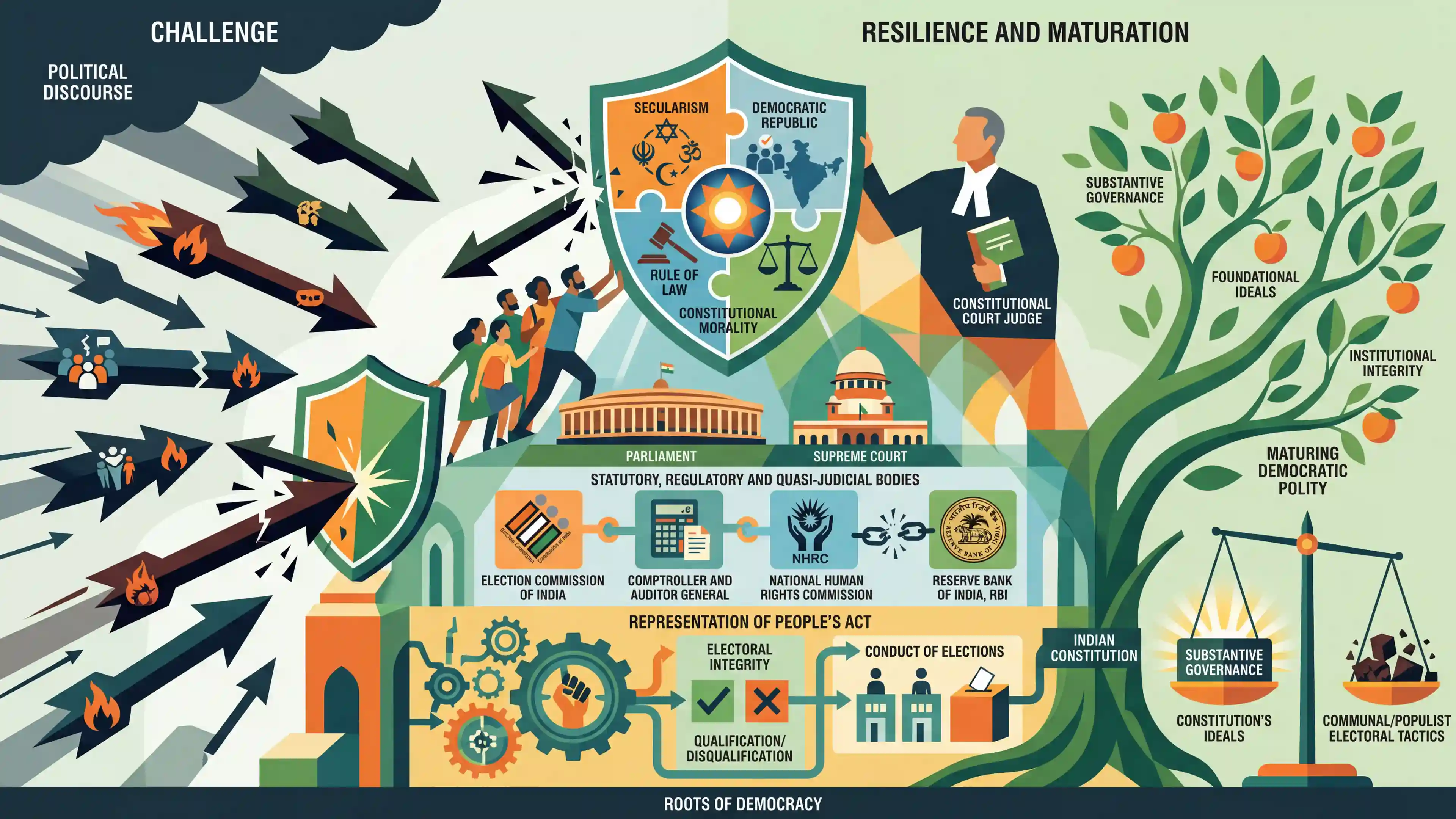
Why It Matters
Understanding the impact of divisive rhetoric on the democratic process is vital for civil servants. The article provides a critical analysis of how constitutional morality and institutional resilience counter majoritarian populism, directly mapping to the GS Paper II syllabus on the Constitution, democratic functioning, and electoral dynamics.
Summary
In this column, P. Chidambaram critiques the employment of polarizing and divisive rhetoric—described metaphorically as 'poisoned arrows'—in India's political and electoral discourse. He argues that when voters and constitutional courts reject these toxic narratives, it serves as a testament to the enduring resilience of Indian democracy. The piece underscores the necessity of upholding constitutional morality, secularism, and institutional integrity. Ultimately, the failure of communal and purely populist electoral tactics indicates a maturing democratic polity that values substantive governance and the Constitution's foundational ideals over divisive politics.
Key Points
- The metaphor 'poisoned arrows' refers to divisive, polarizing, or communal narratives employed for political and electoral gains.
- The rejection ('shooting down') of such tactics highlights the resilience of the Indian electorate and their commitment to secularism and democratic principles.
- Constitutional morality acts as a necessary safeguard against populist and majoritarian impulses in political campaigning.
- Strong, independent institutions—especially the judiciary and election watchdogs—are critical to maintaining the integrity of the democratic process.
Important Terms
Supreme Court of India

The apex judicial body and final interpreter of the Constitution (Article 124). It safeguards fundamental rights and ensures that legislative and executive actions adhere to constitutional values through judicial review.
UPSC context
GS Paper II: Judiciary. Tests knowledge of the guardian of the Constitution and the Basic Structure doctrine.
Election Commission of India
An autonomous constitutional body (Article 324) tasked with the superintendence, direction, and control of elections to Parliament, State Legislatures, and the offices of the President and Vice-President.
UPSC context
GS Paper II: Constitutional and quasi-judicial bodies. Tests understanding of electoral integrity and democratic functioning.
Constitutional Morality
Adherence to the core values and moral spirit of the Constitution, such as liberty and equality. It prevents arbitrary governance by ensuring leaders act according to constitutional norms.
UPSC context
GS Paper II: Significant provisions. Crucial for questions on judicial activism and transformative constitutionalism.
Secularism
In the Indian context, 'positive secularism' entails equal respect for all religions (Sarva Dharma Sama Bhava) and maintaining a principled distance rather than a strict separation between state and religion.
UPSC context
GS Paper I & II: Preamble and Indian Society. Tests the understanding of India's pluralistic democratic identity.
Representation of the People Act, 1951
A key legislation (Article 327) governing the conduct of elections, qualifications/disqualifications of MPs and MLAs, and the redressal of corrupt practices and election disputes.
UPSC context
GS Paper II: Salient features of the RPA. Essential for questions on electoral reforms and political accountability.
Prelims Trap
Under RPA 1951, appealing for votes based on religion is a corrupt practice only if it is the candidate's own religion.
In the 2017 Abhiram Singh judgment, the Supreme Court ruled that appealing to the religion/caste of either the candidate OR the voter constitutes a corrupt practice under Section 123(3) of the RPA.
Static Concepts Connected
What constitutes a 'corrupt practice' under Section 123 of the RPA, 1951?
- Undue Influence: Direct or indirect interference by a candidate or their agent with the free exercise of any electoral right.
- Identity-based Appeals: Section 123(3) explicitly prohibits seeking votes on the grounds of religion, race, caste, community, or language.
- Promoting Enmity: Section 123(3A) outlaws the promotion of feelings of enmity or hatred between different classes of citizens to further election prospects.
What is the doctrine of Constitutional Morality?
- Core Meaning: It means strict adherence to the core principles of the constitutional text, such as liberty, equality, pluralism, and fraternity.
- Non-explicit status: It is not explicitly defined in the Constitution but was championed by B.R. Ambedkar and frequently invoked by the Supreme Court.
- Anti-majoritarian check: It acts as a critical safeguard against populist impulses and the tyranny of the majority, ensuring substantive democratic governance.
Cross-Topic Patterns
Constitutional Morality in SC Judgments
The doctrine of constitutional morality connects deeply to landmark verdicts like Navtej Singh Johar and Sabarimala, where it was utilized by the Supreme Court to strike down popular or majoritarian social morality.
Electoral Speech vs Article 19(1)(a)
The restriction on communal vote appeals under RPA Section 123 acts as a practical application of 'reasonable restrictions' on a candidate's fundamental right to free speech under Article 19(2).

Expect a 2026 Prelims statement contrasting statutory 'corrupt practices' under RPA 1951 against the non-statutory Model Code of Conduct.
Linked PYQs · 3
Linked PYQs · 3
- 2025MainsGS2
"Constitutional morality is the fulcrum which acts as an essential check upon the high functionaries and citizens alike...." In view of the above observation of the Supreme Court, explain the concept of constitutional morality and its application to ensure balance between judicial independence and judicial accountability in India.
- 2021MainsGS2
‘Constitutional Morality’ is rooted in the Constitution itself and is founded on its essential facets. Explain the doctrine of ‘Constitutional Morality’ with the help of relevant judicial decisions.
- 2024MainsGS2
Examine the need for electoral reforms as suggested by various committees with particular reference to "one nation one election" principle.
