Macroeconomic challenges and federal friction in India
Source:Indian Express ↗
Why It Matters
This article is relevant for UPSC aspirants as it provides a critical analysis of the current macroeconomic environment and federal governance issues. It directly relates to GS Paper 3 (Economic Development) and GS Paper 2 (Polity and Governance), particularly concerning structural unemployment, inclusive growth, and the evolving dynamics of Centre-State fiscal relations.
Summary
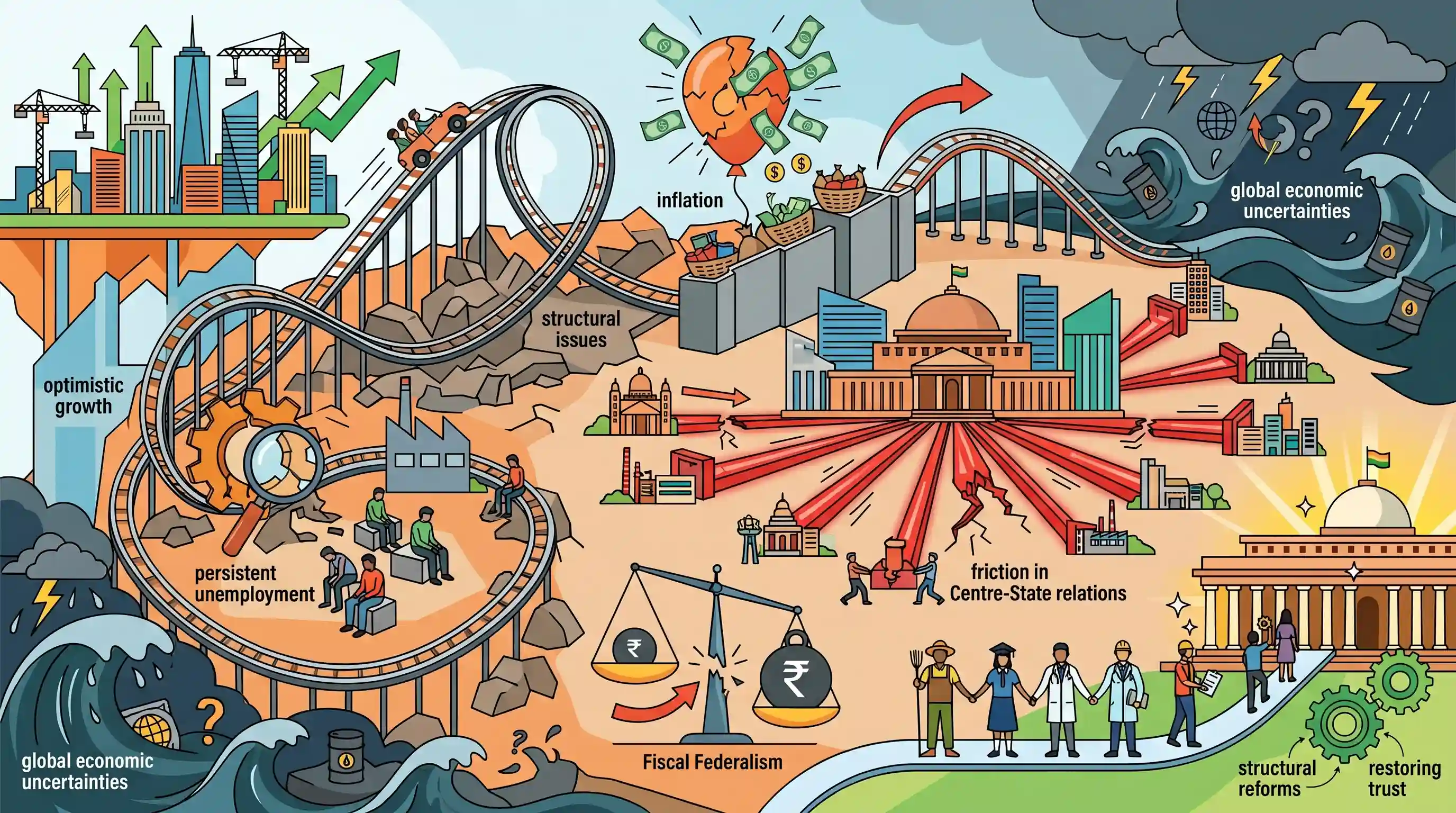
In this column, P Chidambaram warns of upcoming economic and political volatility in India. He highlights the structural issues plaguing the Indian economy, such as persistent unemployment and inflation, which contradict the optimistic narratives of robust growth. The article also points to the increasing centralization of power by the Union government, causing friction in Centre-State relations and undermining fiscal federalism. Coupled with global economic uncertainties, the author argues that India must brace for a 'roller-coaster ride', urging policymakers to focus on inclusive growth, structural reforms, and restoring trust in democratic and federal institutions.
Key Points
- The Indian economy is facing structural challenges, highlighted by persistent inflation and high structural unemployment despite claims of growth.
- Political turbulence and election cycles are expected to create a 'roller-coaster' effect on governance and market stability.
- There is growing friction in Centre-State relations, with regional entities demanding greater fiscal autonomy against the Union government's centralising tendencies.
- Global economic uncertainties, trade disruptions, and macroeconomic volatility require cautious and inclusive policy-making rather than complacency.
Important Terms
Fiscal Federalism

The financial relationship and resource allocation between different levels of government, focusing on the distribution of taxation powers, expenditure responsibilities, and revenue-sharing mechanisms.
UPSC context
Critical for GS-II (Polity) and GS-III (Economy); tests understanding of the Finance Commission, GST, and cooperative federalism.
Centre-State Relations
The constitutional division of legislative, administrative, and financial powers between the Union and the States, governed by Articles 245-293 of the Indian Constitution.
UPSC context
Core GS-II topic; examines the balance between national unity and regional autonomy in India's quasi-federal structure.
Union Government
The official constitutional term for India's central authority, signifying a 'Union of States' (Article 1) where powers are derived from the Constitution, rather than subordinate to a center.
UPSC context
Relevant for GS-II; tests conceptual clarity on Indian federalism and the distinction between 'Union' and 'Central' terminology.
Reserve Bank of India (RBI)
India's central bank and statutory body (RBI Act, 1934) responsible for formulating monetary policy, controlling inflation, managing foreign exchange, and ensuring financial system stability.
UPSC context
Essential for GS-III (Economy); covers monetary tools, banking regulation, and the central bank's role in macroeconomic stability.
Inclusive Growth
Economic growth that is distributed fairly across society, creating equitable opportunities for all sections, particularly marginalized groups, while reducing poverty and inequality.
UPSC context
Key GS-III topic; focuses on the quality of growth, employment generation, and social development outcomes beyond just GDP.
Structural Reforms
Long-term policy measures designed to change the underlying framework of the economy, aiming to improve efficiency, remove supply-side bottlenecks, and enhance global competitiveness.
UPSC context
GS-III (Economy); involves analysis of labor, land, and capital market reforms to address 'jobless growth' and productivity issues.
Prelims Trap
India's current unemployment crisis is primarily cyclical, caused by periodic downturns in the business cycle.
India's unemployment is fundamentally structural (driven by skill mismatch) and disguised (in agriculture), rather than primarily cyclical.
Static Concepts Connected
What are the primary types of unemployment observed in the Indian economy?
- Structural: Caused by a mismatch between available worker skills and market demands, especially as the economy transitions from agriculture to services/manufacturing.
- Disguised: Occurs when more people are employed than necessary. Primarily seen in India's agricultural sector, where marginal productivity is close to zero.
- Frictional: Short-term unemployment occurring when individuals are transitioning between jobs or entering the workforce for the first time.
How does the Union government retain revenue outside the divisible tax pool?
- Cesses: Taxes levied for specific purposes (e.g., Health and Education Cess). Under Article 270, they are excluded from the divisible pool shared with states.
- Surcharges: An additional charge or tax on an existing tax, kept exclusively by the Union government for its own purposes.
Cross-Topic Patterns
Jobless Growth & Skill Deficits
The paradox of robust GDP growth coupled with high structural unemployment bridges GS-3 economic growth directly with GS-2 human resources, education quality, and skill development policies.
Asymmetric Fiscal Federalism
Rising centralization ties into GS-2 Centre-State disputes (e.g., over GST devolution, cesses, and state borrowing limits) and GS-3 inclusive macroeconomic policy.

Expect a 2026 Mains GS-3 question contrasting high headline GDP growth with structural unemployment and shrinking fiscal federalism.
Linked PYQs · 4
Linked PYQs · 4
- 2023MainsGS3
Most of the unemployment in India is structural in nature. Examine the methodology adopted to compute unemployment in the country and suggest improvements.
- 2024MainsGS2
What changes has the Union Government recently introduced in the domain of Centre-State relations ? Suggest measures to be adopted to build the trust between the Centre and the States and for strengthening federalism.
- 2022MainsGS3
Is inclusive growth possible under market economy ? State the significance of financial inclusion in achieving economic growth in India.
- 2025MainsGS2
Examine the evolving pattern of Centre-State financial relations in the context of planned development in India. How far have the recent reforms impacted the fiscal federalism in India?
