Macroeconomic Vulnerabilities and Growth Risks in India
Source:Indian Express ↗
Why It Matters
Understanding macroeconomic volatility and its intersection with global events is crucial for civil servants. It highlights the challenges in balancing inflation control with growth and job creation, which are core themes in GS3.
Summary
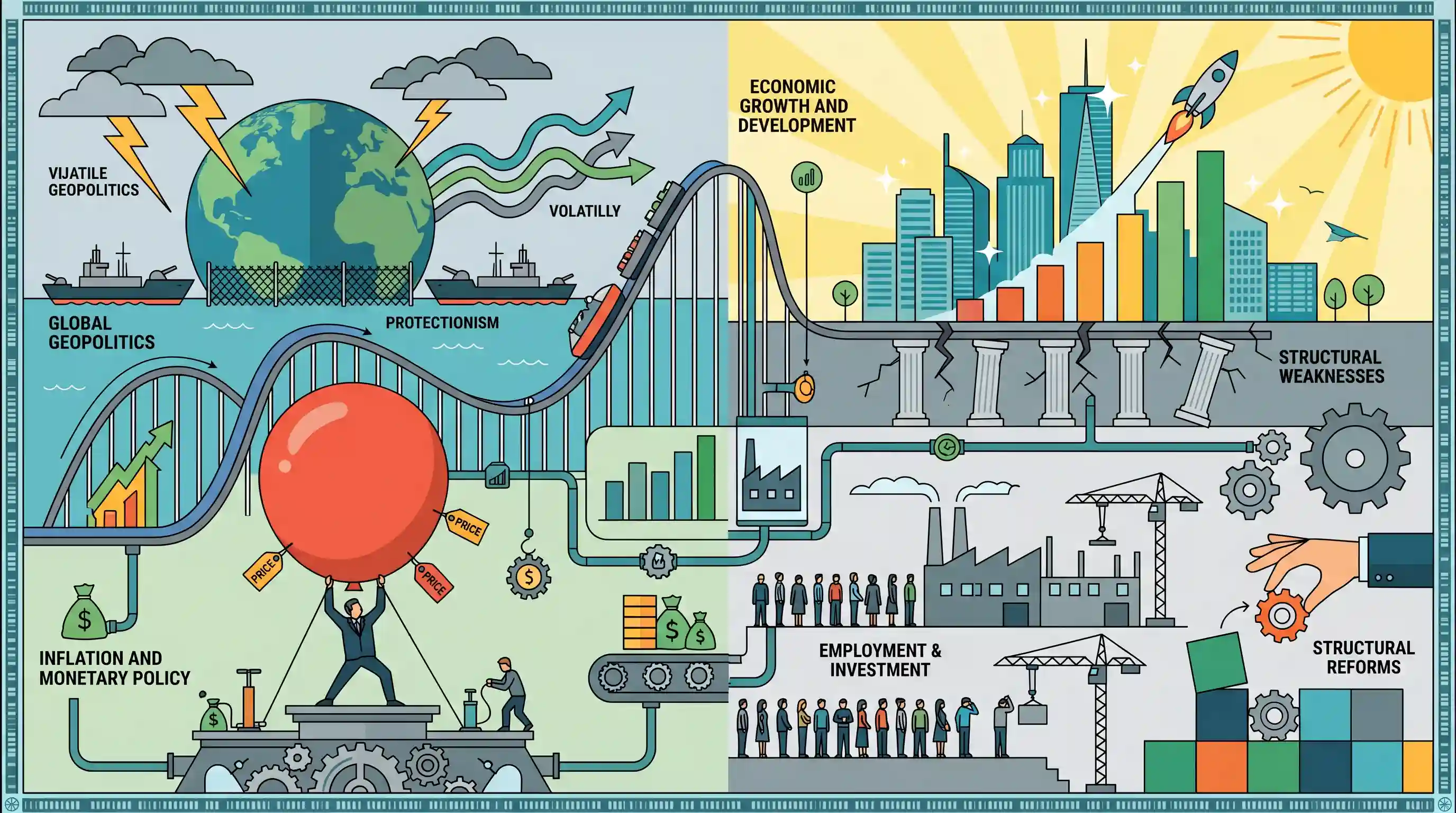
In this column, P. Chidambaram analyzes the macroeconomic vulnerabilities facing the Indian economy amidst escalating global uncertainty. The 'roller coaster ride' alludes to the anticipated economic volatility triggered by geopolitical tensions, trade protectionism, and fluctuating global capital flows. The article highlights the structural weaknesses in India's growth narrative, particularly the disconnect between headline GDP numbers and the ongoing crises of unemployment and sluggish private investment. With stubbornly high inflation limiting the Reserve Bank of India's monetary policy room, the author underscores the urgent need for structural reforms and realistic policy measures to insulate the domestic economy from external shocks.
Key Points
- Global uncertainties, trade protectionism, and shifting monetary policies in developed nations are expected to create a highly volatile 'roller coaster' economic environment.
- There remains a noticeable disconnect between India's headline GDP growth figures and the ground realities of stagnant formal job creation and tepid rural demand.
- Stubborn retail inflation, driven largely by food prices, constrains the RBI's capacity to reduce interest rates, thereby keeping borrowing costs high and stalling private investment.
- To navigate impending external shocks and capital flow volatility, policymakers must pivot from optimistic projections toward robust structural reforms and fiscal prudence.
Important Terms
Reserve Bank of India (RBI)

India's central bank and regulatory body for the banking system. It manages currency, oversees the payment system, and conducts monetary policy to ensure price stability and credit flow.
UPSC context
GS Paper III (Economy). Core for understanding monetary policy, banking regulation, and the central bank's role in macro-stability.
Monetary Policy Committee (MPC)
A six-member statutory body of the RBI that determines the benchmark policy rate (Repo Rate) to keep inflation within a target range (4% with a 2% band).
UPSC context
GS Paper III (Economy). Tests knowledge of inflation targeting, interest rate mechanisms, and institutional frameworks for price stability.
Trade Protectionism
Economic policies, such as tariffs and quotas, designed to restrict imports and protect domestic industries from foreign competition. The article links this to global geopolitical tensions.
UPSC context
GS Paper II (IR) & III (Economy). Crucial for analyzing global trade dynamics, WTO issues, and impacts on India's export-led growth.
Gross Fixed Capital Formation (GFCF)
A measure of total investment in fixed assets like machinery, equipment, and infrastructure. It indicates the health of private investment and future productive capacity in the economy.
UPSC context
GS Paper III (Economy). Key indicator for 'Investment Models' and assessing the sluggishness of private sector capital expenditure.
GDP Deflator
An economic metric that measures the level of prices of all new, domestically produced, final goods and services. It is used to adjust nominal GDP to real GDP.
UPSC context
GS Paper III (Economy). Tests understanding of inflation measurement and the statistical nuances between real vs nominal economic growth.
Structural Reforms
Fundamental changes to the institutional and regulatory framework of an economy (e.g., land, labor, or tax laws) intended to improve productivity and long-term efficiency.
UPSC context
GS Paper III (Economy). Essential for questions on sustainable growth, overcoming middle-income traps, and improving the 'Ease of Doing Business.'
Prelims Trap
The RBI uses aggressive repo rate hikes to resolve supply-side food inflation.
Monetary policy targets demand-pull inflation. Food inflation in India is mostly driven by supply-side disruptions (weather, logistics), which repo rate changes cannot directly fix.
Static Concepts Connected
What is Gross Fixed Capital Formation (GFCF)?
- Definition: Measures the net increase in physical assets (like machinery and infrastructure) within an economy over a specific period.
- Macroeconomic Significance: Acts as the primary metric for tracking investment. High GFCF indicates capacity addition for future economic growth and employment generation.
- Current Trend: Currently, India relies heavily on government capital expenditure, as private GFCF remains sluggish despite deep corporate tax cuts.
Why does food inflation constrain RBI monetary policy?
- CPI Weightage: Food and beverages hold a massive ~46% weightage in the Consumer Price Index (CPI), which the RBI uses as its legal inflation anchor.
- Supply-Side Nature: Agricultural prices are volatile due to monsoons and supply-chain bottlenecks. Interest rate hikes (a demand-side tool) are largely ineffective against these supply-side shocks.
- Policy Paralysis: High food prices keep headline CPI above the 4% target, preventing the RBI from cutting interest rates to spur private investment.
Cross-Topic Patterns
Protectionism vs. Export-Led Growth
Rising global trade protectionism directly threatens India's aspiration to emulate East Asian export-driven manufacturing, forcing a strategic reliance on domestic consumption and structural agricultural reforms.
Fiscal-Monetary Policy Coordination
Persistent food inflation highlights the limits of the RBI's inflation targeting framework, showing that monetary stability increasingly depends on fiscal interventions like supply-chain infrastructure and MSP management.

Expect a Prelims question testing the mechanics of jobless growth, private GFCF stagnation, and CPI's food weightage on RBI policy limits.
Linked PYQs · 5
Linked PYQs · 5
- 2022MainsGS3
Economic growth in the recent past has been led by increase in labour productivity." Explain this statement. Suggest the growth pattern that will lead to creation of more jobs without compromising labour productivity.
- 2018MainsGS3
How would the recent phenomena of protectionism and currency manipulations in world trade affect macroeconomic stability of India?
- 2025MainsGS3
What are the challenges before the Indian economy when the world is moving away from free trade and multilateralism to protectionism and bilateralism? How can these challenges be met?
- 2021PrelimsGS1
Which one of the following is likely to be the most inflationary in its effects?
- 2021PrelimsGS1
With reference to Indian economy, demand-pull inflation can be caused/ increased by which of the following? 1. Expansionary policies 2. Fiscal stimulus 3. Inflation-indexing wages 4. Higher purchasing power 5. Rising interest rates Select the correct answer using the code given below.
