RBI Faces Macroeconomic Dilemma Between Inflation And Growth
Source:Indian Express ↗
Why It Matters
The trade-off between inflation control and economic growth is a central theme in UPSC GS-3 (Indian Economy). Understanding the limitations of monetary policy in tackling supply-side inflation while ensuring adequate job creation is critical for Mains answers on macroeconomic management.
Summary
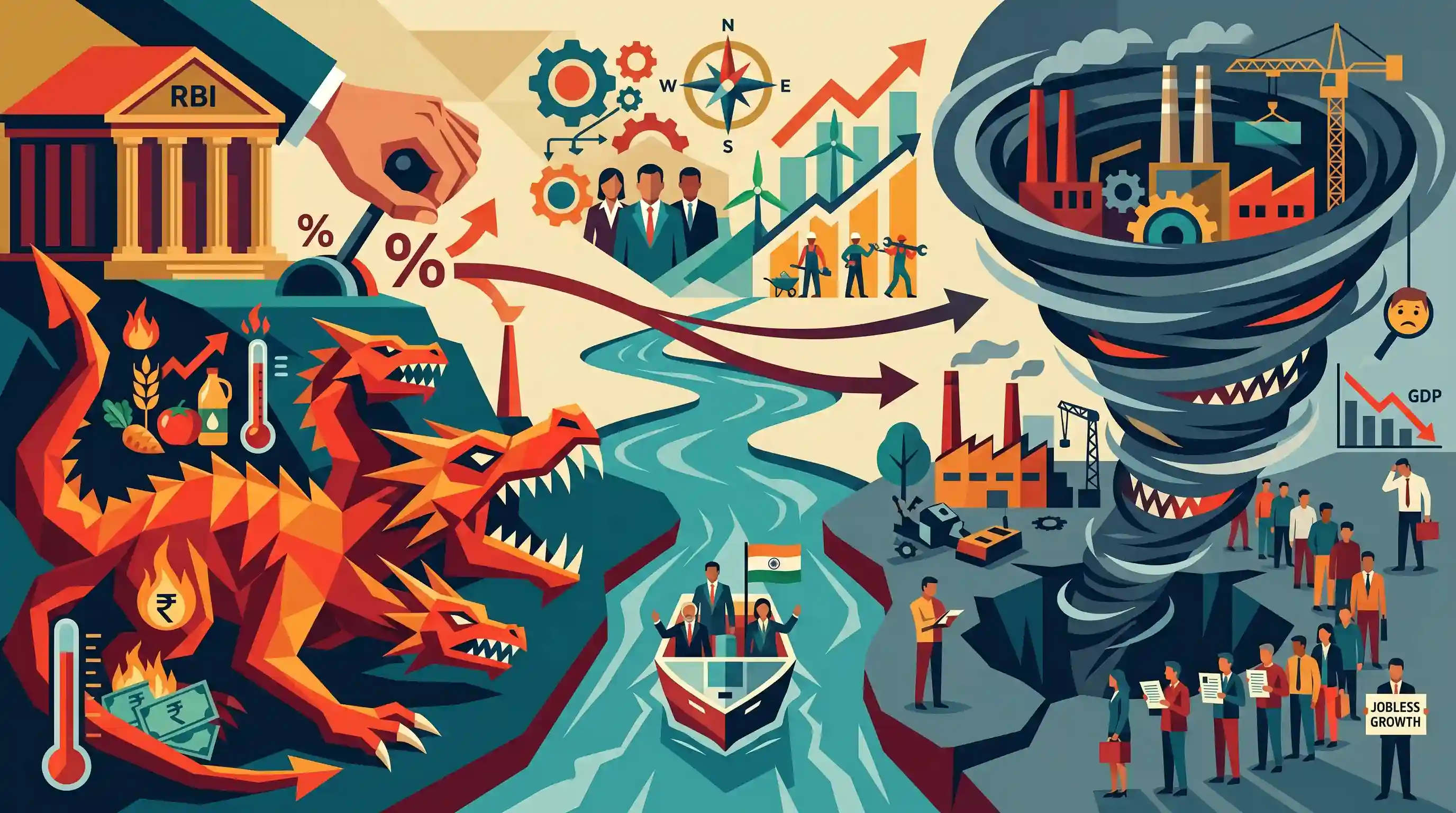
In this column, P. Chidambaram evaluates the formidable macroeconomic dilemma—likened to being caught between 'Scylla and Charybdis'—currently challenging India's policymakers. On one hand, persistent inflation (especially food inflation) exerts upward pressure on the cost of living, compelling the Reserve Bank of India (RBI) to maintain elevated interest rates. On the other hand, this hawkish monetary stance stifles economic growth, dampens private capital expenditure, and exacerbates the crisis of structural unemployment and 'jobless growth'. The author underscores that navigating this tradeoff requires more than just monetary tightening; it demands coordinated fiscal policies, supply-side management, and structural reforms to foster inclusive employment-generating growth without destabilizing price levels.
Key Points
- Policymakers are caught in a classic macroeconomic dilemma (Scylla and Charybdis) between controlling inflation and stimulating economic growth.
- Persistent food inflation forces the RBI to maintain tight monetary policy and high interest rates, which subsequently dampens private investment and industrial expansion.
- The tight monetary stance exacerbates the issue of 'jobless growth' and structural unemployment as credit flow to employment-generating sectors is constrained.
- Addressing this dual challenge requires going beyond monetary tools, necessitating coordinated fiscal interventions and supply-side structural reforms.
Important Terms
Monetary Policy Committee (MPC)

A statutory 6-member body (3 from RBI, 3 government-nominated) tasked with setting the benchmark repo rate to achieve a consumer price inflation target of 4% (±2%).
UPSC context
GS Paper III (Economy); tests knowledge of statutory bodies, inflation-targeting frameworks, and monetary policy transmission.
Reserve Bank of India (RBI)
The central banking institution established under the RBI Act, 1934, responsible for regulating India’s monetary system, managing foreign exchange, and acting as the banker to the government.
UPSC context
GS Paper III (Economy); foundational for understanding central banking, liquidity management, and financial regulation.
Jobless Growth
An economic phenomenon where GDP grows significantly without a corresponding increase in employment, often due to capital-intensive production, automation, or structural skill gaps.
UPSC context
GS Paper III (Employment/Growth); frequently tested in mains regarding India's demographic dividend and sectoral imbalances.
Private Capital Expenditure (Capex)
Investment by private firms in long-term fixed assets (machinery, plants, technology) intended to increase future production; measured as part of Gross Fixed Capital Formation (GFCF).
UPSC context
GS Paper III (Investment Models); critical for analyzing the 'crowding out' effect and sustainable growth drivers.
Scylla and Charybdis
A Greek mythological metaphor describing a choice between two equally perilous options; in economics, it refers to the trade-off between fighting inflation and risking recession.
UPSC context
Essay/Ethics/Economy; used as an analytical lens for policy dilemmas involving high-stakes trade-offs.
Prelims Trap
The RBI uses repo rate hikes as the primary tool to directly resolve agricultural supply shocks and food inflation.
Repo rate hikes cool demand-pull inflation by making credit costlier. Food inflation is largely supply-driven, requiring government fiscal and administrative interventions, not just central bank tightening.
Static Concepts Connected
What is the Phillips Curve and how does it relate to India's current macroeconomic dilemma?
- The Tradeoff: It describes an inverse relationship between inflation and unemployment in the short run. Lowering inflation often leads to higher unemployment.
- Stagflation Risk: Occurs when this curve breaks down, resulting in a stagnant economy with both high inflation and high unemployment, limiting standard monetary tools.
- Structural Limitations: If unemployment is structural (skills mismatch, lack of capacity), monetary easing won't fix it without supply-side economic reforms.
How does Core Inflation differ from Headline Inflation in India's monetary policy framework?
- Headline Inflation: Measures total inflation in an economy, including volatile commodities like food and energy. The RBI's legal mandate is to target Headline CPI (4% +/- 2%).
- Core Inflation: Excludes food and fuel to capture underlying long-term demand trends. It is more responsive to RBI's interest rate changes.
- The Policy Dilemma: Because the MPC must target headline CPI, persistent food shocks force the RBI to keep rates high even if core inflation is well under control.
Cross-Topic Patterns
Monetary Policy + Agri Supply Chains
Recurrent food inflation reveals how climate shocks (El Nino) and APMC bottlenecks actively dictate India's macroeconomic stability, forcing the RBI into a hawkish stance that limits industrial growth.
Jobless Growth + Demographic Dividend
Dampened private CAPEX directly threatens India's demographic dividend window, linking central bank monetary tightening to long-term labor market distress and the broader GS1/GS3 theme of jobless growth.

Expect a multi-statement question on the limits of MPC targeting headline inflation when supply-side food inflation dominates.
Linked PYQs · 3
Linked PYQs · 3
- 2024MainsGS3
What are the causes of persistent high food inflation in India? Comment on the effectiveness of the monetary policy of the RBI to control this type of inflation.
- 2015MainsGS3
The nature of economic growth in India in recent times is often described as jobless growth. Do you agree with this view ? Give arguments in favour of your answer.
- 2023MainsGS3
Most of the unemployment in India is structural in nature. Examine the methodology adopted to compute unemployment in the country and suggest improvements.
