Economic Survey and Union Budget Face Macroeconomic Policy Critique
Source:Indian Express ↗
Why It Matters
This critique provides a critical evaluation of the Union Budget and Economic Survey, which is essential for GS3 mains answers on government budgeting, fiscal policy, and macroeconomic management. It helps aspirants understand the gap between identifying economic challenges and formulating policy solutions.
Summary
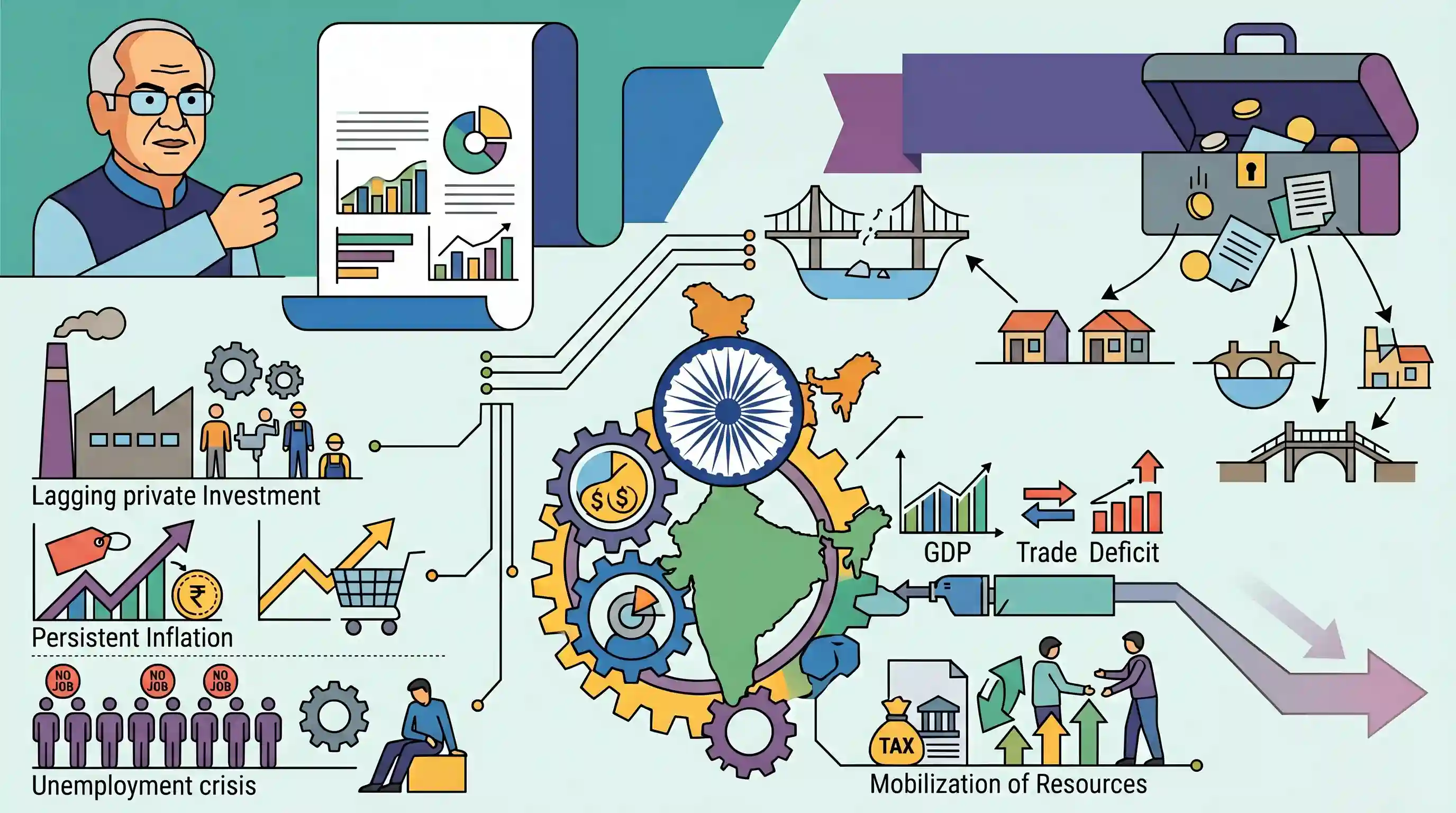
Former Finance Minister P Chidambaram offers a critique of the government's economic approach, contrasting a candid Economic Survey with a 'lazy' Union Budget. While the Survey is commended for honestly identifying structural economic issues such as lagging private investment, persistent inflation, and the unemployment crisis, the Budget is criticized for lacking policy imagination. The piece highlights a disconnect between the accurate diagnosis of macroeconomic challenges and the failure to provide bold, actionable policy reforms needed to stimulate sustained growth and job creation.
Key Points
- The Economic Survey is appreciated for its candid diagnosis of macroeconomic vulnerabilities, including slow private investment, persistent inflation, and the pressing employment crisis.
- The Union Budget is criticized as 'lazy' and uninspired, failing to offer bold policy solutions or concrete structural reforms to tackle the challenges highlighted in the Survey.
- There is a noticeable disconnect between the economic realities identified by the Survey and the incremental policy steps presented in the Budget.
- The critique emphasizes the need for long-term economic reforms and active policy interventions for robust job creation and sustained economic growth.
Important Terms
Economic Survey

An annual document presented by the Ministry of Finance, reviewing the economy's performance over the past year and providing an outlook for the future.
UPSC context
GS Paper III (Economy). Tests ability to analyze macroeconomic trends, sectoral performance, and government policy rationale.
Union Budget
Formally known as the Annual Financial Statement (Article 112), it outlines the government's estimated receipts and expenditures for the upcoming financial year.
UPSC context
GS Paper III and II. Crucial for understanding fiscal policy, budgetary processes, and constitutional provisions.
Ministry of Finance
The nodal ministry for India's financial management, comprising departments like Economic Affairs (which prepares the Budget) and Revenue.
UPSC context
GS Paper II (Governance). Relevant for understanding the institutional framework of India's economic administration.
Chief Economic Advisor (CEA)
The top economic advisor to the Government of India, responsible for authoring the Economic Survey and providing independent policy insights.
UPSC context
GS Paper III. Important for understanding the intellectual leadership behind India's macroeconomic strategy.
Fiscal Consolidation
Policies aimed at reducing the government's fiscal deficit and debt-to-GDP ratio to ensure long-term sustainability.
UPSC context
GS Paper III. Central to discussions on fiscal health, FRBM Act compliance, and macroeconomic stability.
Gross Fixed Capital Formation (GFCF)
A measure of the total increase in physical assets (investment) within the economy, reflecting the private sector's contribution to growth.
UPSC context
GS Paper III. Key indicator for assessing investment trends and productive capacity in the Indian economy.
Prelims Trap
"The Economic Survey is a constitutionally mandated document presented under Article 112."
Article 112 only mandates the Annual Financial Statement (Budget). The Economic Survey is a non-binding government practice, neither constitutionally mandated nor legally required to be accepted by the government.
Static Concepts Connected
What is the "crowding-out" effect in the context of government budgets?
- Mechanism: The government borrows heavily from the domestic market to finance its high fiscal deficit, absorbing available liquidity.
- Interest Rates: This massive public borrowing increases the overall demand for loanable funds, driving up real interest rates.
- Private Impact: Higher borrowing costs make it expensive for the private sector to access credit, leading to stagnant or reduced private investment.
Which departments are responsible for preparing the Economic Survey and Union Budget?
- Economic Survey: Prepared by the Economic Division of the Department of Economic Affairs (DEA), guided by the Chief Economic Adviser (CEA).
- Union Budget: Prepared by the Budget Division of the Department of Economic Affairs (DEA), Ministry of Finance.
Cross-Topic Patterns
Jobless growth and Demographic Dividend
Structural failure to convert GDP growth into labor-intensive manufacturing jobs directly threatens India's demographic dividend window, linking GS3 macroeconomics to GS1 demographic trends.
Fiscal policy vs RBI Inflation targeting
Expansionary budgets can fuel demand-pull inflation, making the RBI's mandate of inflation targeting harder and exposing the tension between fiscal growth pushes and monetary tightening.

Expect a 2026 Mains GS-3 question contrasting the Economic Survey's structural diagnosis of 'jobless growth' with Budget interventions.
Linked PYQs · 5
Linked PYQs · 5
- 2025MainsGS3
Explain how the Fiscal Health Index (FHI) can be used as a tool for assessing the fiscal performance of states in India. In what way would it encourage the states to adopt prudent and sustainable fiscal policies?
- 2021MainsGS3
Distinguish between Capital Budget and Revenue Budget. Explain the components of both these Budgets.
- 2017MainsGS3
One of the intended objectives of the Union Budget 2017-18 is to 'transform, energise and clean India'. Analyse the measures proposed in the Budget 2017-18 to achieve the objective.
- 2021PrelimsGS1
Which one of the following is likely to be the most inflationary in its effects?
- 2021PrelimsGS1
With reference to Indian economy, demand-pull inflation can be caused/ increased by which of the following? 1. Expansionary policies 2. Fiscal stimulus 3. Inflation-indexing wages 4. Higher purchasing power 5. Rising interest rates Select the correct answer using the code given below.
