Five Macro Trends Shaping Socio Economic and Political Future of India
Source:Indian Express ↗
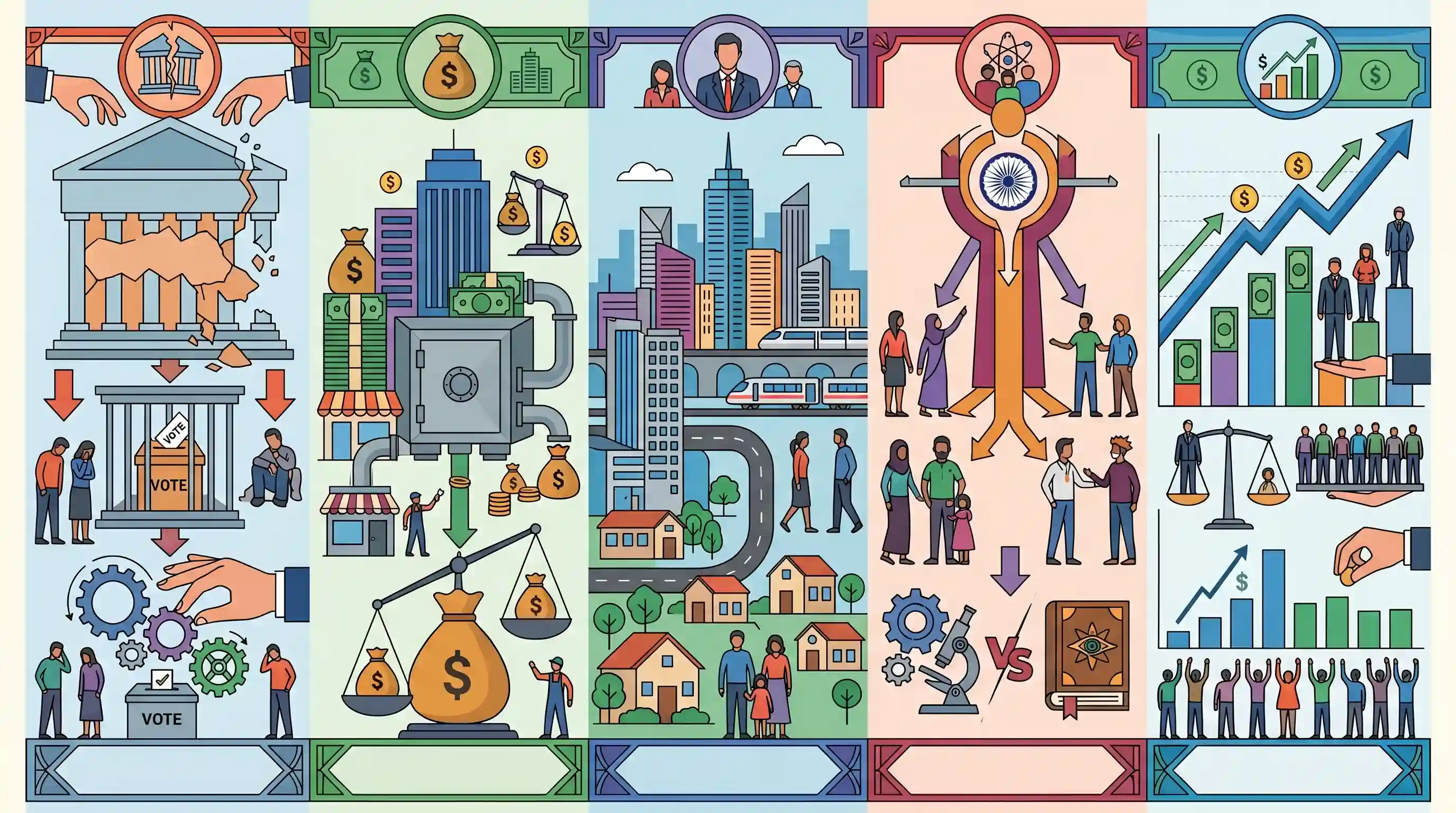
Why It Matters
The article provides a powerful, multi-dimensional framework (spanning polity, economy, and society) for analyzing India's current trajectory. It offers strong critical arguments and fodder for Mains answers across GS1 (Society), GS2 (Polity/Rights), and GS3 (Economy), as well as being highly relevant for socio-economic and political Essays.
Summary
In an opinion piece, P. Chidambaram outlines five critical trends currently shaping India's socio-economic and political future. He argues that India is transitioning from a substantive democracy to a mere 'electoral democracy,' accompanied by growing economic monopolies that concentrate wealth and favor capital over labor. Socially, mass urbanization is eroding traditional family structures and local identities, while a rising tide of cultural nationalism—marked by pushes for a Uniform Civil Code and the institutionalization of pseudoscience—is alienating minorities. Ultimately, this trajectory points toward a deeply unequal society where macroeconomic growth masks the stagnant living standards of the poorest citizens.
Key Points
- Substantive democracy is eroding into mere 'electoral democracy,' a decline reflected in global indices like V-Dem and Freedom House, as citizens trade liberties for basic welfare and infrastructure.
- Economic consolidation is creating monopolies and duopolies in key sectors (telecom, aviation, cement), skewing the power balance heavily toward capital and away from labor.
- Mass urbanization and technology-driven transactional relationships are causing a loss of traditional cultural identities, 'native place' connections, and the joint family system.
- The rise of majoritarian cultural nationalism—seen in pushes for a Uniform Civil Code, Hindi imposition, and institutionalized pseudoscience—is increasingly marginalizing minority communities.
- A deep 'K-shaped' economic divide is solidifying, meaning aggregate national growth will coexist with millions of citizens trapped in a cycle of low demand, low consumption, and poor living standards.
Important Terms
Uniform Civil Code (UCC)

A proposed common legal framework for personal matters like marriage and inheritance, applicable to all citizens regardless of religion, as mandated by Article 44 of the Directive Principles.
UPSC context
GS Paper 2 (Polity); tests secularism, DPSP, and the balance between personal laws and gender equality.
V-Dem Institute
A Sweden-based research organization that publishes the "Varieties of Democracy" report, assessing global democratic health using multi-dimensional indices like the Liberal Democracy Index.
UPSC context
GS Paper 2 (Governance/IR); relevant for discussing India’s democratic rankings and international methodological critiques.
Freedom House
A US-based NGO that publishes the "Freedom in the World" report, ranking countries on political rights and civil liberties as 'Free', 'Partly Free', or 'Not Free'.
UPSC context
GS Paper 2 (IR); important for analyzing global perceptions of civil liberties and press freedom in India.
Substantive Democracy
A democratic model focusing on qualitative outcomes like social justice, equality, and the genuine reflection of the people's will beyond formal voting procedures.
UPSC context
GS Paper 2 (Polity/PSIR); tests the distinction between formal democratic structures and their actual impact on welfare.
Electoral Democracy
A system primarily defined by periodic, competitive elections and procedural voting, which may lack robust protections for individual civil liberties and judicial independence.
UPSC context
GS Paper 2 (Governance); central to debates on "Electoral Autocracy" and the qualitative status of democratic institutions.
Cultural Nationalism
An ideology defining national identity through shared cultural heritage, traditions, and language rather than civic citizenship or political contracts.
UPSC context
GS Paper 1 (Social Issues); tests ideologies impacting national integration, secularism, and minority rights.
Prelims Trap
"A K-shaped economic trend signifies a sharp dip followed by a robust, uniform recovery across all income groups."
A K-shaped trajectory describes diverging economic fortunes: the wealthy/formal sector grows rapidly (upward stroke) while the poor/informal sector simultaneously stagnates or declines (downward stroke).
Static Concepts Connected
What is the Competition Commission of India's mandate regarding monopolies?
- Statutory Origin: Established under the Competition Act, 2002, replacing the MRTP Act to prevent practices that have an adverse effect on economic competition.
- Key Functions: Regulates combinations (M&As), prohibits anti-competitive agreements, and penalizes the abuse of dominant market position to protect consumer interests.
How is the Uniform Civil Code (UCC) positioned in the Constitution?
- Article 44: Enshrined in Article 44 as a Directive Principle of State Policy (DPSP), instructing the State to endeavor to secure a UCC for citizens.
- Non-Justiciable: Like all DPSPs under Article 37, it is fundamental in governance but not legally enforceable by any court.
Cross-Topic Patterns
Democracy indices vs. Sovereign ratings
India's official rejection of V-Dem and Freedom House reports mirrors its broader structural pushback against perceived Western bias in global sovereign credit and ESG ratings.
Monopolies vs. Demographic Dividend
The rise of capital-intensive duopolies contradicts India's urgent need for labor-intensive manufacturing, threatening to turn the demographic dividend into a demographic disaster due to jobless growth.

Expect a GS3 Mains question linking market monopolies to the K-shaped economic divide, stagnant wage growth, and poor mass consumption.
Linked PYQs · 3
Linked PYQs · 3
- 2015MainsGS2
Discuss the possible factors that inhibit India from enacting for its citizens a uniform civil code as provided for in the Directive Principles of State Policy.
- 2019MainsGS1
Are we losing our local identity for the global identity? Discuss.
- 2020MainsGS3
Explain intra-generational and inter-generational issues of equity from the perspective of inclusive growth and sustainable development.
