Artificial Intelligence Transformation of Political Economy
Source:Indian Express ↗
Why It Matters
Offers a critical political-economy framework to understand why governments globally struggle to regulate Big Tech, highlighting how the geopolitical race for AI supremacy dictates industrial policy and challenges democratic oversight.
Summary
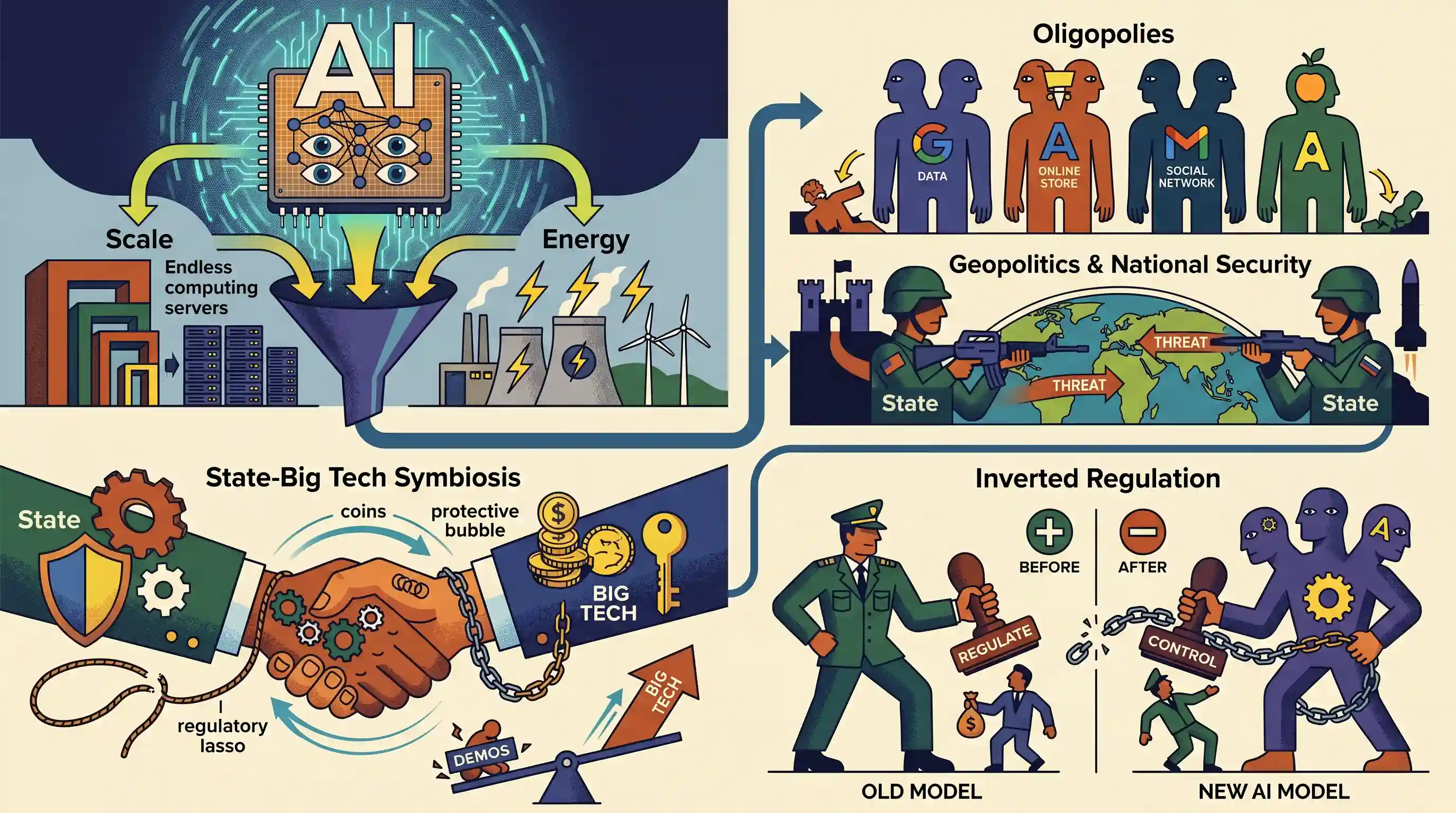
In his column, P B Mehta argues that the rapid advancement of Artificial Intelligence (AI) is fundamentally altering the political economy and state-capital relations. Because AI requires unprecedented scale in capital, computing infrastructure, and energy, it naturally fosters oligopolies. Simultaneously, states view AI supremacy as an existential geopolitical and national security imperative. This convergence forces states into a symbiotic relationship with Big Tech—subsidizing and protecting these monopolies rather than rigorously regulating them. Consequently, traditional democratic oversight is eroded, and the classic model of the state regulating capital is inverted as tech giants entrench their power with state backing.
Key Points
- AI development requires immense resources—computational power, energy, and data—which structurally favors the concentration of capital and the rise of technological oligopolies.
- States increasingly treat AI not merely as commercial technology, but as a critical strategic asset essential for national security and global geopolitical dominance.
- A symbiotic alliance is forming where states subsidize, protect, and rely on tech monopolies to win the global AI race, rather than subjecting them to traditional anti-trust regulation.
- This evolving state-capital dynamic undermines democratic governance, as concentrated corporate power leverages state backing to evade public accountability and oversight.
Important Terms
Big Tech

The most dominant global technology firms that control massive data, infrastructure, and market share, effectively acting as gatekeepers of the digital economy.
UPSC context
GS Paper III: Digital monopolies, competition policy, and the influence of tech giants on national innovation ecosystems.
State-Capital Relations
The dynamic interaction between government authorities and private industry, involving regulation, subsidies, and mutual strategic influence on national policy.
UPSC context
GS Paper II/III: Political economy, crony capitalism, and the state’s role in fostering or regulating industrial growth.
Technological Sovereignty
A nation's ability to develop, control, and govern critical technologies and data without one-sided dependencies on foreign powers or corporations.
UPSC context
GS Paper II: International Relations and Strategic Autonomy; crucial for national security and digital independence.
Compute Infrastructure
The physical hardware, including GPUs and high-performance data centers, required to train and deploy complex artificial intelligence models.
UPSC context
GS Paper III: Science & Technology; foundational for missions like IndiaAI and bridging the global hardware divide.
Regulatory Capture
A form of government failure where a regulatory agency is co-opted to serve the commercial interests of the industry it is supposed to oversee.
UPSC context
GS Paper II/IV: Governance and Ethics; tests understanding of institutional integrity and public interest protection.
Oligopoly
A market structure characterized by a small number of large firms whose actions significantly influence prices and competition within an industry.
UPSC context
GS Paper III: Indian Economy; relevant for antitrust issues and the role of the Competition Commission of India.
Prelims Trap
"The expansion of AI technologies structurally democratises capital and decentralises market power."
Aspirants often assume AI empowers small players. However, its massive demand for compute, data, and energy structurally favours entrenched oligopolies and capital concentration.
Static Concepts Connected
How does the Competition Commission of India (CCI) regulate digital monopolies?
- Statutory Mandate: Enforces the Competition Act, 2002 to eliminate practices having adverse effects on competition and to protect the interests of consumers.
- Digital Scrutiny: Investigates Big Tech for abuse of dominant market position, though traditional metrics struggle with data-monetised, zero-price platforms.
- Deal Value Threshold: 2023 amendments introduced this threshold to review global tech mergers/acquisitions (killer acquisitions) even if target asset values in India are low.
What are the core features of 'Surveillance Capitalism'?
- Definition: An economic system centered on the commodification of personal data, where user experiences are translated into behavioral data.
- Mechanism: Big Tech extracts data to train predictive AI models, utilizing asymmetrical knowledge to manipulate consumer and political behavior without direct consent.
Cross-Topic Patterns
AI's energy footprint vs Climate goals
The massive energy and water demands of AI data centres and large language models conflict directly with national Net Zero targets, creating an environmental-technological paradox.
Tech-nationalism vs Free Trade
States heavily subsidising national tech champions for AI supremacy mirrors semiconductor protectionism, fundamentally challenging WTO norms and the era of globalised free trade.

Expect a GS2/GS3 Mains question on the 'political economy of AI'—specifically how national security imperatives are weakening anti-trust rules.
Linked PYQs · 2
Linked PYQs · 2
- 2023MainsGS3
Introduce the concept of Artificial Intelligence (AI). How does Al help clinical diagnosis? Do you perceive any threat to privacy of the individual in the use of Al in healthcare?
- 2020PrelimsGS1
With the present state of development, Artificial Intelligence can effectively do which of the following? 1. Bring down electricity consumption in industrial units 2. Create meaningful short stories and songs 3. Disease diagnosis 4. Text-to-Speech Conversion 5. Wireless transmission of electrical energy Select the correct answer using the code given below:
