Ozone layer recovery trends amid temporary size fluctuations
Source:The Hindu ↗
Why It Matters
Understanding the distinction between short-term meteorological variability and long-term compliance under international frameworks like the Montreal Protocol is critical for UPSC aspirants studying global environmental governance.
Summary
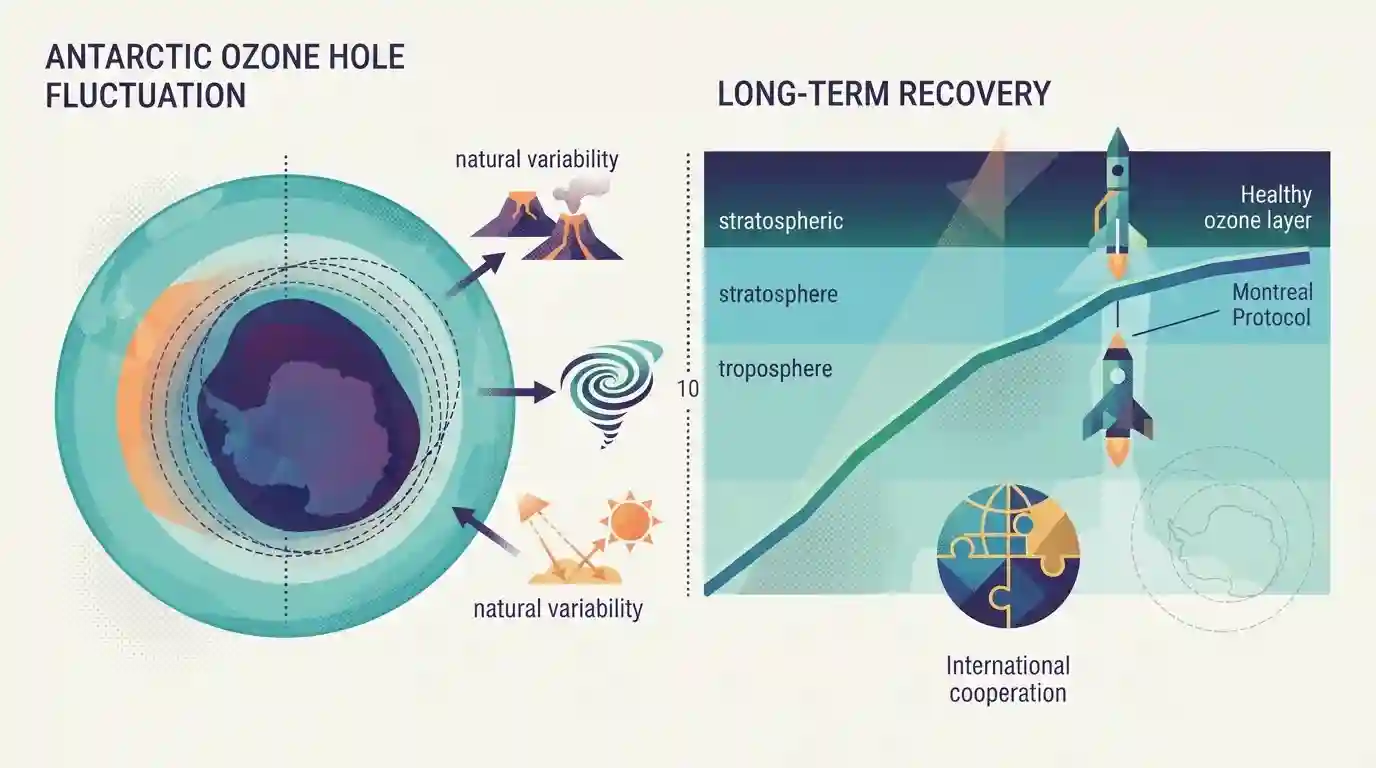
Despite the Antarctic ozone hole recording one of its largest sizes in a decade, scientists affirm that long-term recovery under the Montreal Protocol remains on track. Annual fluctuations are heavily driven by natural stratospheric variability, volcanic aerosols, and polar vortex dynamics rather than a resurgence of ozone-depleting substances.
Key Points
- The Antarctic ozone hole reached one of its largest sizes in a decade due to meteorological conditions such as strong polar vortex dynamics and volcanic aerosols, rather than a failure of global emission controls.
- Despite transient yearly fluctuations and large surface areas, scientific monitoring confirms that the ozone layer remains on a long-term recovery path under the Montreal Protocol.
- Natural factors like volcanic eruptions and stratospheric weather heavily influence annual ozone depletion variations independent of anthropogenic phase-outs.
Important Terms
Montreal Protocol

A landmark international environmental treaty agreed in 1987 to phase out the production and consumption of ozone-depleting substances, successfully placing the Earth's ozone layer on a path to long-term recovery.
UPSC context
UPSC GS Paper III (Environment and Ecology): Crucial international environmental conventions, protocols, and mechanisms addressing global pollution.
Vienna Convention
A 1985 international framework agreement that serves as the basis for global efforts, cooperation, and research to protect the ozone layer from human-induced modifications.
UPSC context
UPSC GS Paper III (Environment): Important global treaties and frameworks for environmental conservation and pollution control.
World Meteorological Organization
A specialized agency of the United Nations responsible for international cooperation on atmospheric science, climatology, and weather monitoring, including tracking ozone layer depletion.
UPSC context
UPSC GS Paper III (Environment): Role of international institutions in monitoring global environmental indicators and climate science.
Copernicus Atmosphere Monitoring Service
An operational service of the European Union's Earth observation programme that provides continuous monitoring and data on global atmospheric composition, including ozone levels.
UPSC context
UPSC GS Paper III (Environment/Science & Tech): Use of advanced satellite monitoring and Earth observation for tracking environmental health.
Static Concepts Connected
What are the key mechanisms and differentiated obligations under the Montreal Protocol and its Kigali Amendment?
- Universal Ratification: Universal ratification by all 198 UN member states, making it the first treaty in UN history to achieve this milestone.
- CBDR Application: Principle of Common But Differentiated Responsibilities operationalized through fixed grace periods and financial assistance via the Multilateral Fund.
- Kigali Amendment: Kigali Amendment (2016) legally binds nations to phase down Hydrofluorocarbons (HFCs), which do not deplete ozone but possess high global warming potential.
Cross-Topic Patterns
Montreal Protocol vs. UNFCCC Compliance Mechanisms
The Montreal Protocol's compliance mechanism is often contrasted with the UNFCCC's pledge-and-review approach, testing candidates on hard enforcement vs. voluntary Nationally Determined Contributions.
Stratospheric Aerosols and Geoengineering Governance
Volcanic aerosols driving stratospheric variability link atmospheric chemistry questions directly with climate geoengineering and solar radiation modification debates.

Expect statement-based questions separating natural stratospheric variability from anthropogenic ODS phase-outs under the Montreal Protocol.
Linked PYQs · 2
Linked PYQs · 2
- 2015PrelimsGS1
Which one of the following is associated with the issue of control and phasing out of the use of ozone-depleting substances?
- 2023PrelimsGS1
Consider the following: 1. Aerosols 2. Foam agents 3. Fire retardants 4. Lubricants In the making of how many of the above are hydrofluorocarbons used?
