Chief Justice of India transition and judicial constitutional morality
Source:The Hindu ↗
Why It Matters
The transition of the Chief Justice of India is a pivotal constitutional event. Discussions around the legacy of the ADM Jabalpur case, constitutional morality, judicial accountability, and the collegium system are core to the UPSC GS2 syllabus concerning the structure, organization, and functioning of the Judiciary.
Summary
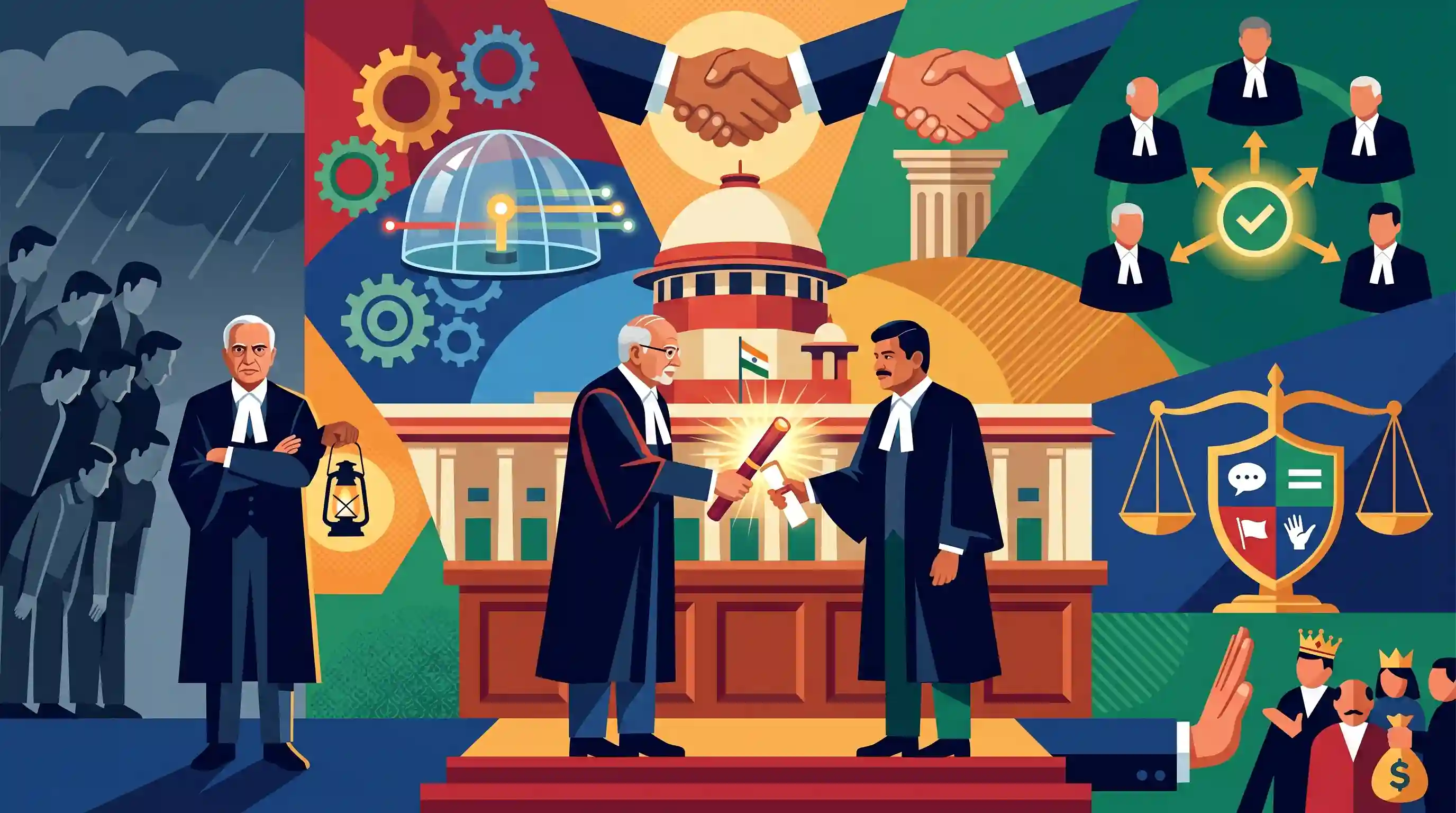
Chief Justice of India Sanjiv Khanna retired, passing the baton to Justice B.R. Gavai. During a ceremonial bench on his last day, CJI Khanna expressed immense faith in Justice Gavai\'s commitment to protecting fundamental rights and constitutional doctrines. The event served as a moment of reflection on judicial independence, the functioning of the collegium system, and the enduring legacy of Justice H.R. Khanna\'s historic dissent in the ADM Jabalpur case. Legal luminaries praised Justice Khanna\'s administrative pragmatism, transparency initiatives, and his steadfast adherence to constitutional morality.
Key Points
- Chief Justice of India Sanjiv Khanna demitted office on May 13, 2025, and will be succeeded by Justice B.R. Gavai.
- CJI Khanna expressed confidence that his successor will uphold the Supreme Court\'s values, fundamental rights, and basic constitutional doctrines.
- The legal fraternity paid rich tributes to CJI Khanna\'s legacy, drawing parallels to his uncle Justice H.R. Khanna\'s historic lone dissent defending constitutional rights in the 1976 ADM Jabalpur case during the Emergency.
- Justice Khanna was lauded for his clarity of thought, transparency initiatives, commitment to judicial accountability, and upholding constitutional morality without personal bias.
Important Terms
ADM Jabalpur Case

A 1976 landmark judgment where the Supreme Court ruled that fundamental rights could be suspended during Emergency. Justice H.R. Khanna’s famous dissent upheld the right to life and personal liberty.
UPSC context
GS Paper II (Polity); essential for understanding civil liberties, Emergency provisions, and the Basic Structure doctrine.
Collegium System
The system for appointing and transferring judges of the higher judiciary, consisting of the CJI and senior SC judges. It evolved through the "Judges Cases" rather than constitutional text.
UPSC context
GS Paper II (Judiciary); critical for discussing judicial independence and the appointment process in higher courts.
Constitutional Morality
The principle of adhering to the core values and spirit of the Constitution—such as liberty and equality—to guide governance and judicial interpretation beyond literal legal text.
UPSC context
GS Paper II and IV (Ethics); tests understanding of values that govern democratic institutions and judicial reasoning.
Chief Justice of India
The highest-ranking officer of the Indian judiciary and head of the Supreme Court. Responsibilities include administrative leadership, presiding over constitutional benches, and acting as the "Master of the Roster."
UPSC context
GS Paper II (Polity); covers the powers, appointment, and constitutional significance of the head of the judiciary.
Judicial Independence
A core constitutional principle ensuring that the judiciary functions without external interference from the executive or legislature, thereby safeguarding the rule of law and fundamental rights.
UPSC context
GS Paper II (Polity); fundamental for discussing the separation of powers and the protection of constitutional values.
Supreme Court Bar Association (SCBA)
A representative body of lawyers practicing in the Supreme Court of India. It represents bar interests, assists in judicial administration, and upholds professional standards within the highest court.
UPSC context
GS Paper II (Judiciary); relevant for the role of legal professionals and bar-bench relations in the justice system.
Prelims Trap
The Constitution of India explicitly mandates that the senior-most judge of the Supreme Court be appointed as the Chief Justice.
Article 124(2) only mentions the appointment of SC judges by the President. The "senior-most judge" rule is a convention codified in the Memorandum of Procedure (MoP), not the Constitution.
Static Concepts Connected
How is the Chief Justice of India appointed?
- Presidential Appointment: The President of India appoints the CJI under Article 124(2) of the Constitution.
- Seniority Convention: By convention, formalized in the Memorandum of Procedure (MoP), the outgoing CJI recommends the senior-most SC judge as their successor.
- Second Judges Case (1993): The Supreme Court explicitly ruled that the senior-most judge should alone be appointed as the CJI, solidifying the convention.
How did the ADM Jabalpur case affect Fundamental Rights during an Emergency?
- 1976 Habeas Corpus Case: The SC majority ruled that citizens cannot move courts for violation of Art 21 during Emergency. Justice H.R. Khanna famously dissented.
- 44th Amendment Act (1978): Enacted to prevent future abuse, it ensured that the enforcement of Articles 20 and 21 cannot be suspended even during a National Emergency (under Art 359).
Cross-Topic Patterns
CJI Office as an RTI Public Authority
The 2019 SC judgment brought the CJI's office under the RTI Act, balancing transparency with judicial independence. This is frequently tested alongside the RTI Act's Section 8 exemptions in Prelims.
Evolution of Constitutional Morality
Mentioned in tributes to CJI Khanna, this principle acts as a check on majoritarianism and arbitrary state power. It is frequently tested in Mains GS2 concerning landmark verdicts like Navtej Johar.

Expect a 2026 Prelims question mixing the MoP for CJI appointment, the Collegium system, and the CJI office's status under the RTI Act.
Linked PYQs · 4
Linked PYQs · 4
- 2025MainsGS2
Discuss the evolution of collegium system in India. Critically examine the advantages and disadvantages of the system of appointment of the Judges of the Supreme Court of India and that of the USA.
- 2025MainsGS2
"Constitutional morality is the fulcrum which acts as an essential check upon the high functionaries and citizens alike...." In view of the above observation of the Supreme Court, explain the concept of constitutional morality and its application to ensure balance between judicial independence and judicial accountability in India.
- 2017MainsGS2
Critically examine the Supreme Court's judgement on 'National Judicial Appointments Commission Act, 2014' with reference to appointment of judges of higher judiciary in India.
- 2021PrelimsGS1
With reference to Indian judiciary, consider the following statements : 1. Any retired judge of the Supreme Court of India can be called back to sit and act as a Supreme Court judge by the Chief Justice of India with prior permission of the President of India. 2. A High Court in India has the power to review its own judgement as the Supreme Court does. Which of the statements given above is/are correct?
