Overfishing Threat to Ocean Wealth and Coastal Livelihoods
Source:The Hindu ↗
Why It Matters
Oceans are vital for the global economy and food security. Understanding the ecological and socio-economic impacts of overfishing is crucial for UPSC aspirants, especially concerning international environmental governance, the WTO's role in global subsidies, and the sustainable utilization of the Blue Economy.
Summary
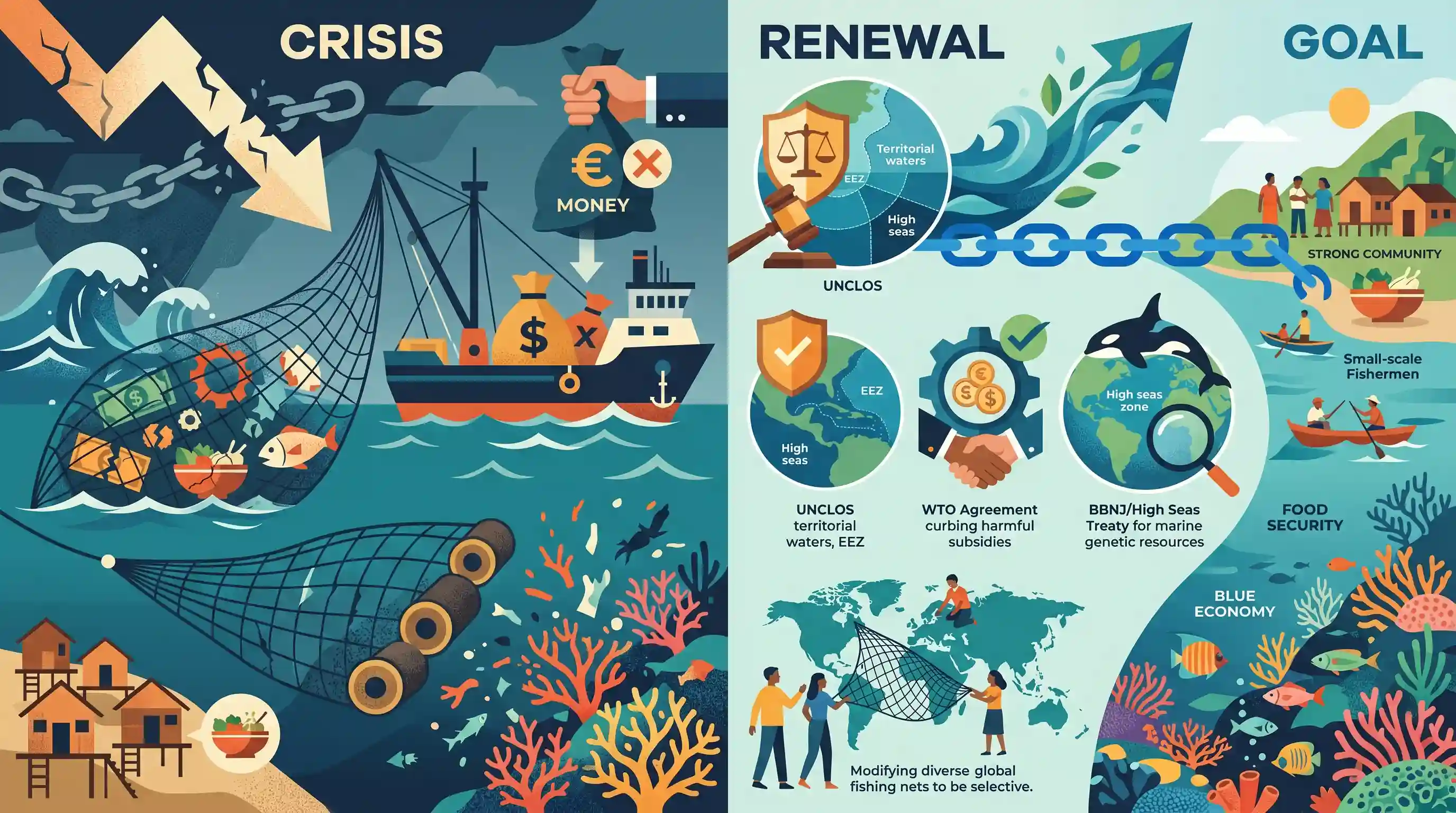
The article highlights the severe consequences of overfishing on global ocean wealth and coastal livelihoods. It explores how destructive practices like bottom trawling and harmful fisheries subsidies are depleting marine resources and destabilizing the Blue Economy. The piece underscores the necessity for effective implementation of international frameworks like UNCLOS, the WTO Agreement on Fisheries Subsidies, and the BBNJ treaty to ensure sustainable marine ecosystem management and safeguard food security for vulnerable communities.
Key Points
- Overfishing driven by commercial demands and harmful subsidies is severely depleting marine fish stocks.
- Destructive fishing methods such as bottom trawling cause long-term damage to coral reefs and benthic ecosystems.
- The depletion of marine resources directly threatens the food security and livelihoods of millions relying on the Blue Economy.
- Harmful fisheries subsidies by major global powers create artificial profitability for large-scale fleets, marginalizing artisanal fishers.
- International treaties like UNCLOS, the High Seas Treaty (BBNJ), and WTO agreements on curbing subsidies are crucial for enforcing sustainable fishing quotas.
Important Terms
UNCLOS

A 1982 international treaty establishing a legal framework for all maritime activities, defining zones like Territorial Seas and Exclusive Economic Zones (EEZ) to manage marine resources.
UPSC context
GS Paper-II (International Relations) and GS-III (Environment); tests maritime sovereignty and resource management frameworks.
WTO Agreement on Fisheries Subsidies
A binding 2022 multilateral pact curbing government subsidies that drive overfishing, overcapacity, and illegal, unreported, and unregulated (IUU) fishing, aligning with SDG 14.6.
UPSC context
GS Paper-III (Economy/Environment); tests knowledge of trade-distorting subsidies and global food security.
High Seas Treaty (BBNJ)
Also known as the BBNJ Agreement, this 2023 legally binding framework under UNCLOS aims to conserve marine biodiversity in international waters beyond national jurisdiction.
UPSC context
GS Paper-III (Environment); tests understanding of global commons and international conservation treaties.
Blue Economy
Sustainable use of ocean resources for economic growth, improved livelihoods, and jobs while ensuring the preservation of the marine ecosystem's health.
UPSC context
GS Paper-III (Economic Development); critical for topics on maritime potential, fisheries, and sustainable resource exploitation.
Sustainable Development Goal 14 (SDG 14)
One of 17 UN Sustainable Development Goals (Life Below Water) aimed at conserving and sustainably using oceans, seas, and marine resources for sustainable development.
UPSC context
GS Paper-III (Environment); standard reference for biodiversity conservation and international sustainability targets.
Prelims Trap
"The WTO Agreement on Fisheries Subsidies completely bans all forms of government subsidies given to fisherfolk."
The WTO agreement targets only subsidies driving illegal, unreported, and unregulated (IUU) fishing or overfished stocks. Developing nations retain Special and Differential Treatment (S&DT) protections for artisanal fishers.
Static Concepts Connected
What is the High Seas Treaty (BBNJ) under UNCLOS?
- Scope: Focuses on Biodiversity Beyond National Jurisdiction, applying only to areas outside any nation's Exclusive Economic Zone (EEZ).
- Marine Protected Areas: Creates a legally binding framework to establish Marine Protected Areas (MPAs) in international waters.
- Genetic Resources: Mandates sharing of benefits from marine genetic resources and capacity building for developing states.
How does bottom trawling structurally degrade marine ecology?
- Benthic Destruction: Weighted nets dragged across the ocean floor physically destroy slow-growing benthic habitats like deep-water coral reefs and sponge grounds.
- Bycatch Crisis: Highly unselective gear leads to massive incidental capture and death of non-target species (turtles, juveniles).
- Carbon Release: Churning the seabed resuspends marine sediments, potentially releasing centuries of naturally sequestered oceanic carbon.
Cross-Topic Patterns
WTO S&DT vs. Blue Economy Goals
India's push for Special and Differential Treatment (S&DT) at the WTO links directly to protecting domestic artisanal fishers while pursuing Blue Economy expansion under PM Matsya Sampada Yojana.
BBNJ and India's Deep Ocean Mission
High Seas biodiversity conservation rules (BBNJ) will dictate compliance costs and environmental limits for India's upcoming poly-metallic nodule exploration in the Central Indian Ocean.

Expect a 2026 multi-statement question mapping the High Seas Treaty (BBNJ), UNCLOS maritime zones, and WTO fisheries subsidies to SDG 14.
Linked PYQs · 5
Linked PYQs · 5
- 2022PrelimsGS1
With reference to the United Nations Convention on the Law of Sea, consider the following statements : 1. A coastal state has the right to establish the breadth of its territorial sea up to a limit not exceeding 12 nautical miles, measured from baseline determined in accordance with the convention. 2. Ships of all states, whether coastal or land-locked, enjoy the right of innocent passage through the territorial sea. 3. The Exclusive Economic Zone shall not extend beyond 200 nautical miles from the baseline from which the breadth of the territorial sea is measured. Which of the statements given above are correct?
- 2013PrelimsGS1
The most important fishing grounds of the world are found in the regions where
- 2011PrelimsGS1
In the context of ecosystem productivity, marine upwelling zones are important as they increase the marine productivity by bringing the 1. decomposer microorganisms to the surface. 2. nutrients to the surface. 3. bottom-dwelling organisms to the surface. Which of the statements given above is/are correct?
- 2016MainsGS2
The broader aims and objectives of WTO are to manage and promote international trade in the era of globalization. But the Doha round of negotiations seem doomed due to differences between the developed and the developing countries." Discuss in the Indian perspective.
- 2014MainsGS2
WTO is an important international institution where decisions taken affect countries in a profound manner. What is the mandate of WTO and how binding are their decisions ? Critically analyse India's stand on the latest round of talks on Food security.
