Retail Inflation Measurement Shift and Monetary Policy Framework
Source:The Hindu ↗
Why It Matters
The CPI base year update fundamentally alters how retail inflation is measured in India. This impacts the RBI's inflation targeting framework, fiscal budgeting (such as Dearness Allowance calculations), and provides a more realistic picture of standard of living and consumption shifts (e.g., increased spending on services over food). It is a core macroeconomic concept heavily tested in both Prelims and Mains.
Summary
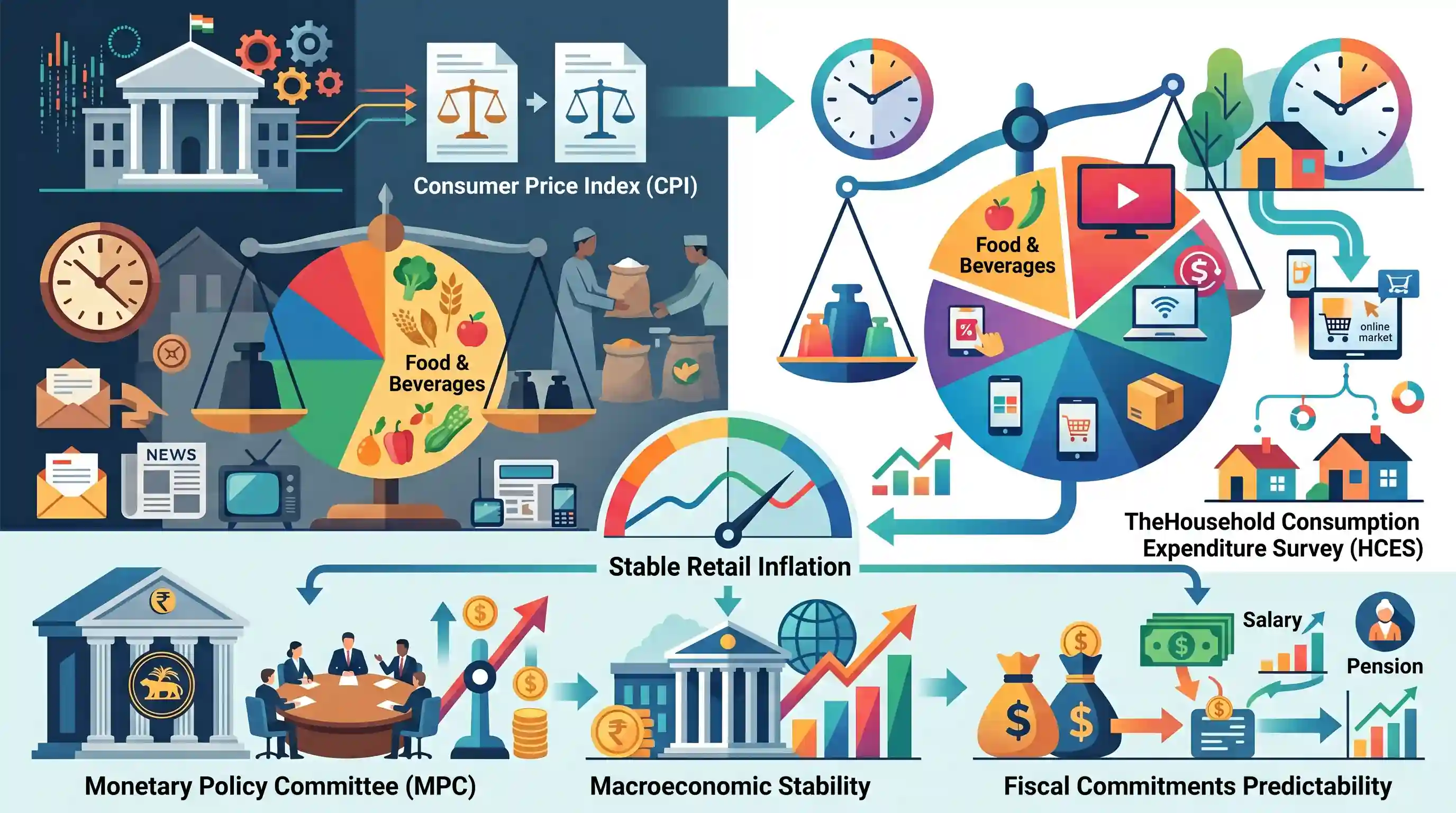
The Ministry of Statistics and Programme Implementation (MoSPI) has released a new series of the Consumer Price Index (CPI), updating its base year from 2012 to 2024. This overdue upgrade reflects modern consumption habits as captured by the Household Consumption Expenditure Survey 2023-24. Notably, the weightage of food and beverages has been reduced to 36.75% from 45.86%, a shift influenced by large-scale free foodgrain welfare schemes. Simultaneously, the index now includes emerging digital services like OTT platforms and online marketplaces. This structural change is expected to yield a more stable and accurate measure of retail inflation, which will significantly benefit macroeconomic management, assist the RBI's Monetary Policy Committee in setting policy rates, and bring predictability to fiscal commitments like inflation-indexed dearness allowances.
Key Points
- The base year for India's Consumer Price Index (CPI) has been updated from 2012 to 2024 by the Ministry of Statistics and Programme Implementation (MoSPI).
- The new CPI series is pegged to contemporary consumption patterns captured in the Household Consumption Expenditure Survey 2023-24.
- The weightage of 'food and beverages' in the CPI basket has been reduced from 45.86% to 36.75%, reflecting the impact of free foodgrain distribution to 80 crore households.
- The revised basket incorporates modern services, including OTT video streaming, and collects data from a larger number of marketplaces, including 12 online platforms.
- By reducing the weight of volatile food prices, the new CPI is expected to be more stable, aiding the RBI's Monetary Policy Committee in interest rate decisions and the government in inflation-indexed budgeting.
- The editorial suggests that the government should institutionalize CPI revisions every five years rather than waiting a decade.
Important Terms
Consumer Price Index (CPI)

A measure that tracks changes over time in the retail prices of a basket of goods and services purchased by households for consumption.
UPSC context
GS Paper III (Economy). Key indicator for measuring retail inflation and the primary tool for the RBI's monetary policy.
Household Consumption Expenditure Survey (HCES) 2023-24
A nationwide survey conducted by the NSSO to assess household spending patterns, calculate Monthly Per Capita Expenditure (MPCE), and provide data for updating the CPI basket.
UPSC context
GS Paper III (Economy). Vital for poverty estimation, analyzing structural shifts in consumption, and rebasing economic indices like GDP.
Monetary Policy Committee (MPC)
A statutory six-member body under the RBI Act, 1934, chaired by the RBI Governor, responsible for determining the policy repo rate to achieve inflation targets.
UPSC context
GS Paper III (Economy). Tested for its composition, mandate of price stability, and the 'flexible inflation targeting' framework.
Flexible Inflation Targeting (FIT)
A policy framework where the central bank is mandated to maintain headline inflation (CPI) at a target of 4%, within a tolerance band of 2% to 6%.
UPSC context
GS Paper III (Economy). Core concept regarding the RBI's mandate and its accountability to the Government of India.
Ministry of Statistics and Programme Implementation (MoSPI)
The nodal agency of the Government of India responsible for the national statistical system, including the compilation of GDP, CPI, and monitoring project implementation.
UPSC context
GS Paper II & III. Important for understanding the institutional framework of India's official statistics and data governance.
Engel’s Law
An economic theory stating that as family income rises, the percentage of income spent on food decreases, even if total food expenditure increases.
UPSC context
GS Paper III (Economy). Explains why the weight of food in India's CPI basket has significantly dropped in the 2024 rebasing.
Dearness Allowance (DA)
An inflation-linked compensatory allowance paid to government employees and pensioners to hedge against the rising cost of living.
UPSC context
GS Paper III (Economy/Fiscal Policy). Represents the practical application of CPI data in managing government fiscal commitments and social security.
Prelims Trap
"The weightage of food and beverages in the new CPI series has increased to reflect the recent spikes in food inflation."
Aspirants conflate high food inflation with basket weights. Food weight actually decreased (from 45.86% to 36.75%) because free foodgrain schemes lowered the out-of-pocket expenditure proportion for households.
Static Concepts Connected
What are the key differences between WPI and CPI in India?
- Publishing Authority: WPI is published by the Office of Economic Adviser (MoCI); CPI is published by the National Statistical Office under MoSPI.
- Coverage of Services: WPI tracks only goods at the wholesale level. CPI tracks both goods and services (like housing, education, and OTT) at the retail consumer level.
- Base Year: WPI uses 2011-12 as its base year, while CPI has now updated its base year to 2024.
What is the statutory mandate of the Monetary Policy Committee (MPC)?
- Inflation Targeting: Amended RBI Act, 1934 mandates the MPC to maintain the headline consumer price inflation (CPI) target at 4%, with a tolerance band of +/- 2%.
- Composition: It has 6 members (3 from RBI, including the Governor as ex-officio chair, and 3 external experts appointed by the Central Government).
- Decision Mechanism: Decisions are taken by a majority vote. The RBI Governor has a casting vote in case of a tie, but no veto power.
Cross-Topic Patterns
Welfare schemes altering macro-metrics
Free foodgrain distribution (like PMGKAY) depressed out-of-pocket household food expenditure, structurally lowering food's weightage in the new CPI basket. A prime example of social welfare distorting traditional macro-indicators.
Digitalization entering the CPI Basket
The inclusion of OTT subscriptions and 12 online marketplaces in the CPI basket reflects the ongoing integration of digital services into official macroeconomic tracking and formalization metrics.

Expect a multi-statement Prelims question testing the CPI base year (2024), publisher (MoSPI), and the reduced weightage of food items.
Linked PYQs · 5
Linked PYQs · 5
- 2020PrelimsGS1
Consider the following statements: 1. The weightage of food in Consumer Price Index (CPI) is higher than that in Wholesale Price Index (WPI). 2. The WPI does not capture changes in the prices of services, which CPI does. 3. Reserve Bank of India has now adopted WPI as its key measure of inflation and to decide on changing the key policy rates. Which of the statements given above is/are correct?
- 2010PrelimsGS1
With reference to India, consider the following statements : 1. The Wholesale Price Index (WPI) in India is available on a monthly basis only. 2. As compared to Consumer Price Index for Industrial Workers (CPI(IW)), the WPI gives less weight to food articles. Which of the statements given above is/are correct ?
- 2017PrelimsGS1
Which of the following statements is/are correct regarding the Monetary Policy Committee (MPC)? 1. It decides the RBI's benchmark interest rates. 2. It is a 12-member body including the Governor of RBI and is reconstituted every year. 3. It functions under the chairmanship of the Union Finance Minister. Select the correct answer using the code given below:
- 2022PrelimsGS1
In India, which one of the following is responsible for maintaining price stability by controlling inflation?
- 2024MainsGS3
What are the causes of persistent high food inflation in India? Comment on the effectiveness of the monetary policy of the RBI to control this type of inflation.
