National Statistics Office Consumer Price Index basket overhaul
Source:The Hindu ↗
Why It Matters
The revision of the CPI base year and its components is a major macroeconomic update. It directly alters how headline inflation is calculated, which subsequently dictates the RBI's interest rate decisions and the government's fiscal math, both core focus areas in UPSC GS-3 Economy.
Summary
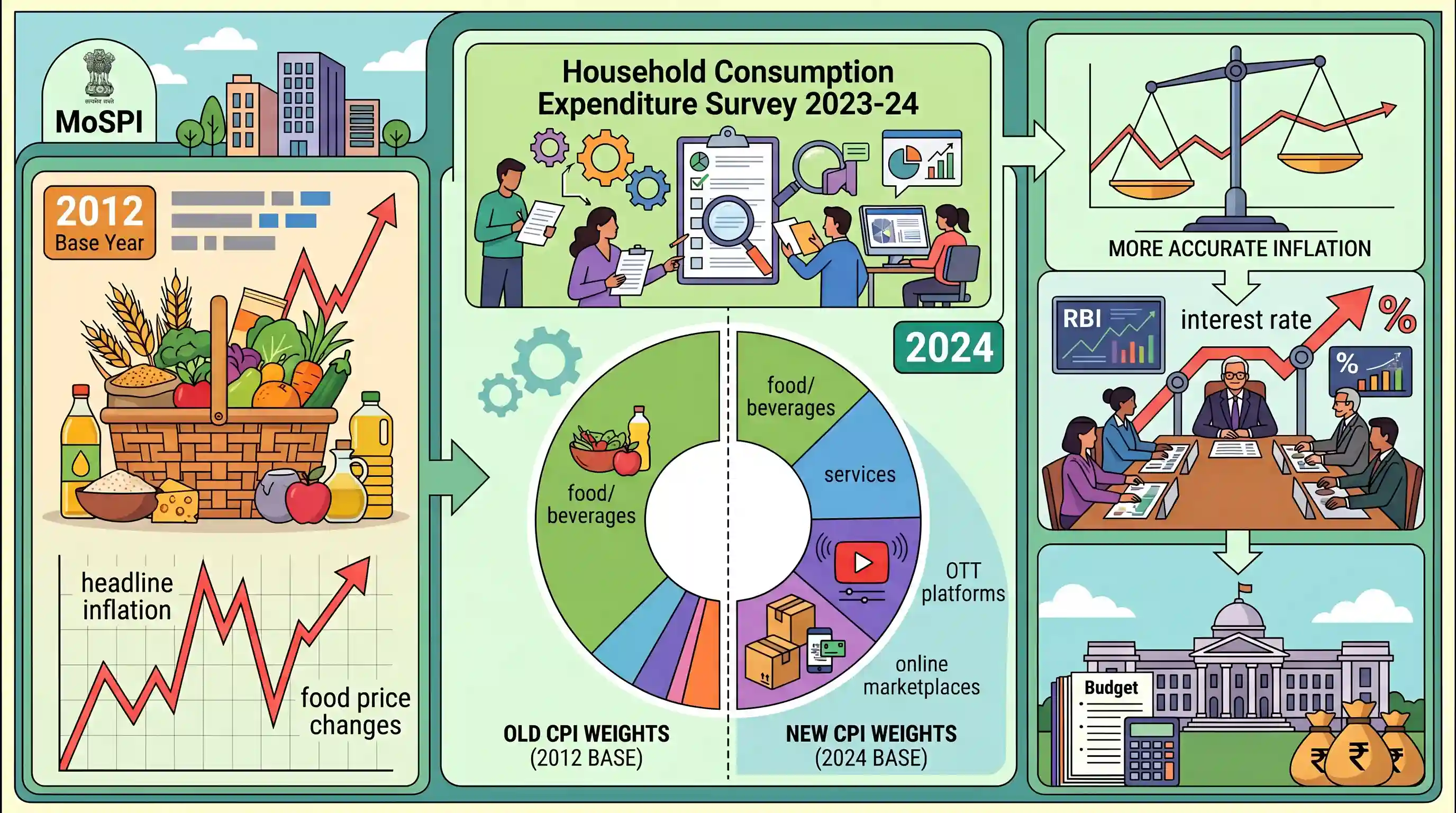
The Ministry of Statistics and Programme Implementation (MoSPI) has revised the base year for the Consumer Price Index (CPI) from 2012 to 2024. Relying on the Household Consumption Expenditure Survey 2023-24, the new series corrects for over a decade of shifts in consumption behavior. Most notably, the weightage of 'food and beverages' has been reduced from 45.86% to 36.75%, tempering the disproportionate effect of volatile food inflation on the headline index. The updated basket captures the rising prominence of services, OTT platforms, and online marketplaces. This overdue upgrade promises a more accurate depiction of inflation, enhancing the RBI Monetary Policy Committee's ability to set interest rates appropriately and ensuring predictability in government budgeting.
Key Points
- The base year for the Consumer Price Index (CPI) has been updated from 2012 to 2024 by MoSPI to better reflect current economic realities.
- The new CPI is pegged to consumption patterns from the Household Consumption Expenditure Survey 2023-24, replacing outdated 2011-12 data.
- The weightage of 'food and beverages' in the CPI basket has been significantly reduced from 45.86% to 36.75%, mitigating the outsized impact of volatile food prices on headline inflation.
- The revised basket incorporates contemporary spending habits, including tracking prices across 12 online marketplaces, OTT subscriptions, and a faster-growing services segment.
- A more accurate inflation metric will aid the RBI's Monetary Policy Committee in setting policy interest rates and provide stability for budget-making and inflation-indexed allowances.
Important Terms
Consumer Price Index (CPI)

A measure of the weighted average of prices for a retail basket of goods and services. It serves as the primary anchor for India's inflation targeting framework.
UPSC context
GS-III (Economy); core indicator for retail inflation and monetary policy decisions.
Household Consumption Expenditure Survey (HCES) 2023-24
A nationwide survey by the NSO capturing household spending patterns. Its 2023-24 data provided the empirical basis for revising CPI weights to reflect modern consumption behavior.
UPSC context
GS-III (Economy); tests knowledge of data collection for poverty and inflation measurement.
Monetary Policy Committee (MPC)
A statutory six-member body under the RBI Act, 1934, responsible for setting the benchmark interest rate (repo rate) to maintain price stability within a target band.
UPSC context
GS-III (Economy); tests institutional roles in economic stability and interest rate management.
Base Year
The reference year used as a benchmark for economic indices. Shifting the CPI base to 2024 ensures price changes are compared against contemporary consumption and market realities.
UPSC context
GS-III (Economy); fundamental concept for understanding index construction and real economic growth.
Headline Inflation
The total inflation measure representing price rises across the entire consumer basket, including volatile food and energy prices, currently targeted by the RBI at 4% (+/-2%).
UPSC context
GS-III (Economy); distinguishes between total and core inflation for policy analysis.
Ministry of Statistics and Programme Implementation (MoSPI)
The nodal Indian ministry for official statistics and project monitoring. It oversees the National Statistical Office (NSO), which releases CPI, HCES, and GDP data.
UPSC context
GS-II/III; relates to governance, institutions, and the quality of national economic data.
Prelims Trap
"Food and beverages no longer form the largest component in the new CPI basket due to the 2024 revision."
Food and beverages STILL remain the largest single component in the CPI basket at 36.75%. The revision reduced its weight but did not dethrone it.
Static Concepts Connected
What is the difference between Headline and Core Inflation?
- Headline Inflation: Measures total inflation within an economy, encompassing all items in the CPI basket including volatile commodities like food and energy.
- Core Inflation: Excludes highly volatile food and fuel prices from the headline index to capture the underlying, long-term macroeconomic price trends.
How does the RBI utilize the Consumer Price Index (CPI)?
- Inflation Targeting: The Monetary Policy Committee (MPC) legally targets CPI-Combined to maintain inflation at 4%, with a +/- 2% tolerance band under the RBI Act.
- Policy Rate Setting: Based on CPI trends, the RBI adjusts the benchmark repo rate to manage money supply, credit cost, and ultimately stabilize consumer prices.
Cross-Topic Patterns
Engel's Law and Economic Growth
The reduced weightage of food in the CPI basket perfectly illustrates Engel's Law: as per capita income rises, the proportion of income spent on food declines, indicating economic development.
WPI vs CPI policy divergence
With food weightage dropping, the structural divergence between CPI (consumer goods) and WPI (heavily weighted towards manufactured goods) may narrow, reducing conflicting signals for macroeconomic policy formulation.

A direct 2026 prelims question testing the exact new CPI food weightage (36.75%), HCES 2023-24 data, and OTT inclusion is highly likely.
Linked PYQs · 3
Linked PYQs · 3
- 2020PrelimsGS1
Consider the following statements: 1. The weightage of food in Consumer Price Index (CPI) is higher than that in Wholesale Price Index (WPI). 2. The WPI does not capture changes in the prices of services, which CPI does. 3. Reserve Bank of India has now adopted WPI as its key measure of inflation and to decide on changing the key policy rates. Which of the statements given above is/are correct?
- 2017PrelimsGS1
Which of the following statements is/are correct regarding the Monetary Policy Committee (MPC)? 1. It decides the RBI's benchmark interest rates. 2. It is a 12-member body including the Governor of RBI and is reconstituted every year. 3. It functions under the chairmanship of the Union Finance Minister. Select the correct answer using the code given below:
- 2024MainsGS3
What are the causes of persistent high food inflation in India? Comment on the effectiveness of the monetary policy of the RBI to control this type of inflation.
