Uttar Pradesh export policy to counter US tariffs and support MSMEs
Source:The Hindu ↗
Why It Matters
Illustrates how state-level proactive interventions can mitigate global macroeconomic shocks (like protectionist tariffs) and support labor-intensive MSMEs, offering a practical example of sub-national economic diplomacy and export promotion.
Summary
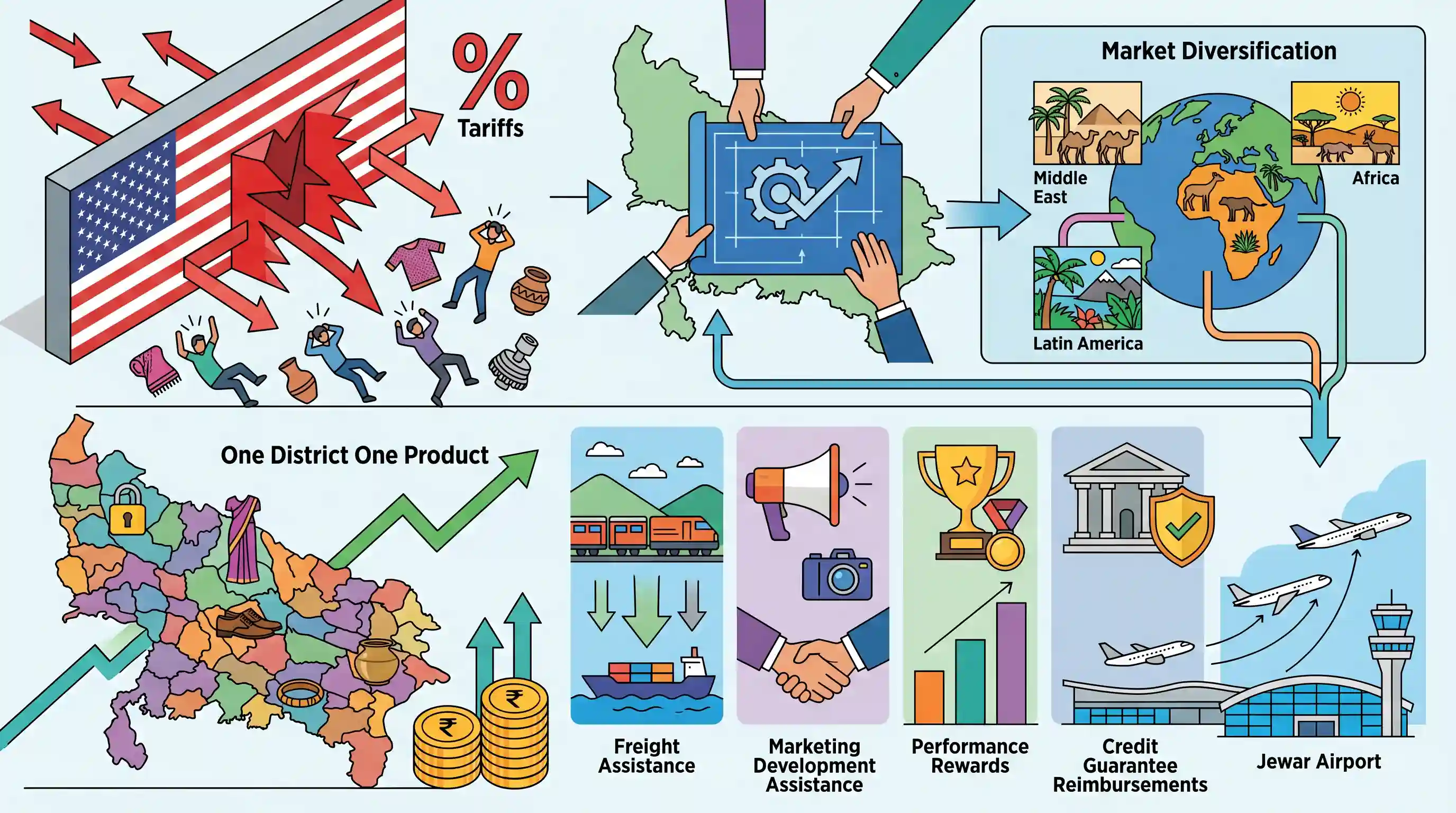
In response to 50% tariffs imposed by the U.S., the Uttar Pradesh government has rolled out the Export Promotion Policy 2025–30 to protect its vital MSME and artisanal export sectors. The policy shifts focus toward diversifying export markets (Middle East, Africa, Latin America) and enhancing the competitiveness of 'One District One Product' (ODOP) goods. It introduces comprehensive support mechanisms including freight assistance to lower logistics costs for landlocked districts, increased Marketing Development Assistance, performance-linked rewards, and premium reimbursements for credit guarantees. The state also plans to leverage upcoming infrastructure like the Jewar airport to achieve its goal of a $1-trillion economy.
Key Points
- Uttar Pradesh introduced the Export Promotion Policy 2025–30 to buffer its handicraft and MSME exporters from newly imposed 50% U.S. tariffs.
- The policy aims to diversify export destinations beyond the US, UK, and EU, targeting emerging markets in the Middle East, Africa, and Latin America.
- Key interventions include enhanced Marketing Development Assistance (MDA), freight subsidy for connecting hinterland districts to major ports, and reimbursement of ECGC premiums for small exporters.
- Logistics and infrastructure push, including multi-modal hubs and the upcoming Jewar airport, aims to reduce the 10-15% logistics cost disadvantage faced by landlocked states.
Important Terms
MSME Sector

Enterprises classified by investment (up to ₹50cr) and turnover (up to ₹250cr). They contribute ~30% to India's GDP and ~45% to total exports, acting as the economy's backbone.
UPSC context
GS-III (Economy): Essential for industrial growth, employment generation, and inclusive development; often tested on definitions and challenges.
One District One Product (ODOP)
An initiative to transform every district into an export hub by identifying and branding one unique local product, boosting regional livelihoods and traditional crafts.
UPSC context
GS-III (Economy): Key for 'Districts as Export Hubs' and balanced regional growth; relevant for 'Atmanirbhar Bharat' and local economy themes.
Export Promotion Policy 2025–30 (UP)
A comprehensive state framework aiming to increase exports from $21 billion to $50 billion by 2030 through market diversification, digital trade, and logistics support for landlocked districts.
UPSC context
GS-II (Governance): Focuses on sub-national trade policies and state-level initiatives to contribute to India's $2 trillion export goal.
ECGC (Export Credit Guarantee Corporation)
A government-owned agency providing export credit insurance to protect Indian exporters from non-payment risks by foreign buyers due to commercial or political reasons.
UPSC context
GS-III (Economy): Crucial for trade facilitation and risk mitigation; relevant to topics on export competitiveness and financial infrastructure.
Marketing Development Assistance (MDA)
A financial assistance scheme that reimburses exporters for marketing costs, such as participation in international trade fairs, exhibitions, and branding efforts to access global markets.
UPSC context
GS-III (Economy): Important for export-led growth strategies and market diversification, specifically for MSMEs and the services sector.
Prelims Trap
The One District One Product (ODOP) scheme was originally launched by the Central Government as a national initiative to promote exports.
ODOP was actually pioneered by the Uttar Pradesh government in 2018. The Central Government later adopted this successful model under DPIIT to transform 'Districts as Export Hubs' nationwide.
Static Concepts Connected
What is the role and structure of the Export Credit Guarantee Corporation (ECGC)?
- Government Ownership: Established in 1957, it is wholly owned by the Government of India and operates under the Ministry of Commerce and Industry.
- Risk Mitigation: Provides export credit insurance to Indian exporters, protecting them against non-payment risks stemming from commercial or political defaults.
- Credit Facilitation: Offers guarantees to banks for advances to exporters, making it easier for resource-strapped MSMEs to secure pre- and post-shipment trade finance.
Why do landlocked states face structural disadvantages in India's export ecosystem?
- Freight Cost Penalty: The absence of direct coastal access adds approximately 10-15% extra inland logistics costs to transport goods from hinterlands to major seaports.
- Turnaround Time: Deficits in seamless multi-modal connectivity (road-to-rail-to-port) delay shipments and inflate turnaround times, eroding the cost-competitiveness of time-sensitive MSME exports.
- Necessary Interventions: States must actively build Inland Container Depots (ICDs) and offer freight subsidies to neutralize the geographic handicap against coastal states like Gujarat.
Cross-Topic Patterns
US Tariffs + Rupee Trade Link
Unilateral U.S. tariffs force emerging markets to seek alternate export routes, often accelerating rupee-trade settlement initiatives and fast-tracking FTAs with Global South nations.
Export Preparedness Index + Competitive Federalism
UP's targeted freight subsidies and ECGC premium reimbursements directly improve its 'Business Ecosystem' pillar score in NITI Aayog's Export Preparedness Index.

Expect a 2026 GS-3 question on how sub-national export policies (like ODOP) buffer India from growing global trade protectionism.
Linked PYQs · 5
Linked PYQs · 5
- 2025MainsGS3
What are the challenges before the Indian economy when the world is moving away from free trade and multilateralism to protectionism and bilateralism? How can these challenges be met?
- 2023MainsGS3
Faster economic growth requires increased share of the manufacturing sector in GDP, particularly of MSMEs. Comment on the present policies of the Government in this regard.
- 2018MainsGS3
How would the recent phenomena of protectionism and currency manipulations in world trade affect macroeconomic stability of India?
- 2017MainsGS3
Account for the failure of manufacturing sector in achieving the goal of labour-intensive exports. Suggest measures for more labour-intensive rather than capital-intensive exports.
- 2023PrelimsGS1
Consider the following statements: Statement-I: India accounts for 3.2% of global export of goods. Statement-II: Many local companies and some foreign companies operating in India have taken advantage of India's 'Production-linked Incentive' scheme. Which one of the following is correct in respect of the above statements?
