National Action Plan on Antimicrobial Resistance and One Health
Source:The Hindu ↗
Why It Matters
Antimicrobial resistance is a critical challenge spanning health, agriculture, and environment (Science & Tech / GS3, Health / GS2). Understanding the drivers of AMR, the 'One Health' strategy, and the implementation hurdles of the National Action Plan is vital for questions on public health crises and center-state governance in healthcare.
Summary
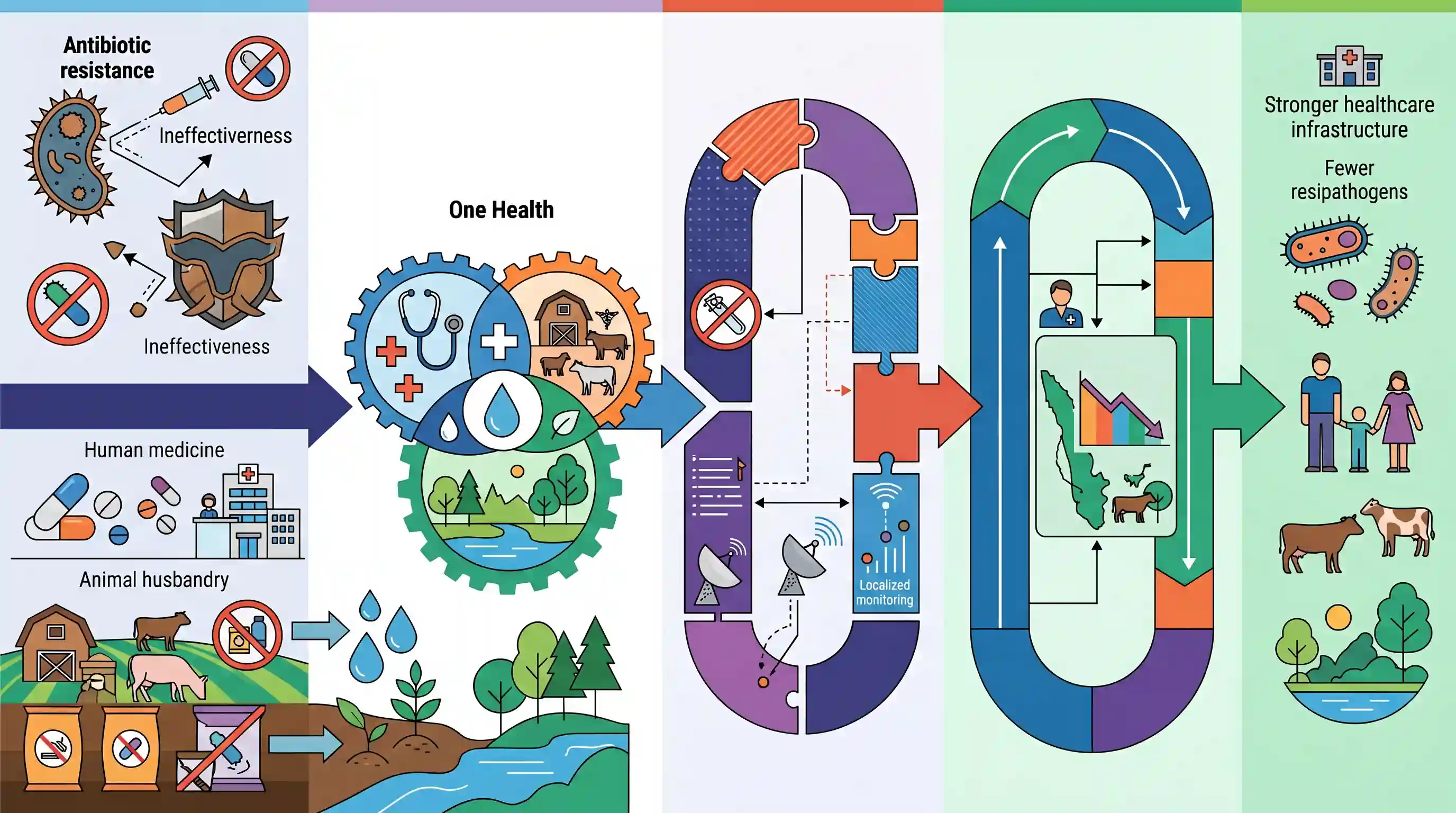
The article discusses the launch of India's second National Action Plan on Antimicrobial Resistance (2025-29) to address the growing public health threat of AMR. With roughly one in three bacterial infections in India showing resistance to common antibiotics, the country faces a far higher burden than the global average. This crisis is fueled by the overuse and misuse of antibiotics across human health and animal husbandry, necessitating a 'One Health' approach that integrates human, animal, and environmental health strategies. While the first action plan successfully banned Colistin in animal husbandry and expanded surveillance networks, it suffered from poor state-level coordination. The new plan aims to rectify this by emphasizing better Center-State collaboration, drawing inspiration from Kerala's successful execution of AMR policies that led to a measurable decline in resistance levels.
Key Points
- India has introduced the second version of its National Action Plan on Antimicrobial Resistance (AMR) covering 2025-2029, following the sluggish implementation of its predecessor.
- A 2023 WHO report revealed that approximately one in three bacterial infections in India were resistant to commonly used antibiotics, significantly higher than the global average of one in six.
- AMR is driven by the overuse and misuse of antibiotics, a high infectious disease burden, and gaps in healthcare infrastructure and surveillance.
- The issue requires a 'One Health' approach because antibiotic resistance spreads across humans, the food chain, veterinary practices, agriculture, and aquaculture.
- Kerala is highlighted as a model state for successfully implementing AMR policies, resulting in a recorded drop in resistance levels and demonstrating the need for stronger Center-State coordination.
Important Terms
Antimicrobial Resistance (AMR)

The phenomenon where microorganisms (bacteria, viruses, fungi, parasites) evolve to resist drugs, making standard treatments ineffective and increasing the risk of disease spread and mortality.
UPSC context
GS Paper 3 (Science & Technology) and GS Paper 2 (Health). Tests knowledge of public health threats and scientific evolution.
National Action Plan on Antimicrobial Resistance (NAP-AMR) 2.0
India's updated five-year roadmap (2025-2029) to combat drug resistance by strengthening surveillance, infection control, and inter-sectoral coordination between the Center and States.
UPSC context
GS Paper 2 (Government Policies and Interventions). Relevant for questions on healthcare infrastructure and public health governance.
One Health Approach
An integrated, multi-sectoral strategy that recognizes the fundamental link between the health of people, animals, and their shared environment to address health threats holistically.
UPSC context
GS Paper 2 (Public Health) and GS Paper 3 (Environment/Disaster Management). Tests understanding of interdisciplinary governance.
Colistin
A 'last-resort' antibiotic used for life-threatening human infections; India banned its use in animal husbandry (2019) to prevent the emergence of resistant 'superbugs'.
UPSC context
GS Paper 3 (Science/Agriculture). Highlights specific regulatory measures to control drug misuse in the food chain.
Antimicrobial Stewardship
The systematic effort to promote the rational and responsible use of antimicrobials through improved prescribing practices, education, and clinical oversight.
UPSC context
GS Paper 2 (Health). Concerns policy-driven behavioral changes in medical and veterinary practice.
State Action Plans (SAP-AMR)
Specific sub-national strategies required to implement the National Action Plan, as health is a State subject under the Indian Constitution (Seventh Schedule).
UPSC context
GS Paper 2 (Federalism/Health). Tests understanding of Center-State relations and administrative jurisdiction in health.
Prelims Trap
India has completely banned the use of Colistin, a last-resort antibiotic, across all sectors including human healthcare.
Colistin is banned only in food-producing animals, poultry, and aquaculture as a growth promoter. It remains a critical 'last-resort' life-saving antibiotic for severe human infections.
Static Concepts Connected
What are the primary biological mechanisms through which bacteria acquire antimicrobial resistance?
- Genetic mutation: Spontaneous changes in bacterial DNA can alter or eliminate the cellular target that the antibiotic is designed to attack.
- Horizontal gene transfer: Bacteria share resistance traits with each other via plasmids (conjugation), scavenging free DNA (transformation), or bacteriophages (transduction).
- Selective pressure: Overuse of antibiotics eliminates vulnerable bacteria, leaving a void for naturally resistant strains to survive, multiply, and dominate.
What does the 'One Health' approach entail in Indian public policy?
- Interdependent health: A unified framework recognizing that human health, animal health, and ecosystem health are inextricably linked.
- Core applications: It is primarily applied to combat Antimicrobial Resistance (AMR), prevent zoonotic spillovers (like Nipah), and ensure overall food safety.
- Institutional mechanism: India operates the National One Health Mission to break governance silos between the ministries of health, agriculture, and environment.
Cross-Topic Patterns
AMR + Pharmaceutical Pollution
Effluent discharge from bulk drug manufacturing hubs creates environmental AMR hotspots. This links public health directly to CPCB pollution norms and the Water Act.
Cooperative Federalism in Healthcare
Because public health is a State subject, national targets rely entirely on state-level enforcement. Kerala’s ‘Operation AMRITH’ exemplifies how decentralized action is vital for NAP-AMR.

Expect a 2026 Prelims multi-statement question on AMR drivers, pairing the Colistin ban in livestock with horizontal gene transfer.
Linked PYQs · 4
Linked PYQs · 4
- 2019PrelimsGS1
Which of the following are the reasons for the occurrence of multi-drug resistance in microbial pathogens in India? 1. Genetic predisposition of some people 2. Taking incorrect doses of antibiotics to cure diseases 3. Using antibiotics in livestock farming 4. Multiple chronic diseases in some people Select the correct answer using the code given below.
- 2022PrelimsGS1
Consider the following statements: 1. Biofilms can form on medical implants within human tissues. 2. Biofilms can form on food and food processing surfaces. 3. Biofilms can exhibit antibiotic resistance. Which of the statements given above are correct?
- 2014MainsGS3
Can overuse and free availability of antibiotics without Doctor's prescription, be contributors to the emergence of drug-resistant diseases in India? What are the available mechanisms for monitoring and control? Critically discuss the various issues involved.
- 2024MainsGS2
In a crucial domain like the public healthcare system the Indian State should play a vital role to contain the adverse impact of marketisation of the system. Suggest some measures through which the State can enhance the reach of public healthcare at the grassroots level.
