President Murmu Emphasizes Inclusive Growth and Tribal Empowerment
Source:The Hindu ↗
Why It Matters
The article reinforces the core constitutional and developmental mandate of inclusive growth, emphasizing the roles of women and tribal empowerment. It is highly relevant for GS Paper 2 (Welfare schemes for vulnerable sections) and GS Paper 3 (Inclusive growth and issues arising from it), as it connects targeted socio-economic empowerment with broad macroeconomic visions like Viksit Bharat 2047.
Summary
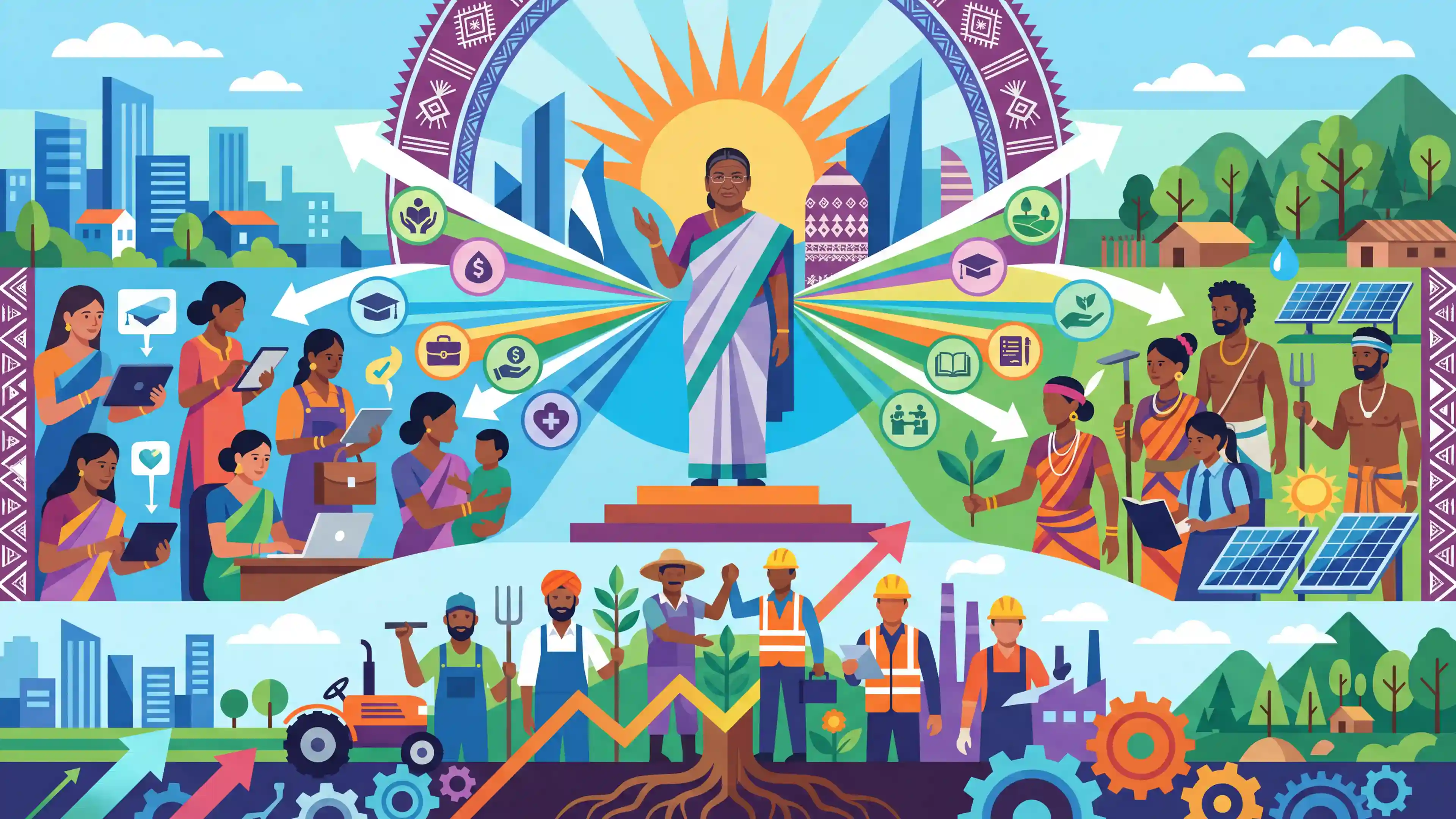
During her visit to Odisha, President Droupadi Murmu inaugurated several development projects in Rourkela and addressed the 'Adi Paraba-2026' event. She emphasized that the vision of a developed India ('Viksit Bharat') by 2047 and a prosperous Odisha ('Sambrudh Odisha') by 2036 depends fundamentally on inclusive growth. Specifically, she underscored the critical importance of empowering women and tribal communities—who constitute significant portions of the population—alongside farmers and labourers, to ensure that the benefits of development schemes reach the most vulnerable and marginalized sections of society.
Key Points
- President Droupadi Murmu emphasized that the overarching goals of 'Viksit Bharat' by 2047 and 'Sambrudh Odisha' by 2036 require the holistic progress of all sections of society.
- She highlighted the critical need to empower women (half the population) and tribal communities (a quarter of Odisha's population) to achieve sustainable and inclusive growth.
- The President addressed the 'Adi Paraba-2026' function and inaugurated infrastructure projects worth ₹158 crore in Rourkela, including a Planetarium, Tribal Museum, and Integrated Command and Control Centre.
- A collaborative effort encompassing farmers, labourers, tribal communities, marginalised sections, intellectuals, and youth is necessary to drive national progress.
Important Terms
Viksit Bharat

Government of India's vision to transform the nation into a developed, self-reliant country by 2047, the 100th anniversary of independence.
UPSC context
GS Paper III (Economy/Governance); relevant for essays on India's future growth, per capita income targets, and sustainable development goals.
Sambrudh Odisha
A strategic roadmap to transform Odisha into a $500 billion prosperous economy by its centenary in 2036, focusing on industrial diversification and social equity.
UPSC context
GS Paper II (Governance/Regional Development); highlights state-level planning, Purvodaya strategy, and competitive federalism in achieving national goals.
Inclusive Growth
Economic growth that is broad-based across sectors, creates productive employment, and ensures fair distribution of benefits to all segments of society.
UPSC context
GS Paper III (Economics); a core syllabus theme testing understanding of poverty reduction, financial inclusion, and social equity.
Vulnerable Sections
Groups at higher risk of socio-economic exclusion, such as SC/ST, women, children, and the elderly, requiring targeted state protection and welfare.
UPSC context
GS Paper II (Social Justice); specifically covers welfare schemes, constitutional protections, and mechanisms for the betterment of marginalized groups.
Adi Paraba
A cultural and developmental event celebrated in Odisha's tribal heartland to showcase indigenous heritage and promote the economic empowerment of tribal communities.
UPSC context
GS Paper I (Culture) & GS Paper II (Tribal Welfare); useful for examples of cultural preservation and tribal-centric governance.
Prelims Trap
"Tribal Museums are exclusively funded and established by the Ministry of Culture to preserve indigenous heritage."
Tribal Museums receive institutional and financial support from the Ministry of Tribal Affairs (not Culture) under the Centrally Sponsored Scheme 'Support to Tribal Research Institutes (TRIs)'.
Static Concepts Connected
What is the core mandate of Tribal Research Institutes (TRIs)?
- Research & Documentation: Conducting baseline surveys, ethnographic studies, and documentation of vulnerable tribal groups, their languages, and cultural practices.
- Policy Inputs: Assisting state governments in formulating Tribal Sub-Plans (TSP) and evaluating the impact of state and central welfare schemes.
- Capacity Building: Organizing capacity-building and training programs for tribal representatives, PRI members, and administrative officials working in Scheduled Areas.
What are the key Constitutional safeguards for Scheduled Tribes regarding administration?
- Article 244: Provides for the administration of Scheduled Areas (Fifth Schedule) and Tribal Areas in Northeast India (Sixth Schedule).
- Article 275(1): Mandates Grants-in-aid from the Union to States specifically for promoting the welfare of STs or raising the level of administration in Scheduled Areas.
- Article 330 & 332: Ensure political representation by reserving seats for Scheduled Tribes in the Lok Sabha and State Legislative Assemblies respectively.
Cross-Topic Patterns
Tribal Identity + Livelihood Generation
Linking tribal cultural festivals (like Adi Paraba) to sustainable livelihood generation through GI tags for forest produce (TRIFED) and tribal eco-tourism circuits under Swadesh Darshan.
Women-led Development + Viksit Bharat
The narrative shift from 'development of women' to 'women-led development' (Nari Shakti) is increasingly central to macroeconomic planning and is a highly probable GS-Mains or Essay theme.

Questions on MoTA’s schemes (like Support to TRIs) alongside constitutional provisions for 5th/6th schedules are highly probable in 2026.
Linked PYQs · 3
Linked PYQs · 3
- 2019MainsGS2
Performance of welfare schemes that are implemented for vulnerable sections is not so effective due to absence of their awareness and active involvement at all stages of policy process. Discuss.
- 2023MainsGS2
“Development and welfare schemes for the vulnerable, by its nature, are discriminatory in approach.” Do you agree? Give reasons for your answer.
- 2025MainsGS2
Women's social capital complements in advancing empowerment and gender equity. Explain.
