Sugam Digital Gujarat portal issues lakhs of certificates digitally
Source:economic-times ↗
Why It Matters
It exemplifies the successful ground-level execution of e-governance architecture, highlighting how integration with broader digital platforms like DigiLocker can revolutionize public service delivery and empower vulnerable sections by reducing red tape.
Summary
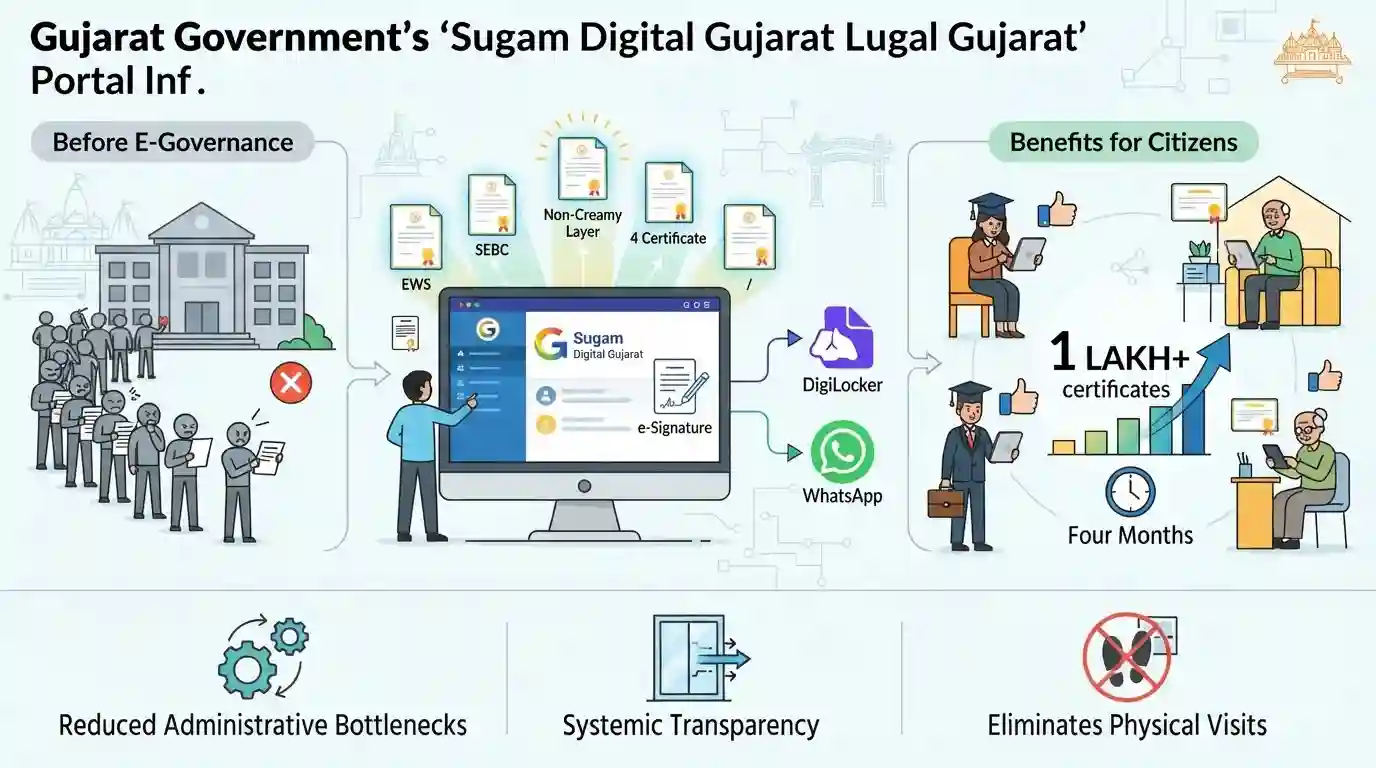
The Gujarat government's 'Sugam Digital Gujarat' portal has achieved significant success, issuing over one lakh vital welfare and educational certificates digitally within a span of four months. The platform allows citizens to seamlessly apply for seven key documents, including EWS, SEBC, and Non-Creamy Layer certificates, from their homes. Featuring integrated e-Signatures and compatibility with DigiLocker and WhatsApp, the initiative effectively eliminates the need for physical visits to government offices. This e-governance leap greatly benefits students and job seekers by reducing administrative bottlenecks and promoting systemic transparency.
Key Points
- The 'Sugam Digital Gujarat' portal enabled the issuance of over one lakh essential certificates online in just four months.
- Seven key certificates, including SEBC, Non-Creamy Layer, EWS, and Religious Minority, have been fully digitized with integrated e-Signatures.
- Citizens can now securely access and store these certificates using digital platforms like DigiLocker and WhatsApp.
- The initiative significantly boosts e-governance by cutting administrative delays and enhancing transparency for students and job seekers.
Important Terms
Sugam Digital Gujarat

A Gujarat government e-governance initiative providing high-demand public services—like caste, income, and EWS certificates—online in a faceless, paperless, and cashless manner.
UPSC context
Relevant for GS Paper 2 (Governance). Highlights state-level digital public infrastructure reducing administrative delays and ensuring transparency.
DigiLocker
A flagship Digital India initiative offering a secure cloud-based platform for citizens to digitally store, share, and verify authentic government-issued documents and certificates.
UPSC context
Relevant for GS Paper 2 (E-Governance). Highlights the role of Digital Public Infrastructure in citizen service delivery and secure data management.
Economically Weaker Sections (EWS) Quota
A 10% reservation in education and government jobs for unreserved category citizens with an annual family income below ₹8 lakh. It was introduced by the 103rd Constitutional Amendment.
UPSC context
Important for GS Paper 2 (Social Justice & Polity). Tests knowledge of affirmative action, constitutional amendments, and eligibility criteria.
Socially and Educationally Backward Class (SEBC)
Gujarat’s state-level designation for Other Backward Classes (OBC). It grants eligible candidates a 27% reservation in state educational institutions and government jobs, subject to a non-creamy layer income ceiling.
UPSC context
Key for GS Paper 2 (Social Justice). Tests understanding of state-specific reservation frameworks and affirmative action parameters like the non-creamy layer.
Non-Creamy Layer (NCL) Certificate
A mandatory document proving that an OBC/SEBC candidate's annual family income falls below the prescribed threshold (currently ₹8 lakh), thereby qualifying them for category reservation benefits.
UPSC context
Vital for GS Paper 2 (Polity). Tests understanding of reservation eligibility criteria and mechanisms preventing the elite capture of welfare benefits.
Prelims Trap
"'Sugam' is a central government portal dedicated exclusively to MSME tax compliance and freight registration."
'Sugam Digital Gujarat' is a state-level e-governance portal for issuing citizen certificates (EWS, SEBC), completely distinct from central taxation/freight portals sharing the 'Sugam' name.
Static Concepts Connected
What are the core models and objectives of e-Governance?
- G2C Model: Government to Citizen services aim to provide direct, paperless access to public utilities and documents, directly illustrated by the Sugam portal.
- Core Objectives: To eliminate rent-seeking intermediaries, reduce red tape, enhance systemic transparency, and ensure time-bound delivery of citizen services.
- DPI Integration: Integration of state applications with national foundational ID and storage layers (like Aadhaar, e-Sign, and DigiLocker).
What are the Constitutional foundations for EWS and SEBC quotas?
- EWS Quota: Enacted the 103rd Constitutional Amendment, inserting Articles 15(6) and 16(6) to provide up to 10% reservation for Economically Weaker Sections.
- Article 340: Empowers the President to appoint a commission to investigate the conditions of socially and educationally backward classes (SEBC).
- Creamy Layer: An income and status threshold applied to SEBCs to exclude socially advanced members from accessing reservation benefits.
Cross-Topic Patterns
Digital Infrastructure driving Social Justice
E-governance tools like Sugam remove intermediaries, ensuring faster processing of EWS/SEBC certificates and preventing exclusionary errors in affirmative action delivery.
Cooperative Federalism in e-Governance
Gujarat's local portal integrating with central APIs like DigiLocker and e-Sign demonstrates successful state-center synergy in scaling India's Digital Public Infrastructure (DPI).

Expect questions linking state portals like 'Sugam' with national DPI (DigiLocker) to evaluate e-governance impact on welfare delivery.
Linked PYQs · 3
Linked PYQs · 3
- 2022GPSC_PRELIMSGS1
One of the following is not a benefit of e-Governance to the citizens:
- 2025GPSC_PRELIMSGS1
Which of the following policies or programs are aimed at improving governance at the state and central level? 1. Digital India Mission 2. Smart Cities Mission 3. Direct Benefit Transfer (DBT) Scheme 4. Pradhan Mantri Awas Yojana (PMAY) Select the correct answer using the codes given below:
- 2026GPSC_PRELIMSGS1
Which of the following initiatives are primarily aimed at strengthening digital governance and digital public infrastructure in India? 1. Digital India 2. Aadhaar 3. Unified Payments Interface (UPI) Choose the correct option from the following.
