CAG Report Highlights Non Functional Oxygen Plants in West Bengal
Source:economic-times ↗
Why It Matters
The article is highly relevant for WBCS Prelims as it touches upon the auditing functions of a critical constitutional body (CAG), the execution of emergency governance mechanisms (PM CARES, CSR funds), and the structural challenges in India's public health infrastructure. Such topics frequently appear in Polity and Governance questions.
Summary
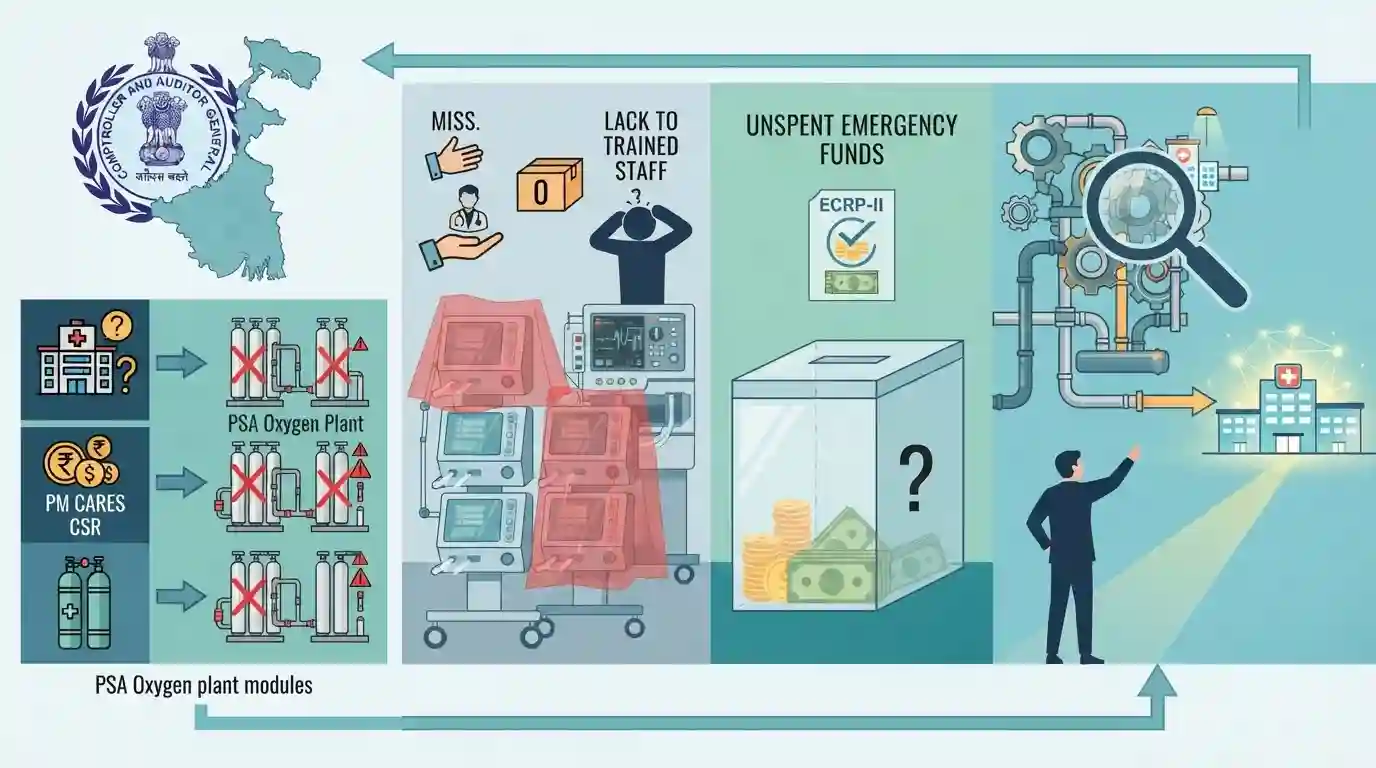
A recent Comptroller and Auditor General (CAG) report revealed that more than half of the PSA oxygen plants installed in West Bengal under PM CARES and Corporate Social Responsibility (CSR) funds during the COVID-19 pandemic remain non-functional. The audit also exposed the under-utilization of critical equipment like ventilators due to lack of consumables and trained staff, alongside significant unspent balances in emergency health packages like ECRP-II. The report raises crucial questions regarding governance, fund utilization, and the long-term sustainability of public health infrastructure created during health emergencies.
Key Points
- A CAG report highlighted that over 50% of the Pressure Swing Adsorption (PSA) oxygen plants set up in West Bengal via PM CARES and CSR funds remained non-functional or uncommissioned post-COVID-19.
- Essential life-saving equipment like ventilators and oxygen concentrators were left idle due to a lack of consumables, trained operators, and non-operational High Dependency Units (HDUs).
- Significant portions of the allocated Emergency COVID Response Package-II (ECRP-II) and state untied funds remained unspent, pointing to under-utilization of emergency public health allocations.
- The findings underscore systemic gaps in public health infrastructure execution, equipment maintenance, and administrative accountability during and after disaster response.
Important Terms
Comptroller and Auditor General of India (CAG)

An independent constitutional body under Article 148 that acts as the supreme audit institution of India, responsible for overseeing and auditing the receipts and expenditures of Central and State governments.
UPSC context
GS Paper 2 (Constitutional Bodies). Tests knowledge of financial accountability, legislative oversight, and the role of independent watchdogs.
PM CARES Fund
A public charitable trust created in 2020 to tackle emergencies like COVID-19. It relies entirely on voluntary donations, receives no budgetary support, and operates outside the CAG's audit purview.
UPSC context
GS Paper 2 (Governance). Important for debates around RTI transparency, extra-budgetary funds, and disaster management financing.
Corporate Social Responsibility (CSR)
A legal obligation under the Companies Act, 2013, requiring eligible Indian businesses to spend at least 2% of their average net profits on specified social, environmental, and developmental initiatives.
UPSC context
GS Paper 2 & 3. Tests the role of the private sector in social welfare, inclusive growth, and ethical governance.
Emergency COVID Response Package-II (ECRP-II)
A centrally sponsored financial package aimed at boosting state health infrastructure, such as oxygen plants, ICUs, and pediatric care facilities, to improve pandemic preparedness and tackle subsequent COVID-19 waves.
UPSC context
GS Paper 2 (Health/Government Policies). Evaluates public health infrastructure funding, federal cooperation, and crisis response mechanisms.
Prelims Trap
The CAG has the constitutional mandate to audit the receipts and expenditures of the PM CARES Fund.
PM CARES is a public charitable trust audited by private CAs. The CAG audited the state's utilization of the physical assets (oxygen plants) installed in public hospitals, not the fund itself.
Static Concepts Connected
What is the CAG's jurisdiction and reporting mechanism for State expenditures?
- Article 151 mandate: Under Article 151, the CAG submits audit reports relating to state accounts to the Governor, who must lay them before the State Legislature.
- Scope of audit: The CAG audits all receipts and expenditures from the Consolidated Fund, Contingency Fund, and Public Account of the State.
- PAC synergy: Post-tabling, the State Public Accounts Committee (PAC) examines these reports, with the CAG acting as a 'friend, philosopher, and guide'.
How does Pressure Swing Adsorption (PSA) technology generate medical oxygen?
- Zeolite sieves: Uses synthetic crystalline aluminosilicates, known as zeolites, which function as molecular sieves to filter ambient air.
- Nitrogen adsorption: Under high pressure, zeolites selectively adsorb nitrogen gas, allowing high-purity medical oxygen to pass through as the product gas.
- Pressure swing cycle: Depressurization releases the trapped nitrogen back into the atmosphere, regenerating the sieve for continuous oxygen production cycles.
Cross-Topic Patterns
Disaster funds & State capacity
The unspent ECRP-II balances highlight a recurring GS2 theme: "state capacity" deficits, where central health allocations outpace the administrative ability of states to hire staff and utilize funds.
CSR asset maintenance deficit
Connects Schedule VII of the Companies Act to governance. Companies meet their 2% statutory CSR capital spend, but governments often lack operational budgets (OPEX) to run and maintain these assets.

Expect a multi-statement Prelims question testing the distinction between PM CARES audit exemptions and the CAG's state-level asset audits.
Linked PYQs · 3
Linked PYQs · 3
- 2022WBCS_PRELIMSGS1
Who is the Guardian of the Public Purse in India?
- 2022WBCS_PRELIMSGS1
The Chairman of the Public Accounts Committee is
- 2023WBCS_PRELIMSGS1
Parliamentary authorization is necessary prior to expenditure from
