Unmitigated Fuel Use and PM2.5 Emissions in Urban Airsheds
Source:Indian Express ↗
Why It Matters
This article shifts the policy conversation on Indian air pollution from simple fuel substitution to 'mitigation status' (the presence or absence of control devices). It exposes systemic enforcement gaps in micro-sectors (like commercial cooking and farm equipment) and offers quantitative proof for the 'airshed' theory of air pollution, making it vital for GS-3 answers on environmental governance, energy policy, and public health.
Summary
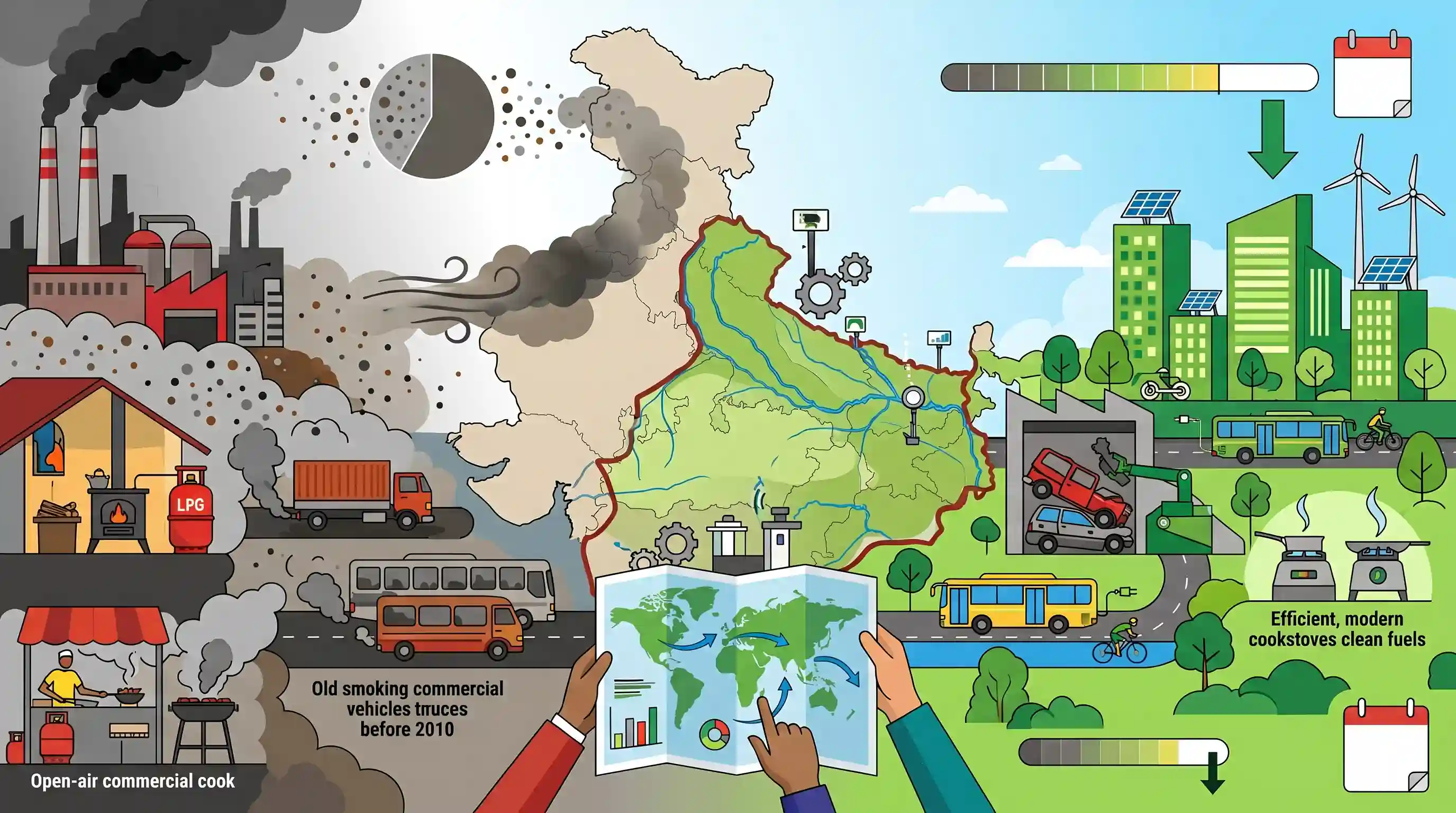
A landmark study by iFOREST reveals that more than half of PM 2.5 emissions in key cities of the Indo-Gangetic Plain (such as Ludhiana and Varanasi) stem from 'unmitigated fuel use'—the combustion of fuel without Air Pollution Control Devices (APCDs). The study highlights that 65-70% of urban PM 2.5 is transported from outside city limits, cementing the case for regional airshed-level planning. It uncovers deep-seated challenges such as 'fuel stacking' in domestic cooking despite high LPG coverage, unregulated commercial cooking, and high emissions from commercial vehicles older than 10 years, offering a roadmap to reduce PM 2.5 emissions by up to 70% by 2035.
Key Points
- The study 'Reducing Emissions from Unmitigated Fuel Usage: Data-Driven Strategies for Air Quality and Climate Action in IGP' was released by the International Forum for Environment, Sustainability and Technology (iFOREST).
- Unmitigated fuel use refers to the combustion of any fuel without applying Air Pollution Control Devices (APCDs) or regulatory oversight.
- Over half of PM 2.5 emissions in Ludhiana (54% out of ~21,000 tonnes annually) and Varanasi (62% out of ~14,000 tonnes annually) originate from unmitigated fuel use.
- Around 65% to 70% of PM 2.5 emissions originate outside the respective city boundaries, highlighting the critical need for regional or 'airshed-level' planning rather than purely city-centric actions.
- In the commercial cooking sector, 98% of PM 2.5 emissions occur without any pollution control devices.
- Despite high LPG penetration (over 90%), domestic cooking remains a massive unmitigated emitter due to 'fuel stacking' (using solid wood/biomass alongside LPG).
- Vehicular emission regulations like Bharat Stage (BS) norms have been highly effective for newer models; however, nearly 69% of transport-related emissions come from vehicles older than 10 years, pointing to gaps in vehicle scrappage and heavy vehicle retrofitting.
- Apart from crop residue burning, diesel-run farm equipment (tractors, water pumps) represents a significant, unregulated source of PM 2.5 emissions in the agricultural sector.
- Target-based interventions focused on clean technology transition, combined with strict compliance, can slash PM 2.5 emissions in both districts by 60-70% by 2035.
Important Terms
National Clean Air Programme (NCAP)

India's flagship national framework launched in 2019 to reduce particulate matter (PM2.5 and PM10) concentrations by 40% by 2026 across 131 non-attainment cities.
UPSC context
GS Paper III (Environment & Ecology); tests knowledge of national air pollution mitigation policies, target metrics, and institutional frameworks.
Pradhan Mantri Ujjwala Yojana (PMUY)
A flagship welfare scheme launched in 2016 by the Ministry of Petroleum and Natural Gas to provide deposit-free LPG connections to poor households, replacing traditional polluting cooking fuels.
UPSC context
GS Paper II (Welfare Schemes) & GS Paper III (Energy/Environment); tests analysis of clean energy access, social schemes, and health impacts.
Bharat Stage emission standards (BS-VI)
Legally enforced vehicular emission standards introduced in 2020, skipping BS-V, to drastically reduce particulate matter and nitrogen oxides by mandating advanced engine technology and ultra-low sulfur fuel.
UPSC context
GS Paper III (Environment/S&T); tests understanding of automotive emission regulations, technology transitions, and their impact on urban air pollution.
Vehicle Scrappage Policy
A government policy launched to phase out old, unfit, and polluting vehicles through mandatory automated fitness tests, offering incentives for scrapping to promote a clean circular economy.
UPSC context
GS Paper III (Infrastructure/Environment); evaluates policy measures for vehicular pollution control, resource recycling, and economic impact on the auto sector.
International Forum for Environment, Sustainability and Technology (iFOREST)
An independent, New Delhi-based non-profit research and innovation organization established in 2019 that focuses on environmental sustainability, clean energy transition, and just transition challenges.
UPSC context
GS Paper III (Environment & Ecology); relevant for citing authoritative studies, data-backed transition strategies, and environmental think-tank contributions in essays.
Prelims Trap
Achieving near-universal LPG coverage automatically eliminates domestic solid biomass emissions.
Aspirants confuse fuel access with exclusive adoption. Due to fuel stacking, households continue burning wood alongside LPG, maintaining high domestic PM 2.5 levels.
Static Concepts Connected
What is Airshed Management and why is it needed?
- Airshed Definition: An area where topographical and meteorological factors govern pollutant dispersion, ignoring administrative borders.
- NCAP Limitation: NCAP targets administrative city boundaries, neglecting the 65-70% of PM 2.5 transported from outside municipal limits.
- Policy Shift: Coordinates clean-air action plans across entire geographic basins (e.g., Indo-Gangetic Plain) rather than fragmented municipalities.
What is 'Fuel Stacking' in household energy dynamics?
- Definition: The simultaneous use of multiple cooking fuels (clean and dirty) by a household instead of completely abandoning biomass.
- Economic Drivers: High recurring LPG cylinder refill costs and free availability of local agricultural residues/wood.
- Policy Gap: It reveals why physical connection access (e.g., PMUY) does not guarantee sustained, exclusive usage.
Cross-Topic Patterns
Airshed Management + Cooperative Federalism
Mitigating transboundary air pollution requires interstate regulatory bodies, shifting the clean air fight from municipal corporations to inter-state councils and regional air basin authorities.
Fuel Stacking + Gendered Health Outcomes
Persistent solid fuel use despite LPG ownership disproportionately exposes women to indoor PM 2.5, highlighting why energy transition metrics must track actual usage over simple distribution.

UPSC may frame a 2026 question contrasting NCAP's city-centric limits with the ecological/meteorological necessity of airshed management.
Linked PYQs · 3
Linked PYQs · 3
- 2020MainsGS3
What are the key features of the National Clean Air Programme (NCAP) initiated by the Government of India?
- 2018MainsGS3
“Access to affordable, reliable, sustainable and modern energy is the sine qua non to achieve Sustainable Development Goals (SDGs).” Comment on the progress made in India in this regard.
- 2022PrelimsGS1
In the context of WHO Air Quality Guidelines, consider the following statements: 1. The 24-hour mean of PM2.5 should not exceed 15 µg/m³ and annual mean of PM2.5 should not exceed 5 µg/m³. 2. In a year, the highest levels of ozone pollution occur during the periods of inclement weather. 3. PM10 can penetrate the lung barrier and enter the bloodstream. 4. Excessive ozone in the air can trigger asthma. Which of the statements given above are correct?
