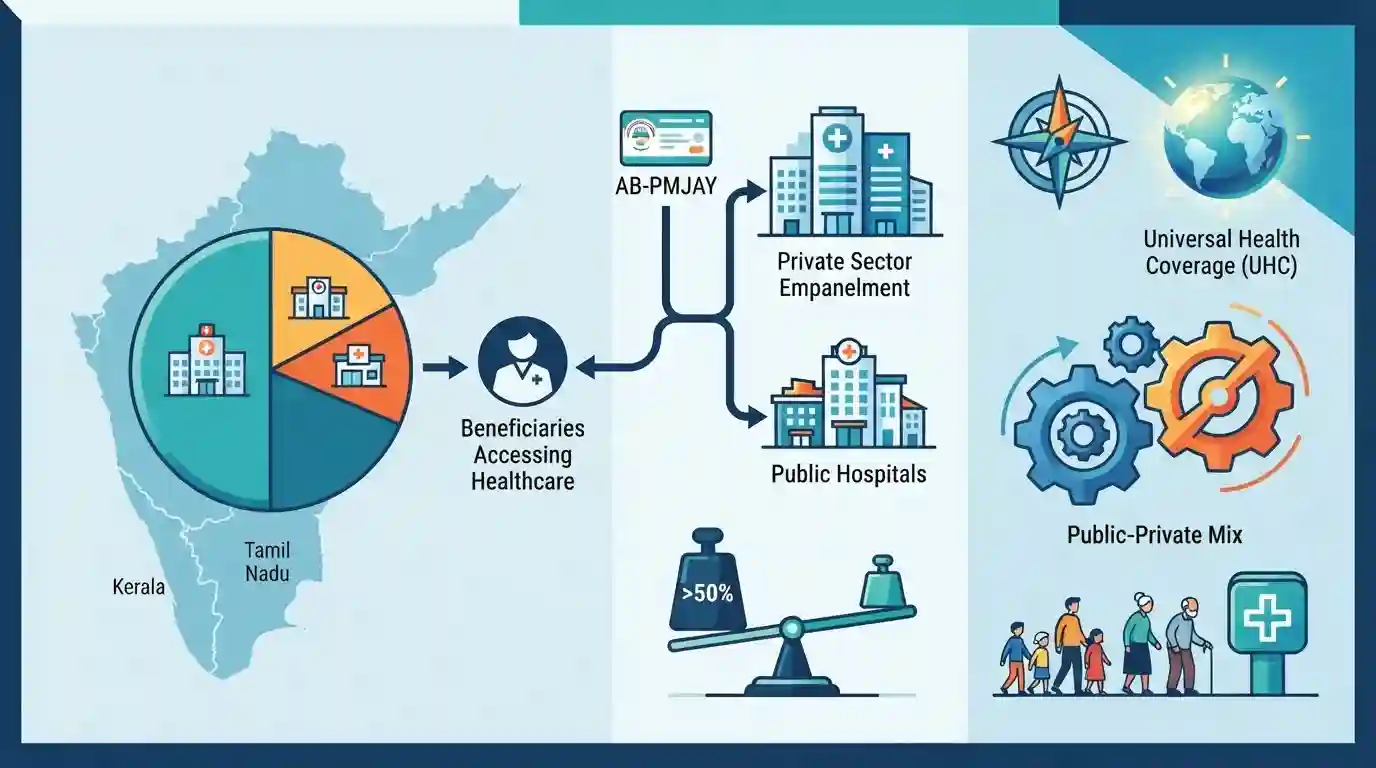
AB-PMJAY private sector reliance in southern states for health care
Source:Indian Express ↗
Why It Matters
The reliance of public health insurance beneficiaries on private healthcare providers is a critical policy issue concerning universal health coverage, public healthcare strengthening, and public-private partnerships in India's social sector.
Summary
An analysis of data regarding the Ayushman Bharat Pradhan Mantri Jan Arogya Yojana (AB-PMJAY) across five southern states reveals that more than 50% of the beneficiaries utilized the scheme to access healthcare services in private hospitals. This reflects the crucial reliance on private sector empanelment to achieve universal health coverage goals, while simultaneously emphasizing debates around public-private mix in healthcare delivery.
Key Points
- Over half of the beneficiaries (53%) of the Ayushman Bharat Pradhan Mantri Jan Arogya Yojana (AB-PMJAY) in five southern states used the scheme to access private healthcare facilities.
- This highlights the significant role of private sector participation in bridging critical gaps in public health delivery under India's flagship health insurance scheme.
- Regional variations exist in how beneficiaries utilize public versus private hospitals for secondary and tertiary care under the scheme.
- The trend underscores the reliance of vulnerable sections on private empanelled hospitals under AB-PMJAY due to potential gaps in public infrastructure or preferred service quality.
Important Terms
Ayushman Bharat Pradhan Mantri Jan Arogya Yojana (AB-PMJAY)

World's largest government-funded health assurance scheme providing ₹5 lakh annually per eligible family for secondary and tertiary care hospitalisation.
UPSC context
UPSC Paper II (Social Sector/Health): Tests knowledge of government policies, universal health coverage, and public-private healthcare delivery models.
National Health Authority (NHA)
The apex body responsible for implementing, designing, and managing the Ayushman Bharat PM-JAY scheme in India.
UPSC context
UPSC Paper II (Governance): Tests understanding of institutional frameworks, statutory bodies, and administrative machinery for welfare schemes.
Prelims Trap
AB-PMJAY exclusively utilizes public healthcare infrastructure for secondary and tertiary care hospitalization.
Aspirants often assume AB-PMJAY is exclusively implemented in government hospitals, missing that private hospital empanelment is a core design feature of the scheme.
Static Concepts Connected
What are the key structural features and eligibility criteria of the Ayushman Bharat PM-JAY scheme?
- Coverage Limit: Provides health insurance coverage of up to ₹5 lakh per family per year for secondary and tertiary care hospitalization.
- Target Beneficiaries: Targets over 10.74 crore poor and vulnerable families identified via the Socio-Economic Caste Census (SECC) 2011, now expanded to all senior citizens aged 70 and above.
- Implementation Model: Implemented through a cooperative federalism model via National Health Authority (NHA) and State Health Agencies (SHAs).
Cross-Topic Patterns
AB-PMJAY Private Utilization & Fiscal Federalism
Rising private sector empanelment in public schemes like AB-PMJAY directly intersects with fiscal federalism debates over health fund devolution and state-level health capacity building.
Public Health Spending vs. Private Empanelment
Heavy reliance on private hospitals under national health schemes underscores systemic gaps in meeting the National Health Policy 2017 target of raising public health expenditure to 2.5% of GDP.

AB-PMJAY's public-private mix and financing models are prime candidates for Mains GS-II governance and social sector welfare evaluation.
Linked PYQs · 3
Linked PYQs · 3
- 2015MainsGS2
Public health system has limitations in providing universal health coverage. Do you think that the private sector could help in bridging the gap? What other viable alternatives would you suggest?
- 2019MainsGS2
Performance of welfare schemes that are implemented for vulnerable sections is not so effective due to absence of their awareness and active involvement at all stages of policy process. Discuss.
- 2024MainsGS2
In a crucial domain like the public healthcare system the Indian State should play a vital role to contain the adverse impact of marketisation of the system. Suggest some measures through which the State can enhance the reach of public healthcare at the grassroots level.
