Higher Education Data Reveals Gender Progress and Gaps
Source:The Hindu ↗
Why It Matters
This article provides excellent quantitative data (AISHE and PLFS) and critical arguments on the gap between educational attainment and workforce entry for women. It highlights the 'leaky pipeline' in higher education and employment, which is a frequent theme in Mains GS1, GS2, and GS3 questions dealing with gender justice, education policies, and economic growth.
Summary
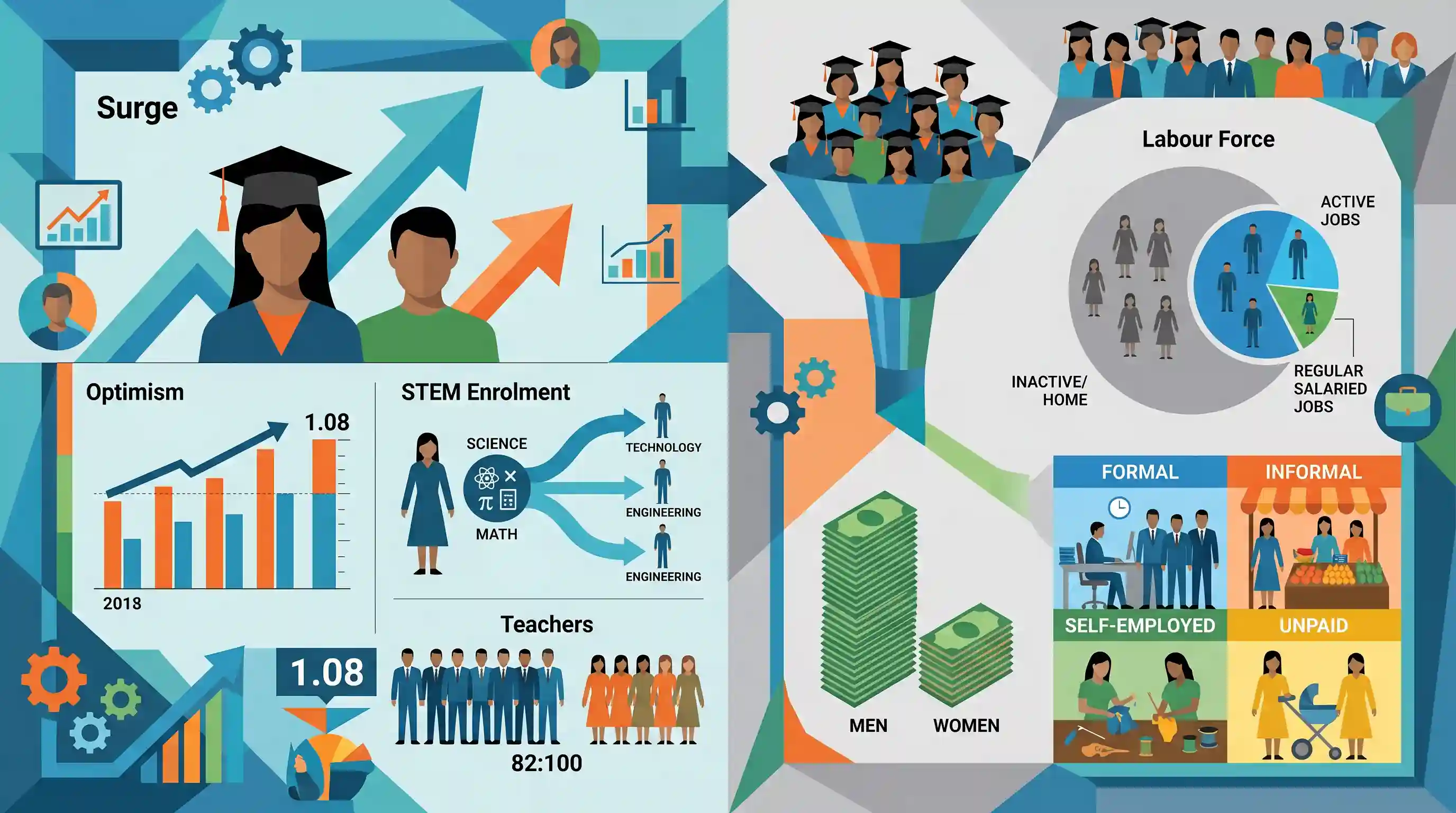
The article analyzes the 2023-24 All India Survey on Higher Education (AISHE) data, which reveals a positive surge in female college enrolment (surpassing male rates to comprise 49.7% of total students and reaching a Gender Parity Index of 1.08). However, it warns against superficial optimism, highlighting structural imbalances. In STEM, women remain segregated in general sciences rather than technology and engineering. Institutional leadership lacks gender diversity (82 female teachers per 100 male teachers), and higher education fails to transition women into formal employment. According to the 2025 PLFS, the Female Labor Force Participation Rate (FLFPR) remains low, regular salaried jobs are male-dominated, and a significant gender wage gap persists, with a high proportion of women categorized under unpaid or informal self-employment.
Key Points
- Total higher education enrolment in India has reached a record 4.5 crore, with female enrolment increasing by 42% over the last decade (reaching 2.24 crore in 2023-24).
- The Gender Parity Index (GPI) in higher education stands at 1.08, meaning 108 women enter higher education for every 100 men. Notably, female enrolment among Scheduled Castes (SCs) and Scheduled Tribes (STs) grew by 51.4% and 75.7%, respectively.
- Despite representing 44% of STEM students, women's enrolment is highly skewed toward traditional sciences (54.6% majority in biology/chemistry), while engineering and technology remain male-dominated (only 31.1% women), isolating women from future-proof economic drivers like AI and software engineering.
- Academic institutions remain patriarchal, with only 82 female teachers for every 100 male teachers and a notable absence of women in top-tier leadership roles, alongside issues of poor infrastructure and faculty shortages in a growing number of private colleges.
- An education-employment mismatch persists, as highlighted by the 2025 PLFS report: men dominate regular salaried work (26.5% vs 18.2% for women) and earn significantly more (average monthly earnings of ₹24,217 vs ₹18,353 for women). Furthermore, 64.2% of women are categorized as self-employed, which often masks unpaid domestic or agricultural labor.
Important Terms
All India Survey on Higher Education (AISHE)

An annual, voluntary web-based survey launched by the Ministry of Education in 2011 to collect comprehensive official data on student enrolment, faculty, infrastructure, and financial indicators of Higher Education Institutions in India.
UPSC context
GS Paper II (Education/Social Sector) and GS Paper III (Human Resources); tests understanding of higher education trends, enrolment, and parity.
Periodic Labour Force Survey (PLFS)
A nationwide survey launched in 2017 by the National Statistical Office (NSO) to measure key labour market indicators like LFPR, WPR, and Unemployment Rate quarterly in urban areas and annually across India.
UPSC context
GS Paper III (Employment and Growth); tests analysis of employment trends, structural workforce shifts, and female work participation rates.
Gross Enrolment Ratio (GER)
A statistical metric expressing the total enrolment in a specific level of education, regardless of age, as a percentage of the official school-age population corresponding to that level.
UPSC context
GS Paper II (Education and Social Sector); tests knowledge of educational access, coverage, and progress towards targets like NEP 2020.
Gender Parity Index (GPI)
A metric calculated as the ratio of female to male Gross Enrolment Ratios at a specific level of education, where a value of 1 indicates perfect parity.
UPSC context
GS Paper II (Social Sector/Education and Women's Issues); tests understanding of progress in female educational access and SDG 4 implementation.
Labour Force Participation Rate (LFPR)
The percentage of the population aged 15 years and above that is either actively employed or seeking employment, indicating the total active labor supply in an economy.
UPSC context
GS Paper III (Employment and Growth); tests comprehension of workforce trends, employment gaps, and female participation dynamics (FLFPR).
Ministry of Education
The nodal Union Ministry responsible for implementing the National Education Policy, improving educational quality, and monitoring progress across primary, secondary, and tertiary education sectors in India.
UPSC context
GS Paper II (Issues relating to Education); tests knowledge of government ministries, policies, institutional frameworks, and national database systems.
Prelims Trap
India's Gross Enrolment Ratio (GER) in higher education remains lower for females than males, reflecting persistent gender access gaps.
Aspirants assume that because female enrolment and GPI are at historic highs, female Gross Enrolment Ratio (GER) must still lag behind males due to historic disparities. Actually, female GER (31.2%) has outpaced male GER (28.9%) for seven consecutive years.
Static Concepts Connected
How are GER and GPI calculated in Indian higher education?
- Gross Enrolment Ratio: Divided total enrolment in higher education by the population of the official age group (18-23 years) and multiplied by 100.
- Gender Parity Index: Calculated as female GER divided by male GER; a value greater than 1.0 indicates higher relative participation of women.
- AISHE Custodian: Conducted annually by the Ministry of Education using web-based data collection directly from all registered higher education institutions.
What is the economic U-curve of female labor force participation?
- Income Effect: At lower-middle income levels, rising household wealth allows women to withdraw from intensive, low-paying manual labor to improve family status.
- Substitution Effect: As women gain advanced education, high-wage formal employment opportunities incentivize them to re-enter the workforce, raising overall participation.
- The Mismatch: In India, the transition from agricultural exit to high-value service sector entry remains slow, stalling the upward segment of the U-curve.
Cross-Topic Patterns
Education-Employment Paradox & Feminization of Agriculture
Rising higher education enrolment alongside PLFS showing high self-employment (64.2%) reveals that educated women are being pushed into informal, unpaid domestic or agricultural work due to formal job deficits.
STEM Gender Segregation and Digital Divide
High female STEM enrolment masks deep horizontal segregation (only 31.1% in engineering), locking women out of high-paying tech sectors and worsening the gender digital divide and wage gaps.

Mains 2026 may ask to critique why rising female Gross Enrolment Ratio and GPI > 1 in higher education fail to resolve low FLFPR.
Linked PYQs · 3
Linked PYQs · 3
- 2024MainsGS1
Distinguish between gender equality, gender equity and women's empowerment. Why is it important to take gender concerns into account in programme design and implementation?
- 2016MainsGS3
Women empowerment in India needs gender budgeting. What are the requirements and status of gender budgeting in the Indian context?
- 2017PrelimsGS1
Which of the following gives 'Global Gender Gap Index' ranking to the countries of the world?
